4.1 Introduction
4.2 Overview of Personnel Costs
4.3 Remuneration
4.3.1 General salary increases
4.3.2 The effects of changes in the salary structure and grading
4.3.3 Summary and Conclusions
4.4 Benefits
4.4.1 Increased access to benefits
4.4.2 Inefficient and inequitable systems
4.4.3 Summary and conclusions
4.5 Overtime
4.5.1 Conclusion
4.6 Strategies for key sectors in the Public Service
4.6.1 Social Services
4.6.2 Security Service
4.6.3 Infrastructure Provision
4.6.4 Agriculture, Forestry and Water Affairs
4.6.5 Other Economic Services and Regulatory Sectors
4.6.6 Summary and Conclusion
4.7 Summary of Strategies to contain personnel expenditure
This chapter will provide an overview of personnel costs in the public service 1. The aim is to provide a better analysis and understanding of trends in personnel expenditure across sectors and provinces. The issue of containing personnel cost in the public service in the medium to long term is quite a topical one. This chapter reflects on some of the options available.
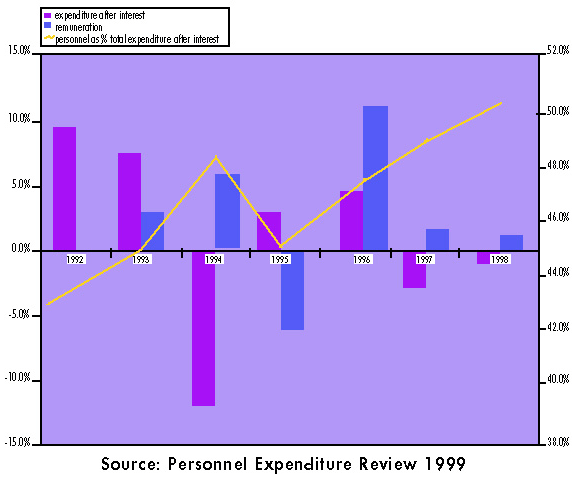
Government has been concerned about the rapid rise of the share of personnel spending in the budget. Up to 1998/99, personnel expenditure grew at an annual rate of 11,4 per cent or nearly four per cent in real terms. Its share of total expenditure rose from 36,2 per cent in 1995/6 to 50,8 per cent in 1998/9. Over the next three years, the Medium Term Expenditure Framework (MTEF) projects personnel expenditure to stabilise at around 51 per cent of total expenditure. In the development of personnel spending, two phases emerged clearly in the recent past. Between 1994 and 1996, personnel costs rose rapidly, outstripping the growth in budgets. After 1996, real growth in remuneration, measured by Consumer Price Index (CPI ), slowed significantly – but since total budgets lagged behind consumer inflation, the share of personnel continued to rise.
Figure 4.1 summarises growth in total spending after interest and in personnel costs since 1994/5, deflated by the CPI.
As part of ongoing efforts to contain personnel expenditure, in 1994 government embarked on a rationalisation exercise. Later on there was a three-year agreement that sought to raise salaries through savings arising from reduced personnel numbers. A review of previous initiatives to contain personnel costs have highlighted certain key lessons.
The most important obstacle remains weak management at departmental level. Managers cannot develop staffing plans that would permit a systematic approach to rightsizing. The freeze on retrenchment, which ended only in July 1999, helped camouflage this weakness. Yet most managers have not even begun to identify redundant positions as the basis for consultation with labour, which the Labour Relations Act (LRA) requires.
The major areas of overstaffing are those of elementary workers in departments that provide economic services and infrastructure in the former homeland areas as well as administrative personnel in national departments.
The label of supernumerary has itself become redundant, and identifying individuals held additional to establishment since 1994 does not help understand overstaffing in the public service. The focus should be on people surplus to operational requirements.
The following sections unpack the various components of the personnel costs and the factors that drive them, resulting in the high proportion expended on personnel.
4.3.1 General salary increases
Between 1994 and 1999 the average salary rose one per cent a year in real terms, just under the Growth, Employment and Redistribution (GEAR) target of 1,2 per cent annually. But salary increases varied substantially by grade, as government tried to address the apartheid wage gap. As a result, salaries for professionals remained virtually unchanged or even decreased, and efforts to reduce their remuneration further seem likely to prove impossible. Differences by level translate into significant differences in expenditure patterns by sector. Sectors that employ predominantly lower-level employees, such as agriculture and infrastructure provision, saw the average real salary increase by around 1,5 per cent between 1997 and 2000. In contrast, departments like Justice, with predominantly higher-level employees, had a fall in the average real salary of almost three per cent. In the major social service departments, the average salary rose between 0,5 and 0,9 per cent in the same period.
Automatic rank and leg promotions add substantially to salary increases for most professionals in the public service. They should add between two and four per cent a year to salary costs in health and police, with much less impact in other sectors. However , very substantial delays have emerged in granting the promotions, so the fiscal impact is unclear. Overall, it appears that rank and leg promotions currently increase the wage bill by about half a per cent a year.
In the past, the instability of government pay led to difficulties. Until 1996 average salaries in both the private and public sector rose at rates slightly over that of inflation. Yet real salaries in the public service fluctuated about twice as much as private-sector pay. Instability in pay caused problems in attracting and retaining skilled personnel; labour conflict, with a wave of strikes affecting health in particular; and, when years of wage restraint culminated in substantial real increases in the late 1980s and1996, budgeting problems. Since 1996, government has attempted to stabilise real pay in the public service in order to avoid the various fiscal and efficiency costs associated with extreme fluctuations in pay.
4.3.2 The effects of changes in the salary structure and grading
Savings on average salaries can only result in the long run if public servants are indeed overpaid. But relatively high salaries in the public service essentially reflect high skill levels in the social services. 2 Two thirds of employees in this sector, an d about half of all public servants, have a tertiary degree – a far higher proportion than in the labour force as a whole. The exception may be elementary employees, who constitute about a fifth of the total public service. As Table 4.1 indicates, public servants in elementary jobs earn an average wage for unskilled security and cleaning workers in the large-scale formal sector, and lag behind on the average package. Their salaries come to 125 per cent of the Household Subsistence Level (HSL), which indicates the minimum standard for a decent living.
However, in South Africa’s highly segmented labour market, salaries at the lowest levels vary substantially from under R1000 a month for the colonial sectors of farming, forestry and household work, to about R1500 on the mines and in construction, to over R2000 a month in large-scale formal employers. 3 Elementary jobs in the public service rank in the top quintile for all unskilled employment. The median household income is around R2000 a month – more or less equal to the salary of unskilled public servants. The median individual income is less, at around R1200 a month.
The evolution of salaries by grade reflects a policy of trying to lead the market in overcoming the apartheid wage gap. But the failure to reform the rest of the formal labour market or to reform work organisation within the public service has meant that t he strategy led to disparities with the private sector. For some of the small professions and departmental management, departments have faced rising turnover as real pay decreased. In turn, departments have upgraded some top-level management and professional jobs, which in turn raises the salary bill and effectively re-institutes the wage gap. Departments have also paid very large sums in overtime to some professional groups. Commuted overtime for doctors and dentists alone accounts for around 40 per cent of their salaries and half of all overtime paid in the public service.
On the other hand, the increase at the minimum between 1994 and 1996 did not result in visible improvements in productivity. Departments did not reorganise work to give elementary employees greater opportunities to use their competencies. Instead, faced with declining budgets and rising salaries for unskilled workers, departments shed lower-level jobs as rapidly as possible.
4.3.3 Summary and conclusions
In sum, since 1996 salaries in the public service have stabilised, rising more or less at inflation. Shifts in grading have, however, caused considerable salary drift. As the employer held down salaries at the top, departments have increased higher-level employment and provided upgrades for some groups. Departments did not react to rising salaries at the lower levels by raising productivity, but rather by shedding jobs. In these circumstances, it seems unrealistic to hope for substantial savings on salaries
However, significant improvements in the efficiency of the salary system seem possible, which would support higher productivity and morale throughout the public service.
Recorded payments for pensions, homeowner allowance and medical aid rose by over 60 per cent in 1994 to 1996. Thereafter, as Table 4.2 shows, growth slowed down substantially, although continuing high at around three per cent a year in real terms. Benefits have increased from 25 per cent of total remuneration to over 35 per cent.
Despite the substantial growth, only pensions have an equitable distribution among public servants. Other benefits are skewed toward the higher salary levels, urban areas, and non-African public servants.
4.4.1 Increased access to benefits
The dramatic increase in the cost of benefits since 1994 mostly reflects the extension of these benefits to more employees as well as some escalating costs due to inefficiencies in the system of benefits.
Before 1994, various regulations excluded many public servants, especially lower-level black workers and married women, from the major benefits. These restrictions were eliminated between 1994 and 1996, without supplementary measures taken to avoid escalating costs, for instance by limiting benefits or ensuring greater efficiency.
Recorded take-up virtually doubled between 1994 and 1997. Thereafter, the rate of increase tailed off to less than five per cent a year. The actual increase in take up before 1996 remains unclear. The former homelands did not always classify benefit payments under personnel spending. The actual increase in take-up may, therefore, be less than it appears. For instance, the number of employees recorded as receiving homeowner allowances climbed 34 per cent in 1994/5; the rate of growth declined rapidly, however, and take-up rose only three per cent in 1998/9. The rate of take-up grew fastest by far for African women, whose use of the homeowner allowance increased by two thirds annually between 1994 and 1996, and by 16 per cent in 1998/9. It is impossible to tell how much of the increase reflected new access to the scheme, and how much the gradual inclusion of homeland schemes on the PERSAL.
4.4.2 Inefficient and inequitable systems
Despite the improvements, benefits systems remain highly inefficient and inequitable. Relatively few employees receive them – but the cost is high. Furthermore, benefits are generally designed to increase rapidly after 10 years’ service and to benefit those who stay to retirement. These relatively crude incentives probably do little to retain high-performing employees, but impose substantial costs.
Despite the higher take-up, only about a third of public servants actually receive housing and medical benefits. Some 90 per cent of lower-level and rural employees do not utilise these benefits. African employees who are homeowners also receive smaller allowances. Even in 1999, only 18 per cent of African women accessed the homeowner allowance, compared to 43 per cent of White men.
This situation points to weaknesses in the design of the benefits, since they exclude the most needy public servants. It also poses a serious financial risk. If all formally eligible employees received these benefits, government would have to pay an additional R10 billion a year. The slow-down in expansion indicates that this danger is not likely to occur soon, but the risk remains. Inefficiencies in the medical and housing schemes also add to costs. In both cases, public servants must negotiate individually with service providers. This situation means that the public service cannot exercise its market power to obtain a better deal, which could also ensure packages suitable for lower-level and rural employees. Appropriate umbrella agreements with service providers would effectively de-link medical aid from the medical price index, which is substantially higher than the overall consumer price index. The current pension system is inefficient and inequitable in several ways, leading to both higher costs and inappropriate incentives.
- Some benefits may have become inappropriate. Pensions increase significantly for employees with over ten years’ service, and the public service gives much better medical coverage as part of pensions than does the private sector.
- Government has sought to raise the funding level very rapidly by international standards. It contributes 15 per cent of salaries, which is higher than for the average private employer. In addition, it provides the equivalent of 21 per cent of service bon uses, at a cost of R1 billion a year, to the stabilisation fund. Since government pays its pension contribution in bonds, the net savings effect is relatively limited. 4.4.3 Summary and conclusions
Benefits contributed substantially to the increase in recorded personnel costs between 1994 and 1996. Although growth in spending has tailed off considerably, because most public servants, particularly at the lower level, do not receive them, the potential for very high increases remains. Inefficient systems for housing and medical aid, and the loading of incentives toward retirement, add to the potential cost. Reforms should improve efficiency and incentives, leading to long-run savings. But substantial short-run savings seem possible only through changes in policies on funding the pension system.
Currently, overtime accounts for two per cent of public service salaries. Of that sum, almost a half goes to doctors and dentists for commuted overtime, and a quarter is spent in Correctional Services. The implementation of the Basic Conditions of Employment Act (BCEA) for the public service in June 2000 may compel additional overtime payments in departments that provide continuous services especially health, police and correctional services. As Table 4.3 indicates, very substantial differences in the rate of overtime payment emerge between departments. While these differences reflect occupational differences, in part, they are also derive from differences in control procedures.
4.5.1 Conclusions
Analysis of public service remuneration indicates little scope for savings on average salaries. Efficiency gains seem possible in providing benefits and allowances, while also improving equity and targeting needs better. Government has completed a wage policy framework, highlighting its objective to improve the efficiency of remuneration, without sacrificing on the issue of equity and overall sustainability. The overall aim is to ensure that the structure of public service remuneration supports overall government policy objectives.
As highlighted in the overview of personnel costs, the scope for reducing personnel expenditure varies significantly between the different sectors in the public service. This is largely due to differences in the functions performed, variation in service delivery mechanisms, expenditure patterns, and the nature of employment. This section will briefly summarise the key personnel cost containment strategies o over the medium to long term for the sectors. 4
4.6.1 Social Services
Social services constitute the largest sector within the public service, both in terms of personnel numbers and expenditure. Education alone employs 39 per cent of all public servants, while health accounts for a further 20 per cent. The major social services, except for welfare, are labour intensive and thus spend well over half their budgets on employees. Welfare forms the exception, since its budget goes almost entirely for transfers for social grants. The core business of education and health requires professionals, and more than 60 per cent of personnel employed in both these sectors are professionals.
4.6.1.1 Decline in non-personnel expenditure
Since 1994, non-personnel expenditure has been declining in both education and health. This trend has been particularly severe in those provinces that incorporated the former homelands. Declines have resulted from real decreases in overall budgets as well as marginal increases in actual personnel expenditure.
Increases in personnel expenditure occurred due to increased employment of teachers and nurses, rank and leg promotions in health, and general increases in the utilisation of benefits. The latter trend had a greater impact on the social services relative to other sectors because of the larger proportion of employees, particularly professionals, in the social sector.
In the major social services, black communities historically faced serious skill shortages. In the first few years after 1994, the major social services responded by hiring more professionals. Education apparently added between 20 000 and 35 000 teachers, or seven to 10 per cent. The figures are estimates based on fiscal analysis and surveys by the Department of Education, since the PERSAL did not capture educator employment adequately until after 1997. Nurses, health therapists and social workers also gained, with an increase of 6500, or nine per cent. Expansion in these occupations helped fuel the rise in average grade and overall personnel costs. In the past two years, however, declining budgets have begun to reverse the trend. In the year to June 1999, the number of teachers and nurses in the public sector declined by two per cent, by a total of just under 10 000. This has mainly been a result of natural attrition.
The substantial costs of rank and leg promotions – between two and three per cent a year – for nurses and most health professionals has also squeezed staffing levels. Provincial budgets have not generally taken rank and leg promotions adequately into account, leading to substantial backlogs and further pressure on non-personnel spending.
In education, which accounts for the lion’s share of provincial personnel spending, the provinces with the lowest spending per pupil have the highest share of personnel within their overall budget. Savings in the infrastructure and agriculture sectors (as discussed in more detail below) could assist in increasing the budget of education and health. The skills and service audits highlighted that the social services in these provinces are in fact under-staffed with regard to support functions, including lower-level workers. There is therefore a need to continuously assess the potential of redeployment of lower-level workers between sectors. Due to the fact that a large proportion of the budget is used for personnel expenditure, assuming a constant budget, minor reductions in personnel costs will lead to significant increases in non-personnel costs in percentage terms. For example, a one per cent reduction in personnel costs of an education department that spends 90 per cent of its budget on personnel, will increase non-personnel expenditure by almost nine per cent.
4.6.1.2 Strategies
In education and health, it seems virtually impossible to deliver services on a large scale and in an equitable manner from outside the public service. The main cost drivers, then, become the level of skills and numbers employed. Therefore, a key strategy for controlling costs will be to manage upgrades. There may, therefore, be a need to review policies that encourage upgrades in the major social services. Some of the less skilled functions in health, particularly food and laundry services and security, are candidates for outsourcing. These functions employ almost three out of ten health workers, and account for around 15 per cent of the salary bill. Departments in this sector are considering options in this regard. Notwithstanding the limited scope for personnel cost-containment in the short-term, the impact and quality of personnel spending in education and health should be improved through improvements in the distribution of staff within these functions. In education, for example, the redeployment of teachers has led to substantial improvements. Strategies should be explored with respect to support staff, who are spread unevenly between rural and urban and former white and black areas. In general, historic ally black schools have almost no support staff. Innovative solutions for improving equality in distribution of support staff, without soaring costs, are needed. For instance, an agency could serve more than one school. In health, the staffing systems are more complex, making redeployment goals more difficult. In summary, cost containment possibilities in social services are: managing skills to control upgrades; a general revision of benefits and allowances; replacement of rank and leg promotions with a fair and affordable pay progression system; and possibly outsourcing of support services.
4.6.2 Security services
As with health and education, it seems virtually impossible to outsource the main functions of the security services. Again, a shift toward smaller numbers with higher skills has emerged. Between 1994 and 1998, the police lost 11 000 jobs, or nine per cent of the total, while defence lost 10 000 jobs, or 13 per cent. In the year to June 1999, this trend persisted, with a decline of 5000 defence workers and 4000 police personnel. Only Correctional Services gained, with an expansion of almost 1500 officers, or five per cent, in the year to June 1999. The police adopted a conscious strategy of encouraging attrition at lower levels in order to improve skill levels. Between 1996 and 1999, the average police salary rose eight per cent a year in nominal terms, compared to five per cent for teachers and two per cent for defence workers. Like the South African Police Service (SAPS), the South African National Defence Force (SANDF) has adopted a policy of reducing personnel costs, primarily to permit an expansion in capital spending. In the coming Medium Term Expenditure Framework (MTEF) period, the defence budget is expected to grow rapidly – an average of 15 per cent a year for the coming MTEF period, compared to under six for spending as a whole – but virtually the entire increase will go on armaments.
In all the security services, rank and leg promotions add substantially to personnel costs – around five per cent a year. Except in correctional services, this increase has generally not been budgeted for, leading to significant backlogs as well as difficulty in meeting non-personnel costs. The cost of benefits in the security sector is much greater than that of the rest of the public service. Medical aid is more heavily subsidised and employees receive higher pension benefits than the rest of the public service. The nature of the work in this sector may well require special arrangements regarding the provisions for medical aid. This, however, will have to be done in the most cost- effective manner possible.
In summary, the security services face similar cost containment strategies to those of the social service sector: the management of skills to control upgrades, replacement of rank and leg promotion with an appropriate pay progression system, and a revision of benefits.
4.6.3 Infrastructure Provision
Departments that provide household and economic infrastructure, including roads, basic municipal services and housing, face a particularly heavy challenge in the next three years. According to the Medium-Term Budget Policy Statement, they can expect a decline in their budgets, in real terms, of an average four per cent a year. To avoid a substantial deterioration in infrastructure will require creative approaches to infrastructure provision.
Departments in this sector either undertake projects directly or through alternative service delivery arrangements, such as subcontracting to private providers. If they engage directly in construction, they generally spend a fairly high share of their budgets on personnel; if they subcontract, in contrast, the budget will reflect purchases of goods and services instead. The effect on the economy and services depends, of course, on the relative efficiency of their construction work, not the categorisation of spending on the budget.
Infrastructure provision accounts for approximately seven per cent of employment in the public service but for less than four per cent of the total wage bill. This is due to the large numbers of elementary workers in this sector. Almost two thirds of the employees are elementary workers on levels one and two, earning between R1700 and R2000 a month.
In addition, because of higher than average increases at the bottom end of the scale, personnel expenditure within these departments has grown at a faster pace than other departments. Based on the understanding that minimum wages have reached adequate levels, the public service should not provide disproportionately higher general increases for workers at lower levels. In future, elementary employees should gain higher salaries primarily through improved training and promotions, not through the general increase.
The number of employees and share of personnel in budgets in this sector varies considerably between provinces. On average, personnel expenditure accounts for 40 per cent of provincial budgets in the sector. The differences reflect historic variations in service delivery systems: in the former homelands, the government provided construction of infrastructure largely through directly employed elementary workers; while in the former Republic of South African (RSA), these functions were outsourced.
Most departments that provide infrastructure argue that they can ensure lower costs and improve flexibility by outsourcing work. Construction has already lost around 10 000 jobs in the past five years. This shift to outsourcing has three main roots:
- The possibility of finding more flexible management structures. Departmental procurement and redeployment rules do not easily support the construction projects required for most infrastructure development.
- Average salaries for construction workers are typically much lower than the minimum salary in the public service, at least in the rural areas. In the formal sector, as measured by Statistics South Africa surveys, the average package in construction came to R2750 a month in March 1998. In contrast, at the same time the average public servant in infrastructure earned a package of R3300 a month. In the Eastern Cape, public works officials estimate that road-workers in the private sector earned around R1000 a month – about half the salary of similar workers in the public service.
- Because of the project-based nature of construction work, permanent employment imposes rigidities. Employers generally prefer to hire people when and where they need them, without having to pay salaries during slack periods or to bear the redeployment costs of staff. Relying on relatively casual employment arrangements allow management to manage costs more effectively.
In terms of the criteria discussed above, outsourcing construction in relatively poor provinces seems likely to pose major difficulties. The private sector in these areas may lack the skills and capital to tender for major projects. If national firms take up contracts, the process could lead to a further drain of funds and skills from the poorer provinces to metropolitan areas. This already appears to be happening, and Alternative Service Delivery (ASD) mechanisms should thus aim to empower local social cap ital.
Over the last few years, no additional employment of elementary workers has occurred within this sector. In addition, the sector has a disproportionately higher number of older workers. A quarter of all workers over 65 years of age are employed in Infrastructure while they account for only seven per cent of employment.
Minor cost containment can occur through better management of retirement, including early retirement. However, many of these workers were denied pension benefits in the past and are potential beneficiaries of a Public Service Co-ordinating Bargaining Council (PSCBC) agreement to compensate workers for past discrimination. Departments would need to ensure that these workers are fast-tracked for receiving this compensation.
In summary, the key strategy for cost containment would be the move towards alternative service delivery mechanisms. However, this would need to be done responsibly and within collective frameworks and agreements. In addition, the slowing down of increases at lower levels will also facilitate cost containment. Finally, departments would need to ensure that they facilitate attrition through management of retirement of elementary workers.
4.6.4 Agriculture, Forestry and Water Affairs
Agriculture, forestry and water affairs has an employment profile similar to infrastructure, with around five per cent of all public servants and close to two thirds of employees on salary levels one and two. As in infrastructure, too, the bulk of employee s are located in former homeland areas, where many are engaged in direct production services in forests and farms. But where infrastructure departments see outsourcing as a major solution, most agriculture departments and the national forests foresee a fundamental change in functions that will eliminate much of their employment all together. They also employ almost 20 per cent of workers over the age of 65.
The Department and Water Affairs and Forestry (DWAF) is in the process of commercialising most of the national forests. This strategy should ultimately reduce staff numbers and personnel costs for the department by about half. Between 1996 and March 1999, the number of forestry workers declined by 10 000, or about 60 per cent.
DWAF found that downsizing required significant capacity as well as effective involvement of labour. Redeployment of forestry workers into the private sector faced substantial obstacles, as staffing levels in the public sector were estimated at four times as high and salaries, about twice as high. To help bridge the gap, DWAF paid the affected employees a salary subsidy equal to the difference between public service and private sector salaries over three years. It developed an extensive programme of training, redeployment and voluntary severance for employees, and built on the 1998 agreement to backdate pensions for former casual employees.
In summary, key strategies for cost containment are the use of alternative service delivery, better management of older workers, and slowing down increases at lower levels.
4.6.5 Other Economic Services and the Regulatory Sector
The economic services – trade and industry, agriculture, labour and other economic-support departments – provide a combination of subsidies and regulatory services. Transfer payments dominate their budgets, with the bulk reflecting Department of Trade and Industry’s (DTI’s) subsidies.
The regulatory sector undertakes other administrative and policy work. This sector includes Home Affairs, treasuries, Public Service and Administration, Premier’s Offices, and similar agencies. Together, these sectors employ four per cent of all public servants. In addition, virtually all departments employ some administrative staff. Administrative personnel expanded overall by about one per cent between 1996 and 1999, with a much more rapid increase for administrative officers, personnel officers and other middle management positions. Several departments are moving towards smaller departments and employing people at higher levels.
The main decline in employment in the sector resulted from the transfer of some 10000 employees to South African Revenue Services (SARS). This shift reduced the number of public servants and personnel spending on the budget, since SARS salaries are paid by a separate transfer. The cost, of course, is still borne by the fiscus.
About a quarter of employees in the administrative sector are elementary workers on levels one and two. Most are cleaners, messengers and similar support workers. Two provincial departments account for a quarter of these workers - Gauteng employs almost 2 000 in corporate services and the Free State has 1500 in the Office of the Premier. Moves towards shared services centres will assist in rationalising these functions and provide for savings on personnel expenditure.
The relatively small size of these sectors limit any significant impact on the overall control of personnel expenditure. Departments within these sectors would need to ensure an appropriate balance between skills levels and numbers. These sectors offer some possibilities for the development of one-stop shops, sharing corporate services and other alternative service delivery mechanisms.
4.6.6 Summary and Conclusion
The above section motivated for sector-specific cost containment strategies. In the social services and security services, consideration would have to be given to trade-offs between skills, wages and employment with some possibility for outsourcing of auxiliary services. In Infrastructure, Agriculture, Forestry and Water Affairs, outsourcing and contracting-out of services would dominate restructuring and cost containment. Because of the small size of the economic services and regulatory sectors, cost containment will contribute negligibly to reducing overall personnel costs.
The time required to implement these strategies will differ as well as the time required for savings to be generated. Much work is required on detailed strategies, cost implications, and impact assessments. Further work would need to involve the DPSA, the Department of Finance, as well as appropriate departments within a sector.
It is hoped that a sector approach will enable Cabinet, Departments and the public to adopt a more targeted approach to cost containment. Efforts to reduce personnel expenditure entail a wide variety of mechanisms, some of which have been very successful. An example is the ghost busting exercise that was launched in 1998.
Government is preparing itself for intensive negotiation with its labour partners on finalising strategies to contain personnel expenditure. Although details cannot be provided in a report of this nature, in broad terms the approach will capture the following sentiments:
- shifting work from employees to consultants, with costs recorded as a professional expense rather than personnel;
- outsourcing without cutting costs or improving services, which merely changes the label on the cost for personnel to purchase goods and services;
- relocating functions to local government, so that the cost appears under transfer payments rather than as an employment expense; and - introducing measures to reduce employment without considering the cost on the broader society, which can inflate welfare and policing burdens.
Although where available we present December 1999 figures, the bulk of this chapter relies on earlier information, either June 1999 or year end 1998 figures, the bulk of this chapter relies on earlier information, either June 1999 or year end 1998/99. An updated version of the figures for the current 1999/00 figures will be reported in the exchequer report which will be issued in June 2000. A more detailed exposition of these matters is available from the DPSA website at www.dpsa.gov.za
Studies that purport to show educators are overpaid for their skill levels incorporate fundamental methodological flaws, which cast doubt on their accuracy. (In order to “clean up the data “ they apparently dropped cases that did not fit in with their predictions, which undermines the stochastic value of the regression analysis). In 1996, professionals in the public service ranked at the median for the professionals throughout the labour force, according to the October Household Survey.
Table 4.1 Salaries in elementary jobs in the formal sector, 1999
| Occupation | Number in private sector survey | Average salary | Public service salary |
| Cleaner (Pat A1 / Per 18) Labourer (Pat A1 /Per 19) Shelf Packer (Pat A3 / Per 16) Teamaker (Pat A2 Per 17) Night Watchman Guard (Pat A2 / Per 17) Waiter / Waitress (Pat A2 / Per 17) Messenger (Pat A3 / Per 16) Cook (Pat A3 / Per 16) |
3,095 23,624 107 542 260 1,614 960 1,457 318 |
,911 1,941 1,942 1,995 2,085 2,222 2,335 2,617 2,628 |
,117 2,117 2,117 2,117 2,117 2,117 2,117 2,117 2,117 |
Source: For private sector, FSA Contact Remuneration Survey: General Staff
Table 4.2 Growth in real terms of expenditure on home-owner allowance and medical aid, and on pensions
| Budget Year | Home-owner Allowance and Medical Aid | Pensions (not including SAPS or KWZN |
| 95/96 96/97 97/98 98/99 |
17 per cent 33 per cent 24 per cent 7 per cent |
-7 per cent 30 per cent 41 per cent -1 per cent |
| Expenditure in | R5,4 bn. | R9,0 bn. |
Table 4.3 Overtime by sector, 1999
| Sector | Cost in R millions | per cent of Salaries | per cent Share of Total Overtime |
| Government Printing Works Economic Services Welfare Agriculture and Land Public Works Environment Local Govt and Housing Education, Sports, Culture, Arts Finance and SARS Justice Administrative Functions Water and Forestry Transport Safety and Security Corrections Health (almost entirely doctors) |
3 mn 5 mn 5 mn 9 mn 9 mn 12 mn 14 mn 20 mn 26 mn 28 mn 37 mn 37 mn 39 mn 128 mn 447 mn 668 mn |
9.1 per cent 0.9 per cent 1.5 per cent 0.7 per cent 0.8 per cent 7.0 per cent 2.0 per cent 0.1 per cent 3.1 per cent 3.1 per cent 3.3 per cent 4.7 per cent 5.2 per cent 1.9 per cent 26.6 per cent 6.6 per cent |
0 per cent 0 per cent 0 per cent 1 per cent 1 per cent 1 per cent 1 per cent 1 per cent 2 per cent 2 per cent 2 per cent 2 per cent 3 per cent 9 per cent 30 per cent 45 per cent |
| Total | R1 487 mn | 2.8 per cent | 100 per cent |
| Total outside corrections and health | R372 mn | 0.9 per cent | 25 per cent |
Table 4.4 Ghost workers and related expenditure in the Northern Province
| Department | Number of employees | Net amount per month |
| Department of Health and Welfare | 140 | 233 320.10 |
| Department of Local Government | 8 | 8 705.14 |
| Department of Public Works | 27 | 37 612.36 |
| Department of Agriculture | 17 | 30 955.89 |
| Department of Education | 658 | 2 255 396.23 |
| TOTAL | 850 | 2 565 989.72 |
Source: Northern Province Government