3.1 Introduction
3.2 The size of the Public Service
3.3 The public service as a factor in the labour market
3.4 Sectoral breakdown of the South African Public Service
3.5 The racial and gender composition of the Public Service
3.6 A sectoral perspective on representativity
3.7 Race and gender analysis of skill and salary levels
3.8 An age profile of the Public Service
3.9 Conclusion
In this chapter we will report on the form and composition of the public service as it stood in December 1999. Multiple units of analysis are used. The most prominent three are that of the public service as:
This chapter will provide information on the size, composition of the public service, representivity and distribution of public servants across the various sectors. The statistics used here have been gleaned from the PERSAL system, a salary administration
system, with very distinct shortcomings when it comes to broader human resource information issues. Information derived from the PERSAL has often been criticised for reliability and validity. However, this is the best that currently exists and the analyst is reliant on this information, with all its limitations.
The information captured on the PERSAL system is being systematically improved. One of the aspects that is not being systematically updated is “disability”, but this is currently receiving attention. As the sole basis for comparisons over time - especially straddling the democratic transition period, the persal database is completely inadequate. Severe limitations are being placed on carrying ou t any system wide analysis over any meaningful period. Within these constraints, some comparisons of the changing picture over the past three years were possible and are presented in this chapter.
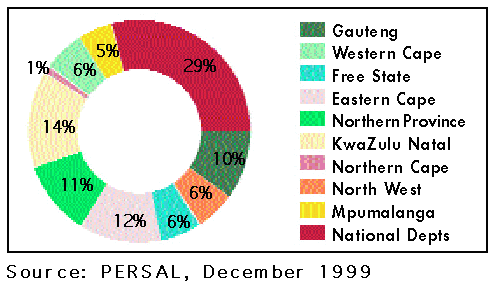
The total South African public service comprised 1 065 999 people at the end of 1999. This means that the public service has shrunk by 14 787 employees since December 1998, when the previous Exchequer Report for the DPSA was prepared. The following graphs show the size of the public service from a range of perspectives.
Figure 3.1: Breakdown of total public service into Provincial Administrations and National Departments
71 per cent of public servants are attached to nine different provincial administrations. Of these, the three largest administrations, in order of size are KwaZulu Natal, Eastern Cape and Northern Province. The Northern Cape has the smallest administration , comprising only one per cent of the total public service and two per cent of the provincial share, although the geographical area of this province constitutes 29,7 per cent of the national territory, making it the largest province. However, the area is s parsely populated and the population of the Northern Cape constitutes 2,4 per cent of the national figure.
Table no. 3.1: Distribution of personnel over provinces and national departments
| Public Servants | % of provincial share | % of total public service | Mid-year population estimate 1999 | Public Servants/1000 population | |
| Gauteng | 111 495 | 15 | 10 | 14 | 7 807 000 |
| Western Cape | 64 261 | 8 | 6 | 15 | 4 171 000 |
| Free State | 58 509 | 8 | 6 | 22 | 2 715 000 |
| Eastern Cape | 311 857 | 17 | 12 | 20 | 6 659 000 |
| Northern Province | 113 902 | 15 | 11 | 21 | 5 337 000 |
| KwaZulu-Natal | 148 716 | 20 | 14 | 17 | 8 924 000 |
| Northern Cape | 15 533 | 2 | 1 | 18 | 875 000 |
| North West | 64 922 | 9 | 6 | 18 | 3 562 000 |
| Mpumalanga | 50 492 | 7 | 5 | 17 | 3 003 000 |
| Provincial Share | 759 685 | 100 | 71 | 21 | 36 488 000 |
| National Depts | 306 312 | 29 | 7 | 43 053 000 | |
| Total national share | 1 065 999 | 100 | 25 | 43 053 000 |
Source: PERSAL, December 1999
Table 3.1 shows the size of the public service in relation to the estimated population size. It is interesting to note that the ratios for most of the provincial public services in relation to the population size have come down over the past year. The most remarkable drop occurred in the Northern Province where the ratio has come down from 25:1000 to 21 :1000. The Western Cape, Eastern Cape and North West have each managed to lower their ratio by two, while Gauteng, Mpumalanga, KwaZulu-Natal and the Free State have managed to bring it down by one each. Northern Cape and the National Departments have ret ained their ratios. Free State, Eastern Cape and Northern Province still have relatively high proportions of public servants to population, compared to other provinces, and could still drop between 3 and 5:1000 to come in line with other provinces. Howeve r, it is likely that geographical spread of the population and levels of development are factors influencing the size of the public service in relation to the population size. A marginal redistribution of public servants to the provinces has occurred since September 1995. Comparing the current picture with the situation in September 1995, the proportion of public servants in the provincial administration to that in the national departments has grown by two per cent. The share of each province of the public service grew roughly in equal proportions, with the notable exception of the Western Cape that has shrunk from a 10 per cent share of the pie, to its current six per cent.
Between 1996 and 1999, there was a systematic shrinking of the public service in all its dimensions.
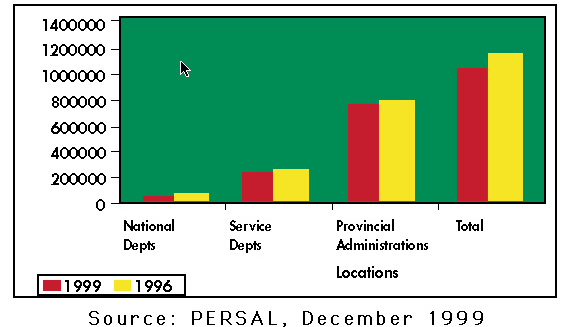
Figure 3.2: Change in size of public service locations between 1996 and 1999
The public service as the single largest employer in the country is influential in the overall national labour market. With the exception of the Eastern Cape, the public service is reducing its role of job provider in the various regional economies of the country. For the nation as a whole the public service as a proportion of the economically active population has dropped from 7.9 per cent in 1996 to 6.7% in 1999. As a consequence of privatisation initiatives, the public sector as contributor to the econom ically active population has shown an even larger drop. In 1996 the public sector constituted 12.9 per cent of all employment opportunities. This dropped to a mere 8.9 per cent by the end of 1999. In all other provinces except the Eastern Cape the public s ervice is showing negative growth as a proportion to the overall economically active population. The shrinkage is anything between 0.4 (Northern Cape) and 1.7 per cent (Western Cape). Even a province like the Northern Province which is exhibiting high leve ls of employment is managing to shift the emphasis in the importance of the public service as job provider away to other economic players.
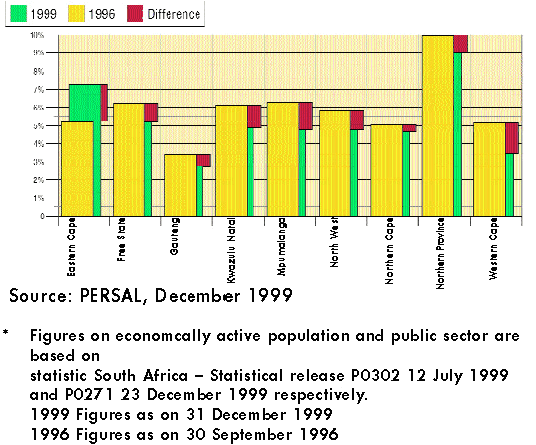
Figure 3.3 The Changing contribution of the public service to regional employment
Another way to divide the public service is to look at it in terms of sectors. Sectors are groupings of national departments and departments in provincial administrations that share a common logic. These would include most commonly the type of function and the policy area. Table 3.2 Sectoral composition of the public service
Table 3.2 Sectoral composition of the public service
| Number of public servants | % public service | |
| Social Services | 651 339 | 61 |
| Core Civil Services | 18 128 | 2 |
| Economic Services | 61 789 | 6 |
| Infrastructure | 74 929 | 7 |
| Criminal Justice | 171 782 | 16 |
| Defence and Intelligence | 81 783 | 8 |
| Other | 847 | 0 |
| Total | 1 065 997 | 100 |
Source: PERSAL, December 1999
When we look at the South African public service the Social Services accounts for 61 per cent of all public service employment. The second largest sector is the Criminal Justice sector. Defence and Intelligence, Infrastructure and Economic Services are roughly of equal proportions (accounting for eight per cent, seven per cent and six per cent respectively of the public service). The smallest of all the sectors is the Core Civil Service or Regulatory Civil Service. Graphically represented, the public service cake divides as follows across sectors:
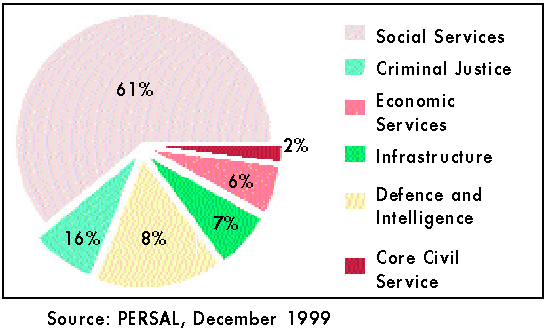
Figure 3.4: Public service distribution across sectors
The table demonstrates the immense variety that exists in the size of sectors, their relative size to the whole of the public service and in which salary levels the majority of the personnel are concentrated. The Security Service and Social Service departments are disproportionately large when compared to all the other sectors. The majority of their personnel are to be found in the salary levels six - nine, which are commensurate with highly skilled, production workers. These groupings are usually highly qualified. Although the Agricultural and Allied and the Infrastructure Sectors are relatively small, the majority of the employees in these departments are elementary, unskilled workers.
Table 3.3: Employment by sector, 1999 3
| Sector department | Number of employees per department 4 | Average share of total public service employment | Per cent share of total public service | Salary level 1-2 | Salary level 6-9 |
| Economic Services | 12 | 800 | 1% | 20% | 39% |
| Regulatory | 50 | 700 | 3% | 28% | 35% |
| Agriculture and Allied | 12 | 4,600 | 5% | 59% | 18% |
| Infrastructure | 28 | 2,700 | 7% | 62% | 17% |
| Security Services | 12 | 21,400 | 24% | 9% | 58% |
| Social Services | 42 | 14,800 | 61% | 16% | 62% |
| Total | 156 | 7,000 | 100% | 21% | 54% |
Source: PERSAL, December 1999
Given the history of South Africa and the policy objective of achieving representivity in the work place, it is important to look also at the composition of the public service in terms of race and gender. By December 1999, the following picture of representivity in the public service pertained. The racial and gender composition of the public service in crude numbers is approaching a situation where the make-up of the public service will mirror the make-up of the South African population. The Coloured component of the public service has achieved the same proportion, while Asians are slightly over-represented. Whites are still over-represented by six per cent, and Africans are still under-represented by eight per cent. Compared with the situation in September 1995, the racial composition, particularly the balance between African and White employees, is being restored. In 1995, the African portion of the work force in the public service only comprised 64 per cent, six per cent less than the current 70 per cent. Bearing in mind that the bulk of efforts of rightsizing the public service occurred at the skills levels where Africans are found in the largest proportions, this growth of six per cent constitutes no mean feat. At the same time, the white proportion of employees has shrunk by eight per cent.
Women are now making up 51 per cent of the total public service, only one per cent short of their proportion in the total population. In September 1995 the gender statistics were reversed, men constituting 51 per cent of all employees. Black women are the fastest growing component of the public service.
As will be shown below, straight numbers are, however, misleading. If we dissect the public service across skills and post levels, and sectors, the picture is skewed, and less representative of the overall gender and racial profiles of the population.
Table 3.4: Percentage change in racial distribution of the public service between 1996 and 1999
| Year | African | White | Asian | Coloured | Total | |
| National Departments | 1996 | 4.4 | 2.9 | 0.1 | 0.5 | 7.9 |
| 1999 | 4.1 | 1.7 | 0.1 | 0.5 | 6.4 | |
| Service Departments | 1996 | 12.2 | 7.7 | 1.4 | 1.3 | 22.6 |
| 1999 | 12.9 | 6.5 | 1.4 | 1.5 | 22.3 | |
| Provincial Administrations | 1996 | 47.4 | 12.8 | 1.7 | 7.6 | 69.5 |
| 1999 | 54.1 | 8.5 | 2 | 6.7 | 71.3 |
Source: PERSAL, December 1999 and September 1996
As employees in the service departments as well as in the provinces, the African component shows the only significant growth across all categories. The White proportion of the public service shows a systematic decline in all three categories of location, with the most significant shrinkage found in the provincial administrations, where it also translates to the largest numbers. Public servants from Asian origin constitute a very small proportion of the public service overall, and this has not changed significantly. This grouping has shown a marginal increase in numbers in the provinces. The Coloured component also shows change in the provincial make up, where numbers are shrinking.
Women by-and-large make up the work force in the Social Services. Historically, teaching, nursing and welfare workers have been regarded as typically women’s professions, and this clearly shows in the sectoral breakdown. The gender composition is balanced out over four sectors that are traditionally heavily male dominant, the most obvious being the Criminal Justice, Defence and Intelligence sectors. The Core Civil Service is exemplary in its gender balance - but the gender balance is not carried through post and skills levels.
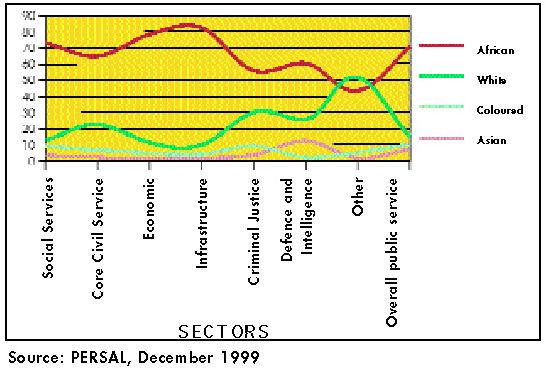
Figure no. 3.7 indicates that a roughly similar picture emerges when one analyses the racial make-up of the sectors. The most interesting pattern to note is that those sectors that are struggling with getting the racial balance right, are the same ones that struggle to get adequate numbers of women in their personnel make-up. The only other unexpected deviation from the expected pattern in terms of distribution is the swapping of positions by the Asian and Coloured population in the Defence and Intelligence sector. Asian employees are achieving numbers that closely profile the nine per cent of the population share of the Coloured population, while coloured employees in this sector drop down to the proportions to be expected from the numbers of Asians in the overall population make up.
Proportionally to their representation in the overall population, both Asians and Whites are over-represented in all levels of skills, except lower skills, Whites significantly more so than Asians. Africans constitute a disproportionately large share of the lower skilled category.
A more nuanced picture of racial and gender inequality emerges when one starts interrogating the numbers against skills levels and salary structures.
An extremely skewed picture of racial distribution against salary structure groups (or skills levels) is graphically represented in figure 3.7. Although the proportions of Coloured and Asians remain fairly consistent, it is the African and White categories that tell the overall story. In the top three skills levels, and especially in the managerial category, Whites account for disproportionately large numbers, While their presence in the lower skilled category is insignificant. The only management category where Africans constitute a higher proportion than Whites is in the senior management skills level. Other than that, Africans are largely concentrated in the lower three skills levels.
Table 3.5: Distribution of the public service by race and skills level 1999
| African | Asian | Coloured | White | % of overall public service | |
| Lower skilled | 88 | 2 | 9 | 2 | 19 |
| Skilled | 74 | 4 | 9 | 13 | 22 |
| Highly skilled production | 66 | 4 | 9 | 21 | 55 |
| Highly skilled Supervision | 42 | 6 | 6 | 47 | 3 |
| Management | 28 | 5 | 6 | 61 | 0 |
| Senior Management | 47 | 7 | 9 | 37 | 0 |
| Proportion of population | 77 | 3 | 9 | 11 |
Source: PERSAL, December 1999
Obviously this graph must also be interpreted against the overall distribution of public servants against skills levels. Table no. 3.5 shows that the overall composition of the public service over these six skills levels is so bottom heavy, that the real numbers in the three highest categories together hardly show up on the graphs when they are expressed as proportions of the overall public service. The picture emerging from a provincial analysis is fairly consistent (see table 3.6). The bulk of the South African public service is to be found in the “highly skilled” production level. This can largely be explained by the fact that the public service in South Africa is directly responsible for providing social services such as education, health and welfare. Large numbers of police and defence/ intelligence personnel in the highly skilled production level further bolster the figures. The extremely low proportions of highly skilled supervision, management and senior management combined, in relation to the very broad, and heavy base of the public service is significant.
This profile points to problems that can be expected in terms of the demands being made in transforming the public service from a public service administration to public service management.The virtual absence of management and supervisory levels has ramifications for issues of vision, coordination and alignment, working smarter, discipline and control.
The sectoral breakdown by skills levels reveals that more than 90 per cent of each sector is made up of lower skilled, skilled and highly skilled production workers. The Core Civil Service is the only one of the sectors that has a highly skilled supervision level that is clearly noticeable (at 10 per cent of the employees in that sector). The entire management echelon is so small it is almost invisible. The Core or Regulatory Sector again shows a slightly different pattern, with a total of 3 per cent of its employees in the senior management and management echelons. The Criminal Justice Sector registers a combined total in the management echelons of 1 per cent, with none of the other sectors even registering a combined 0,5 per cent.
Table 3.6: Provincial skills level breakdown of the public service (percentage)
| EC | FS | GP | WP | NW | KZN | MP | NC | NP | NAT DEPT | |
| Lower skilled | 19 | 26 | 22 | 19 | 20 | 19 | 23 | 22 | 26 | 14 |
| Skilled | 19 | 21 | 18 | 19 | 21 | 26 | 20 | 19 | 13 | 28 |
| Highly skilled production | 60 | 50 | 56 | 57 | 56 | 53 | 55 | 56 | 58 | 53 |
| Highly skilled supervision | 3 | 2 | 4 | 5 | 2 | 3 | 3 | 3 | 2 | 4 |
| Management | 0 | 3 | 0 | 0 | 0 | 0 | 0 | 0 | 0 | 1 |
| Senior Management | 0 | 0 | 0 | 0 | 0 | 0 | 0 | 0 | 0 | 0 |
Many issues regarding age relate to conditions of employment, organisation and work culture, as well as the unfolding and impact of trends on the work force, e.g. the prevalence of HIV/AIDS. In this section we take a look at an age breakdown of the public service and begin to comment on the implications of this for the future transformation agenda.
Table 3.7: Breakdown of the South African public service according to the age of public servants
| % of total public service in location | Under 30 | 30-49 | Over 50 | |
| Gauteng | 10 | 8 | 10 | 13 |
| Western Cape | 6 | 4 | 6 | 6 |
| Free State | 5 | 4 | 6 | 6 |
| Eastern Cape | 12 | 8 | 12 | 18 |
| Northern Province | 11 | 5 | 11 | 13 |
| Kwa-Zulu Natal | 14 | 13 | 14 | 14 |
| Northern Cape | 1 | 1 | 1 | 2 |
| North West | 6 | 4 | 6 | 7 |
| Mpumalanga | 5 | 3 | 5 | 5 |
| National Dept | 29 | 49 | 27 | 16 |
Source: PERSAL, December 1999
49 per cent of public servants under 30 years are found in the national departments, while only 16 per cent of public servants in national departments are over 50 years of age. This is disproportionately large, relative to the size of the public service on a national level. This translates into a particularly youthful public service at the national level. The youthfulness on this level is unexpected, given the focus of the national departments on responsi-bility for policy formulation and regulation. The difficulty with relation to policy implementation is likely to find one of its causes in this factor. Those responsible for policy making, simply do not have the maturity that experience brings to anticipate the gap between idealistic, normative thinking a nd the translation of this into practical outcomes.
When one looks at the age profile for each province and national department, and compares this with the age profile for the total SA public service, the few exceptions from the overall national profile are remarkable. Only three deviations from the general pattern are really worth mentioning. The first, and most obvious, is the profile of the national departments, already referred to, and once again obvious in this graph. The under-30 category is disproportionately larg e, and a concomitant small number of over-50 are found. It is likely that issues of career-pathing, retention of public servants and remuneration may dominate the thinking of this category, while they will give less emphasis to issues related to retirement , succession planning, etc.
The second deviation is to be found in the Eastern Cape. The trend is the opposite from that of the national departments. The youthful proportion of the Eastern Cape public service is small, relative to the profile for the overall public service, while the over-50 category is seven per cent bigger than that of the total profile for the overall public service. It can be anticipated that issues related to retirement will be important for a large number of public servants in that province.
The third deviation from the overall national picture worth referring to is the low number of under-30s to be found in the Northern Province. Taken into consideration the low levels of employment in the Northern Province, this trend points to severe difficulty that young workers in the Northern Province will experience in finding employment, since the entry levels of the single largest employer seems to be quite restricted.
The Criminal Justice and Defence and Intelligence sectors sport particularly youthful compositions. Approximately 75 per cent of employees in both these sectors are under 40 years of age. It can be expected that issues about career advancement will be burning issues in these departments, more so in those organisational units where career progression is yet to be defined. The only sectors where the over-50 category is significant enough to offer possibilities of shrinking the size of the public service further through natural attrition, particularly retirement, are the infrastructure and economic sectors. A closer analysis of skills and salary levels should reveal whether or not it is necessary to start paying attention to succession planning in certain job categories.
Large numbers of women of child-bearing age are present in the Social Sector and the Core Public Service. Issues regarding flexible work hours, child care facilities and the like can be expected to be high on the agenda of parts of these groups.
Much policy discussion takes place in a vacuum without adequate information. Even this chapter represents an early, and sometimes incomplete, picture about the public service. Policy decision-making on the public service will only improve once it is based on more reliable empirical information. We believe that this chapter will make a difference in this regard and, in the year to come, a significant effort will be made to fill in more of the missing information. Even with the current information though, we are starting to detect quite instructive patterns that will be considered in the coming rounds of decision around further transformation of the public service.