





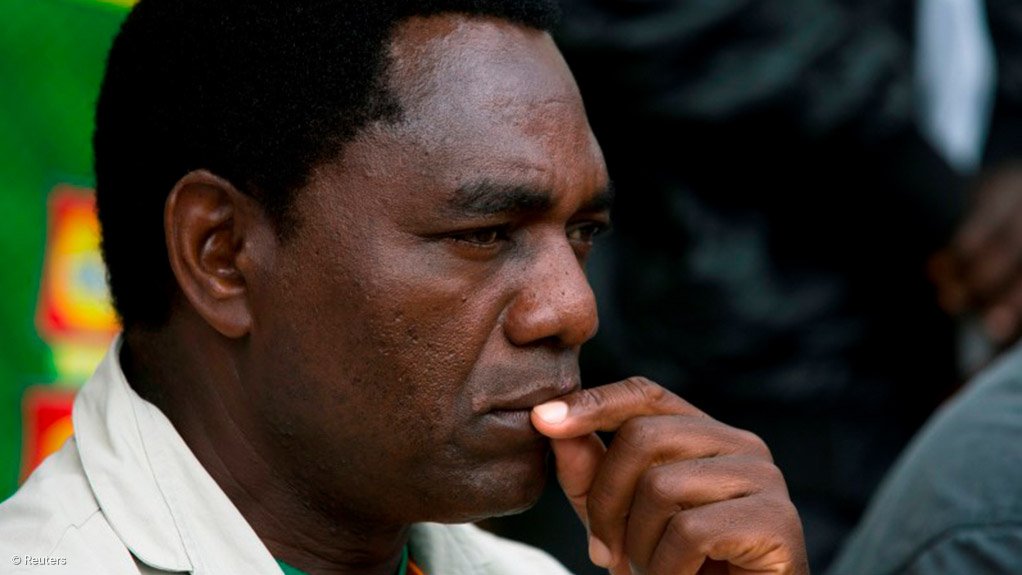

Zambian President Hakainde Hichilema's re-election hands investors the policy continuity they sought, while negotiations on a new International Monetary Fund programme provide an early test of whether a second term can turn economic stabilisation into sustained growth.
The copper producer is emerging from years of economic turmoil after becoming the first African sovereign to default during the Covid-19 pandemic in 2020. Hichilema's first term was dominated by a lengthy debt restructuring and IMF-backed reforms, while drought, power shortages and a weak currency tested the recovery.
Results released by the election commission in the early hours of Tuesday morning showed Hichilema received roughly 60% of valid votes, compared with 38% for his main challenger Brian Mundubile.
"For investors, Hichilema offers continuity," said Stuart Culverhouse, chief economist and head of fixed-income research at Tellimer. The challenge now will be to build on gains in macroeconomic stability, lower inflation and fiscal discipline while accelerating growth and investment, he said.
"His government has already said they would seek a new IMF programme if re-elected, so that may be the first test for investors."
Zambia's 2033 dollar bond, the country's sole international bond, was bid at 97.72 cents on the dollar on Tuesday, broadly unchanged despite a weaker backdrop for African debt markets.
ZAMBIA SEEKS NEW IMF PROGRAMME
The southern African nation aims to secure a new IMF programme by year-end after its previous $1.7 billion arrangement expired in January. Finance Minister Situmbeko Musokotwane told Reuters before the election that fresh investment was needed to drive growth and create jobs, but said it was still too soon for Zambia to return to international bond markets as the government seeks to cement its relationship with the Fund.
Investors say an eventual Eurobond issuance could help attract foreign capital.
"If they were to reissue debt in the international market, that would also be a good thing because it would give the companies in the country a benchmark to price debt off," said Philip Fielding, portfolio manager at Fidelity International. "It would just build out a curve," he said, referring to a broader range of bond maturities that would offer investors more choice.
Jetro Siekkinen, head of emerging markets fixed income at LGT Capital Partners, which holds domestic Zambian government bonds, said the country had delivered an "extremely strong performance on the economical perspective," and had made "a lot of reforms," referring to measures by the Hichilema government addressing debt, fiscal discipline and issues with the mining tax regime.
Siekkinen said investors are watching whether the central bank maintains its independence and transparent communication, and whether fiscal policy remains disciplined as the government pivots toward infrastructure spending.
RISKS TO ZAMBIA'S OUTLOOK
Africa's second-largest copper producer is targeting annual output of 3 million metric tons, nearly triple current levels, as it seeks to capitalise on rising demand for the metal for industries such as power grids and construction.
But Thomas Christiansen, head of emerging markets fixed income at UBP, said the El Niño weather phenomenon posed a risk to copper production, pointing to the disruption three years ago when drought hit hydropower output. Scientists say the current El Niño is intensifying and has a greater than 90% chance of becoming a strong event.
"The last time around, Zambia did get quite a lot of their energy from hydropower," Christiansen said. "When they had the drought electricity production was down quite a lot, they had some rolling blackouts.
"As a result, the copper production did decline quite a bit."
EMAIL THIS ARTICLE SAVE THIS ARTICLE FEEDBACK
To subscribe email subscriptions@creamermedia.co.za or click here
To advertise email advertising@creamermedia.co.za or click here


