







The May seizure of over 700 kg of methaqualone, or Mandrax, was one of the largest at a South African border post in recent years. Acting on intelligence, customs and police officials at the Beitbridge border with Zimbabwe discovered the illicit substance hidden behind steel panels in a truck travelling from Malawi. Two foreign nationals were arrested.
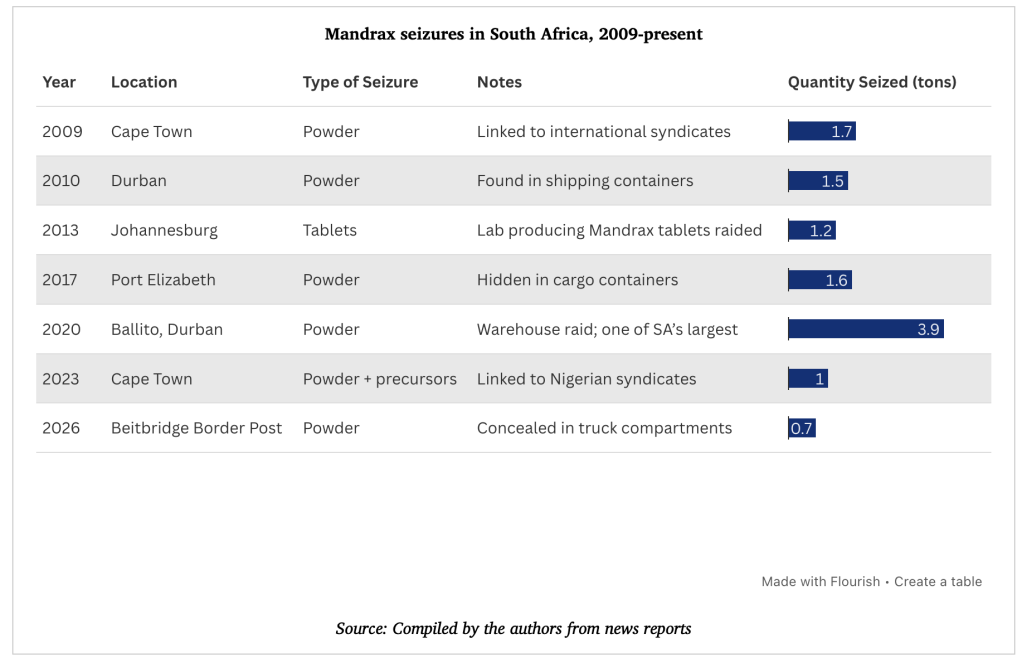
In 2020, an even bigger Mandrax seizure – 3.9 tonnes – was made in Ballito, KwaZulu-Natal (see table), showing criminal syndicates’ capacity for domestic storage on an industrial scale.
The Beitbridge case highlights the regional dimension of Mandrax trafficking. The drug often moves through Mozambique, Zambia and Zimbabwe before reaching South Africa, drawing on regional smuggling networks that source precursor chemicals from Asia.
The bust comes as the Madlanga Commission investigates the South African Police Service’s (SAPS) infiltration by organised crime syndicates, including drug cartels.
Methaqualone is commonly used in South Africa, smoked with cannabis in the infamous ‘white pipe’. It was once prescribed for insomnia, anxiety and muscle tension, but later became notorious as Quaalude and Mandrax. Criminal networks like its relatively simple synthesis and ease in manufacture, while users like its affordability.
Local surveys identify cannabis as the most widely used drug in South Africa, with Mandrax ranking fourth after methamphetamines and heroin. Law enforcement sources estimate that most methaqualone consumed locally is imported, largely from India and China. Some is produced domestically in clandestine labs.
Mandrax seizures in South Africa since 2009 show that syndicates exploit ports and borders. Most consignments enter the country in powder form, with South Africa providing both a consumer market and a manufacturing site for the drug. For organised criminals, Mandrax offers a lucrative niche – less competitive than heroin or cocaine, but profitable enough to sustain networks.
As police uncover more Mandrax consignments, syndicates may pivot to smuggling precursor chemicals like anthranilic acid, which has legitimate industrial uses. With several clandestine labs dismantled in recent years, diverted precursors could fuel new waves of domestic synthesis.
South Africa’s law enforcement did well to prevent a large amount of Mandrax from entering the country in the Beitbridge seizure. But the truck’s interception on the South African side of the border highlights gaps in cross‑border detection capacity and intelligence sharing.
Lessons can be learned from recent successes like last month’s cocaine seizures in Durban. South African Revenue Service customs officers collaborated with the Directorate for Priority Crime Investigation (known as the Hawks) and international law enforcement, bolstered by private sector intelligence from banks, freight companies and telecom providers. Direct contact between agencies such as the Hawks and SARS is especially effective in drug busts.
Joint operations and intelligence sharing by South African law enforcement and the Southern African Regional Police Chiefs Cooperation Organisation would strengthen regional coordination. It would also help tackle drug trafficking under the Southern African Development Community Organised Crime Strategy.
Domestically, law enforcement must go beyond chasing low‑level drug runners. Tackling criminal networks means weakening syndicates from within by cutting off their profits through asset freezes on syndicate leaders, targeting corruption and conducting effective lifestyle audits of police and border officials. To do so, law enforcement agencies need the capacity and expertise to act, but South Africa’s drug enforcement capacity is fragmented.
The Hawks are mandated to investigate organised crime and trafficking, SAPS detectives handle day‑to‑day drug cases, and SAPS Crime Intelligence supports investigations. SARS customs officials play a frontline role at ports of entry, while the Independent Police Investigative Directorate (IPID) provides oversight.
Parliamentary reports highlight that the country’s detective services suffer attrition despite modest budget increases. Police Crime Intelligence consumes billions with little visible impact, and IPID faces budget cuts that weaken accountability. Since the mid-2000s, the disbanding of specialised drug units and leadership challenges in the Hawks have further eroded capacity.
‘We are stretched across everything – narcotics, trafficking, cash in transit, even wildlife and infrastructure crimes – but with too few people and almost no vehicles or computers,’ a police officer requesting anonymity told ISS Today. Sources described technical knowledge gaps, with experienced members lost through promotions to managerial positions or departures to join the private sector.
The Madlanga Commission has uncovered senior police leaders implicated in organised crime and corrupt government contracts, and testimony has raised suspicions that seized drug consignments may have been diverted by police. Strengthening the SAPS narcotics unit might require ring‑fencing its resources and narrowing its mandate, with merit‑based promotions to retain expertise and ease the burden on overstretched officers.
Although effective intelligence‑led operations can deliver major drug busts, enforcement alone cannot solve South Africa’s drug problem. In Mauritius, tough laws and disrupted shipping routes curbed Mandrax in the late 1980s, but then heroin and synthetic drugs quickly took root. Enforcement must be paired with harm‑reduction and broader socioeconomic interventions.
South Africa’s 1992 Drugs and Drug Trafficking Act mandates the SAPS to prevent, investigate and combat the illicit manufacture, trafficking and use of prohibited drugs. But preventing substance abuse should not be only the police’s responsibility. Health, education and social services departments must play a leading role, alongside community‑based initiatives that link enforcement with socioeconomic reform.
South Africa’s drug epidemic cannot be resolved by the state alone. At the same time, community involvement must not mean vigilante-style drug busts. Legal and creative community responses – from treatment networks to prevention programmes – could be complementary strategies.
Fast‑tracking the National Drug Master Plan 2026-2030 and empowering the Central Drug Authority with financial autonomy would improve oversight and ensure consistent implementation across departments.
During his Madlanga Commission testimony, Lieutenant-General Nhlanhla Mkhwanazi warned that South Africa must prevent organised crime on the scale of El Salvador and Mexico. He described how criminal networks were infiltrating Crime Intelligence, Parliament and even the heart of police investigations.
The recent Mandrax bust is a reminder that drug trafficking is an entry point that syndicates use to entrench themselves in communities and institutions. South Africa must act swiftly to prevent the outcome Mkhwanazi alludes to.
Written by Willem Els, Consultant, Transnational Threats and Organised Crime, ISS Pretoria and Richard Chelin, Independent Governance Consultant
EMAIL THIS ARTICLE SAVE THIS ARTICLE ARTICLE ENQUIRY FEEDBACK
To subscribe email subscriptions@creamermedia.co.za or click here
To advertise email advertising@creamermedia.co.za or click here


