





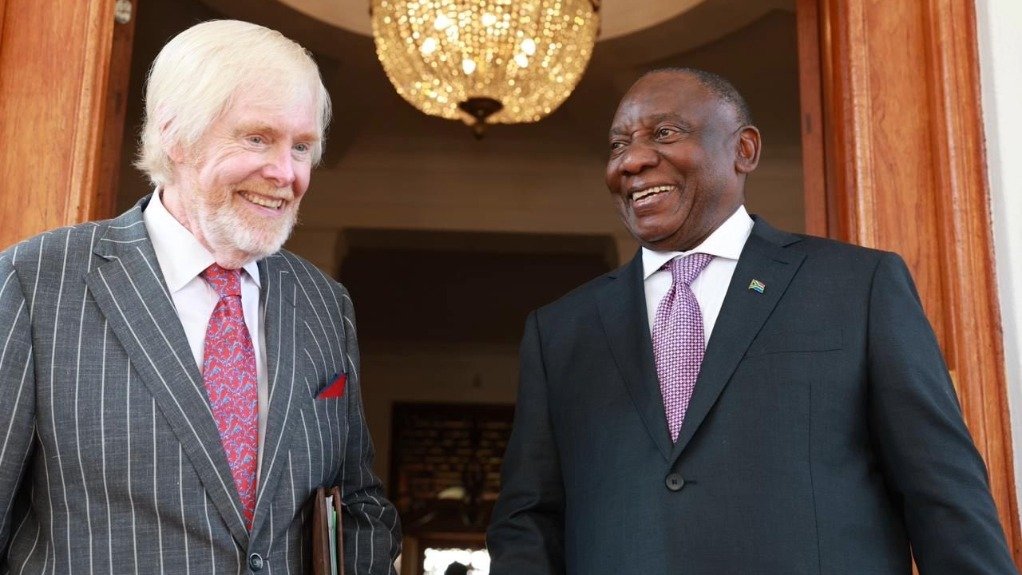
Relations between the US and South Africa have reached a critical low point following a scathing assessment by US Ambassador Leo Brent Bozell III, who accused the South African government of actively rejecting a constructive relationship with Washington.
The diplomatic fallout follows the September 15 announcement by US Secretary of State Marco Rubio introducing targeted visa restrictions against South African officials deemed responsible for enabling uncompensated land seizures, race-based discrimination, or the incitement of violence against minority groups.
In an op-ed, Bozell III revealed that Washington's patience wore thin after a nine-month period of "formal silence" from Pretoria regarding three core policy requests.
"It is safe to say my government was not just disappointed, it was shocked," Bozell III stated. "The message was clear: The South African government does not want a constructive relationship with the United States."
According to the Ambassador, the friction followed from a series of diplomatic objectives delivered to Pretoria in November 2025, known as the "Five Asks".
These objectives built on US President Donald Trump’s February 2025 Executive Order 14204 (Addressing Egregious Actions of the Republic of South Africa), which formally outlined American anxieties regarding rural farm attacks, regulatory hurdles for US investors, and South Africa’s geopolitical alignment with US adversaries.
While Bozell III acknowledged that the first two points had been broadly addressed or paused, negotiations collapsed over the remaining three.
He pointed out that Washington requested that Pretoria not interfere with the processing of Afrikaner refugees under the US Executive Order – an assurance granted in January 2026 and currently deemed resolved by the US.
Bozell III said the US also expressed deep concern over the 2024 Expropriation Act.
While the legislation is currently under judicial review, Bozell III criticised the South African government for signing the Act and "hiding behind a judicial process" rather than outright rejecting it. For now, the US is awaiting the court's final ruling.
Further, the US requested that President Cyril Ramaphosa and senior officials publicly condemn the singing of "Kill the Farmer! Kill the Boer!," which Bozell III characterised as an incitement to violence that leaves rural farmers living in fear.
Bozell III also revealed that the US urged Pretoria to formally designate rural crime as a priority and fully resource existing safety plans, even offering technical and financial support to assist local law enforcement – a proposal he said went unanswered.
The US also asked South Africa to allow foreign telecommunications and mining companies to use Equity Equivalent Investment Programmes as an alternative to Broad-Based Black Economic Empowerment ownership requirements.
The Ambassador emphasised that the implementation of the US’s new visa policy against some South Africans is a calibrated initial response rather than a final measure.
He clarified that the US government’s dispute is strictly with the State’s “ideological posturing”, not its citizens, highlighting the economic potential currently at risk.
"Our disagreement is with the government that continues to put its ideology above its own people," Bozell III said, pointing to young entrepreneurs in Soweto, winemakers in Stellenbosch, and software engineers in Durban who he says are bearing the brunt of a stagnant economy.
While major US corporations already employ hundreds of thousands of South Africans, Bozell III warned that substantial capital targeting critical minerals, energy cooperation, and telecommunications is actively diverting away from the country owing to regulatory uncertainty and "burdensome race-based regulatory environments".
He made it clear that the US will no longer engage in open-ended talks that yield no legislative adjustments.
"At this point, we find it a useless proposition to continue with endless dialogue leading nowhere. It is up to the South African government to show it is serious about positive relations with the United States of America. It is beyond time for the South African government to put its ideological posturing aside and put their people first," Bozell III said.
Polity reached out to the Department of International Relations and Cooperation for comment. Minister of International Relations and Cooperation Ronald Lamola's spokesperson Chrispin Phiri responded, "We will not be engaging via the media."
EMAIL THIS ARTICLE SAVE THIS ARTICLE ARTICLE ENQUIRY FEEDBACK
To subscribe email subscriptions@creamermedia.co.za or click here
To advertise email advertising@creamermedia.co.za or click here


