





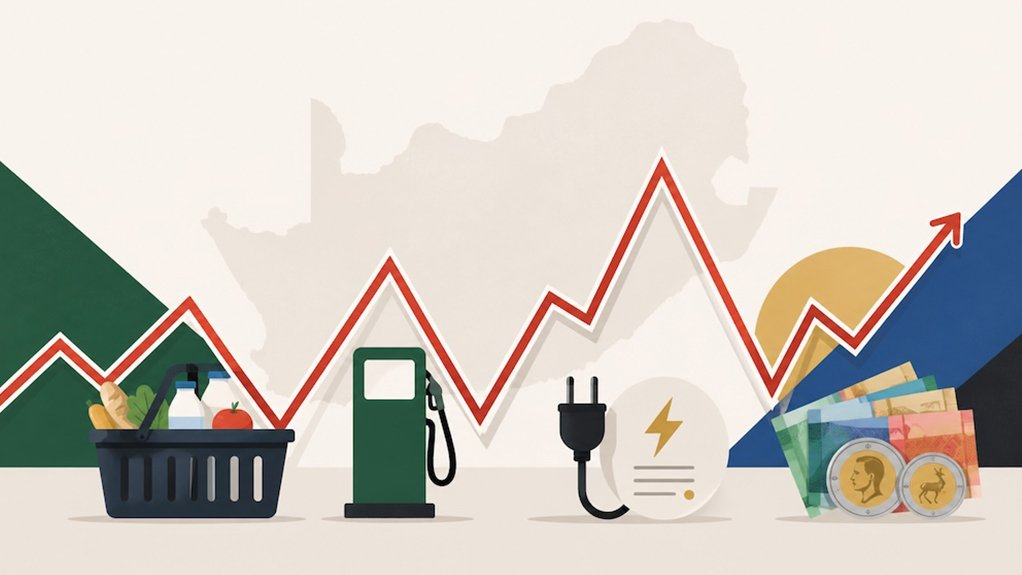
For many South Africans, the biggest pressure on household finances does not arrive as a clearly labelled deduction on a payslip. It shows up in quieter, more frustrating ways: the rand slipping, petrol jumping, electricity rising, and imported goods suddenly costing more. That is why even a person who has never opened an account with a forex broker still lives with the consequences of currency and price instability. The hidden tax is not always tax. Often, it is volatility.
That matters because volatility behaves like a charge on everyday life without ever being voted into law. A formal tax is visible. It can be measured, debated and planned for. Volatility is different. It moves through the economy indirectly, but households still pay. When the rand weakens sharply, the cost of fuel can rise. When fuel rises, transport costs move. When transport costs move, food distribution becomes more expensive. Even when headline inflation is relatively contained, families can still feel ambushed by the speed and unpredictability of individual price shocks.
South Africa offers a very clear example of this problem. Inflation has recently been much softer than many consumers may have expected after the price spikes of the previous few years. Statistics South Africa reported headline consumer inflation at 3.0% in February 2026, down from 3.5% in January. On paper, that looks like relief. But a national inflation figure can hide the lived experience of volatility, because households do not buy “headline CPI”. They buy electricity, fuel, food, airtime, transport and debt repayments. If one or two of those items swing hard enough in a short period, the financial stress feels much larger than the average number suggests.
Fuel is one of the clearest channels through which volatility reaches South African consumers. The country adjusts fuel prices monthly, and those prices are influenced by both global oil markets and the exchange rate. In the April 2026 fuel price adjustment, petrol increased by R3.06 per litre, while diesel rose by more than R7 per litre depending on grade. That is not a small nudge in a family budget. It is the kind of jump that changes commuting habits, delivery costs, grocery bills and the operating margins of small businesses almost immediately. A worker may not describe that as a tax, but in practical terms it reduces disposable income in much the same way.
Electricity works similarly, though through a different mechanism. Eskom’s direct customer tariffs were already raised materially in 2025, and revised tariffs effective from April 2026 brought a further increase for direct customers, with municipal tariff changes following later in the year. For households and firms, this does not just mean a higher utility bill. It also means higher production costs, pressure on retail prices, and less room to absorb other shocks. Businesses that cannot improve productivity fast enough often pass costs on. Those that cannot pass them on delay hiring, trim hours or scale back expansion. Volatility in administered and energy-related prices therefore taxes both consumption and opportunity.
Interest rates add another layer. The South African Reserve Bank’s policy rate stood at 6.75% in April 2026. That level is not extreme by historical standards, and it reflects the Bank’s effort to maintain price stability in an uncertain global environment. Still, the burden is uneven. Households with mortgages, vehicle finance, credit cards or business loans experience rate volatility directly. A move in rates can be economically rational at the macro level while still feeling punitive at the kitchen-table level. The hidden tax here is not simply the level of borrowing costs. It is the uncertainty around where debt servicing may go next, especially when incomes are not rising at the same speed.
The rand amplifies all of this because South Africa remains deeply exposed to imported costs. Fuel is the obvious example, but it is not the only one. Medicines, technology, industrial inputs, agricultural chemicals and many consumer goods are all affected, directly or indirectly, by exchange-rate movements. A weaker rand does not have to produce immediate panic to erode purchasing power. It only needs to make planning harder. Households postpone upgrades. Firms hold back on inventory. Importers widen margins defensively. Consumers start paying more not only for goods, but for the risk premium embedded in them.
This is why volatility hits the middle and lower end of the income distribution hardest. Wealthier households may be inconvenienced by price swings, but they usually have buffers: savings, assets, flexible transport options, solar installations, private schooling already budgeted in foreign-linked terms, or access to cheaper credit. Poorer and middle-income households are more exposed to timing risk. They cannot easily smooth a sharp fuel increase or an electricity jump across several months. They do not buy in bulk as efficiently. They often rely on transport networks whose costs reset faster than wages do. In that sense, volatility is regressive. It takes a larger share of financial resilience from those with the least resilience to spare.
The macroeconomic irony is that South Africa can appear more stable than households feel. The economy grew by 1.1% in 2025, according to Statistics South Africa, and inflation has eased. Those are meaningful improvements. But stability at the aggregate level does not eliminate volatility at the household level. A country can show progress in the data while families still feel trapped in a cycle of sudden cost resets. That gap between national indicators and lived financial reality is where the idea of a hidden tax becomes useful.
The more serious policy question, then, is not only how to lower inflation on average, but how to reduce the frequency and severity of shocks that cascade through transport, power, food and credit. For South Africans, predictability has value in its own right. A household can adapt to many prices if those prices move slowly enough to plan around them. What drains confidence is the constant repricing of ordinary life, where the cost of getting to work, keeping the lights on and stocking a fridge starts to feel less like economics and more like exposure
EMAIL THIS ARTICLE SAVE THIS ARTICLE ARTICLE ENQUIRY FEEDBACK
To subscribe email subscriptions@creamermedia.co.za or click here
To advertise email advertising@creamermedia.co.za or click here


