





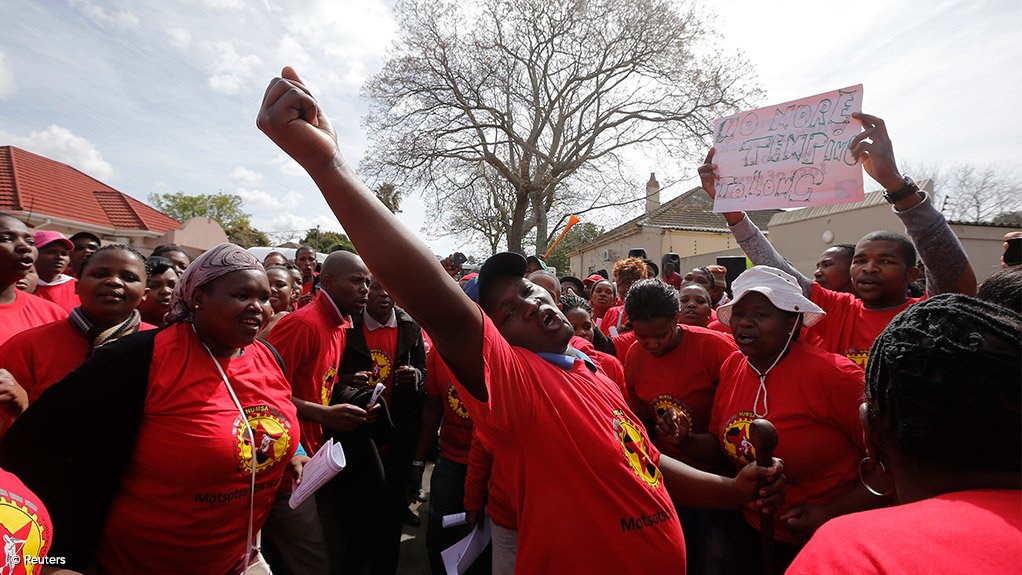
The strike by 220 000 members of the National Union of Metalworkers of SA (NUMSA) in the metals and engineering sectors, as well as various other strikes and labour-related developments continue to dominate on the political and economic fronts. While the strike puts more pressure on an already struggling economy, there is also little sign of government following through with any urgency on the promised and much-needed measures to address labour instability in South Africa. Far more than just the labour picture is being affected.
The damage done by the NUMSA strike
The damaging NUMSA strike by the most radical far-left union affiliated to the Congress of SA Trade Unions (COSATU), which is part of the governing alliance led by the African National Congress (ANC), comes in the wake of the very costly 5-month long strike by the Association of Mineworkers and Construction Union (AMCU) which only recently ended in the key platinum mining sector. In the end the AMCU strike settlement was almost derailed by government’s intransigence and other political developments despite the commendable attempt by Mineral Resources Minister Ngoako Ramathlodi to lead the parties to a settlement.
In the wake of the AMCU-strike South Africa already experienced a credit downgrade by rating agencies with some of the stricken mines indicating they are likely to restructure their operations, leading to job losses.
Coming on top of a week of bad economic news for SA, the Numsa strike has already resulted in -
- Moody's warning that the labour unrest would consign South Africa to a third consecutive year of sub-par growth and further risks for its rating;
- General Motors suspending its output at its plant in Port Elizabeth;
- Economists warning that if the NUMSA strike should inflict a second quarter contraction it will officially push the country into a recession;
- Warnings that small businesses affected by the strike could be permanently put out of business, resulting in job losses; and
- Warnings that the effects of the NUMSA strike could also cause damage in other areas of the economy, most notably national power utility Eskom.
Moody’s further warned that the strike would damage the country’s “already deteriorating reputation among investors” and that it “risks paralysing nearly one third of the manufacturing sector”.
Political issues
While little progress has been made in narrowing the wage increase gap between the union and employers, the NUMSA strike is also being complicated by political demands. As we pointed out previously it was inevitable that underlying political and socio-economic issues would form part of the picture.
But demands around issues such as that employers dispense with labour broking and do not implement the Employment Tax Incentive Scheme or so-called “youth wage subsidy” are complicated issues that cannot be addressed in a wage dispute and rather belong in the “social partners dialogue” arena. However, government is providing little input on this front and has not been very helpful. While it should not directly intervene in the details of the dispute, it should provide leadership, facilitate settlement and address issues that do fall under its area of competence.
Also, Labour Minister Mildred Oliphant has interacted only with NUMSA and the Steel and Engineering Industries Federation of South Africa (SEIFSA), while ignoring the National Employers Association of South Africa (NEASA). The positions of the two employer bodies differ substantially and if an agreement is forced upon the latter without it having been a party to the negotiations, it could lead to legal actions causing delays.
Labour relations system failures
The strike has degenerated into various acts of violence and vandalism for which the union leadership denies responsibility. The denial adds to signs that increasingly suggest union leaders are unable to control their members during strikes. The practices, trends and demands that emerged during the wildcat and legal strikes as well as other labour unrest and protests since August 2012 are regularly seen to be emulated in recent and current strikes.
In addition the strike and associated developments have again further exposed the weaknesses and failures of the current labour bargaining system and structures in South Africa, as well as the fact that workers and employers alike are increasingly losing faith in the system.
Against the background of the strike developments, a number of related matters are cause for concern.
Government not showing promised leadership
Government has not shown the leadership and more urgent addressing of problems it promised when President Jacob Zuma recently delivered his state of the nation address (SONA).
Instead of Deputy President Cyril Ramaphosa displaying more focused urgency in convening the social partners dialogue to address the widespread labour unrest and underlying factors in SA as promised by President Zuma in his SONA, Ramaphosa is currently in Sri Lanka to assist with advancing that country’s peace process. Before that he was in France for a WWI commemoration. Meanwhile there has been no indication of the rate of progress being made by Ramaphosa with the task assigned to him in the SONA.
The other two top government members that, according to Zuma’s SONA, would be leading stabilising processes in the mining sector, namely Zuma himself and Minister in the Presidency Jeff Radebe, have also been extremely quiet.
It can only be assumed that the top three government leaders are either not approaching these matters with the urgency and importance they deserve (or as had been promised by Zuma), or they are possibly involved in delicate preparatory activities aimed at proceeding with these processes and are maintaining silence so as not to derail or stall the process. But it is hard to believe the latter can take place in a total vacuum of silence.
What is behind Zuma’s continued “disappearance”?
Zuma’s “disappearance” at a very difficult time for South Africa also continues to puzzle. He has been hidden from public view since shortly after the recent general election, emerging only to deliver his SONA – with him apparently having had no direct hand in its writing – and to travel to Equatorial Guinea for the 23rd Ordinary Session of the African Union Assembly. Other than that he has not been seen, although he did sign off the Restitution of Land Rights Amendment Act and the controversial property valuation bill that almost gives the state carte blanche in deciding the amount of compensation (if any, when read together with other laws in the making) to be paid for expropriated property.
As SA faced a deluge of bad news and problems on many fronts – including negative adjustments to its risk ratings outlook – only a number of press statements announcing various administrative decisions or actions were released by Presidency spokesman Mac Maharaj on Zuma’s behalf.
Whether Zuma’s health issues are still keeping him out of the public eye, or whether political developments – about which there has been much speculation in political circles – are to blame, is not clear. What is clear however is that it is bad PR for South Africa when there is a lack of direction-giving political leadership at a time when it is being afflicted by numerous crises. Unlike the tone and promises of Zuma’s SONA, the government’s top three leaders are not seen to be leading the processes that were announced to address these crises.
Ironically on Thursday President Zuma will be in Port Elizabeth to attend the launch of the First Automotive Works, an assembly plant that will assemble commercial vehicles. Perhaps he uses his presence in the strike epicentre to address the issues and give some direction.
Other similar negative labour impacts
Meanwhile a number of other labour developments are cause for concern. At Impala Platinum’s Marula mine some 2,000 workers are on strike, but no reason has been offered, no demands made and no union or committee is claiming responsibility or leadership.
At Sun City another strike/protest action led by the COSATU-affiliated SA Transport and Allied Workers’ Union (SATAWU) and South African Commercial, Catering and Allied Workers Union (SACCAWU) has just ended. The strike issues in this case mostly fell outside the labour relations/shop floor sphere and would have been better suited to being resolved in the human rights/legal/political arena.
And in Newcastle, KwaZulu-Natal a strike threat by the SA Municipal Workers’ Union (SAMWU) also has strong political undercurrents rather than being caused by shop floor issues. Joined by COSATU, the ANC and the SA Communist Party (SACP), SAMWU has warned of a full-blown strike if the Newcastle municipality fails to address its grievances within 14 working days. Despite the municipality being run by an ANC local government, the SACP, COSATU and ANC support SAMWU in its fight against it.
What it means
Many issues and impacts are involved. But essentially these developments underscore again just how important it is that the government ends its ongoing paralysis both in respect of pro-active political leadership, starting a social dialogue that can lead to action, and in respect of implementing the many agreements, plans and programmes it already has in place. The developments also again highlight the failures and weaknesses in the current labour relations framework and the need for urgent revision.
Unless government leaders move with greater speed on the promised dialogues, implementation of agreements and socio-economic improvement measures, and start visibly addressing the labour relations framework, labour instability and its economic impact, any momentum that may have been created in President Zuma’s SONA, will be lost and these processes will simply falter like before. Without government’s visible and active participation neither labour nor business will be able to take the process forward.
Considering the key issues targeted in President Zuma’s SONA, government appears for one to be more focused on land redistribution than the destabilising labour situation affecting the economy. It may be that the government expects serious destabilising pressure from affected rural areas if this issue is neglected. Or it may equally – or more likely - be motivated by little more than a fear of the ruling party losing its very strong support in the rural areas in the same way that it recently lost much of the support of its urban constituency whose most pressing concerns had not been addressed sufficiently.
Failure to address both the immediate NUMSA strike and the longer-term labour instability picture together with all its accompanying issues, will lead to more instability and chaos in the labour relations sphere; further loss of confidence in South Africa and its prospects for growth; and it would result in South Africa being unable to take advantage of a more favourable global economic outlook.
Written by Africa-International Communications political analyst and editor Stef Terblanche
EMAIL THIS ARTICLE SAVE THIS ARTICLE FEEDBACK
To subscribe email subscriptions@creamermedia.co.za or click here
To advertise email advertising@creamermedia.co.za or click here


