





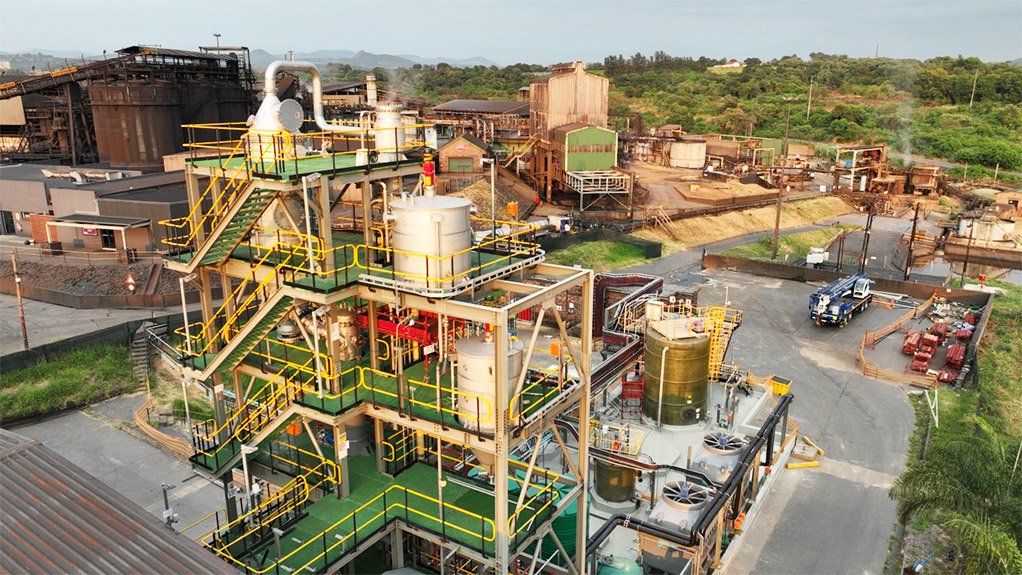
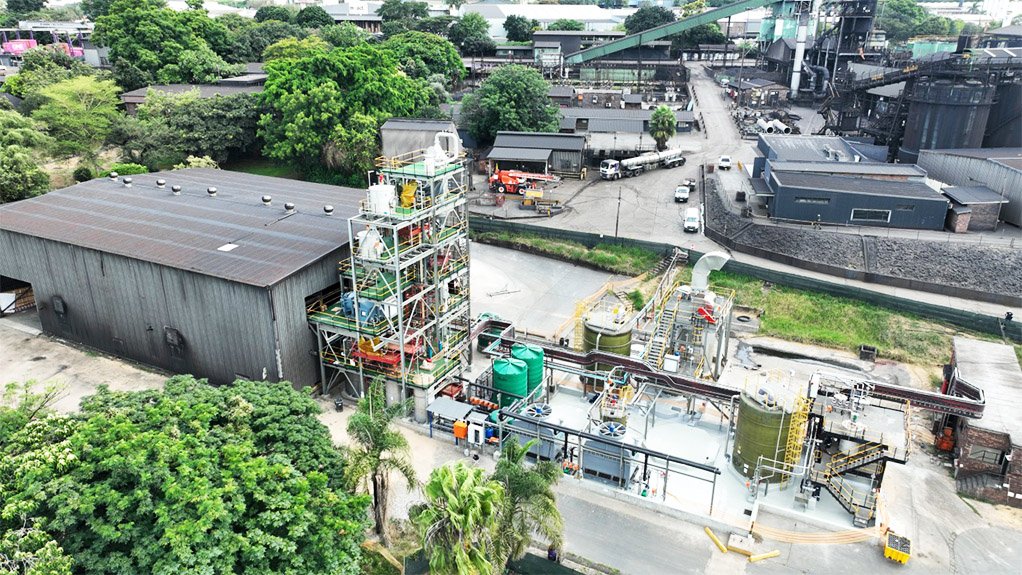
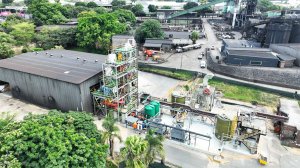
JOHANNESBURG (miningweekly.com) – South Africa’s supply status in the rapidly evolving and increasingly geopolitically fragmented battery materials market has taken a major leap forward with the completion of the construction by Manganese Metal Company (MMC) of Mpumalanga of the first phase of a battery-grade high-purity manganese sulphate monohydrate (HPMSM) plant in Mbombela.
What’s more, MMC is already evaluating a second significantly larger phase to the project amid also developing a patented ore-to-crystals process that could support larger-scale future growth in the battery supply chain, without the need to use the metal-based route.
Chaired by mining luminary Bernard Swanepoel, MMC is the world's only producer of electrolytic manganese metal (EMM) outside China, and the largest producer of high-purity selenium-free EMM.
Presenting at the International Manganese Institute (IMnI) annual conference in Rio de Janeiro, MMC chief marketing officer Morné Ruiters outlined MMC’s seven-year journey from project conception in 2019 to commissioning of the 6 000 t/y HPMSM facility in 2026 at its Mbombela location, where the second phase is poised to add a further 18 000 t/y.
The IMnI conference was attended by stakeholders from across the global manganese value chain, including manganese mining companies, alloy, metal and chemical producers, traders, consultancies, logistics companies and steel and battery sector participants.
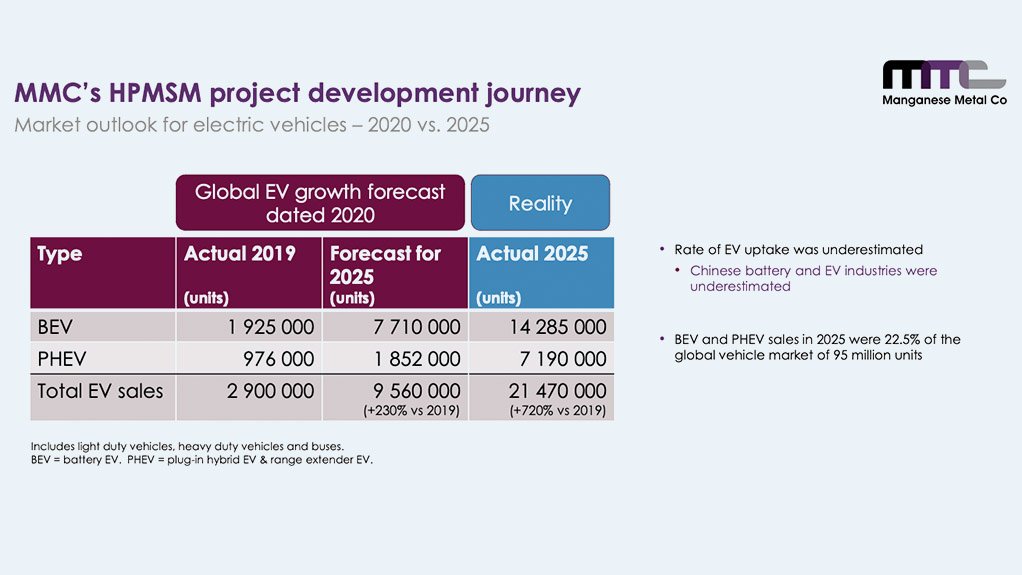
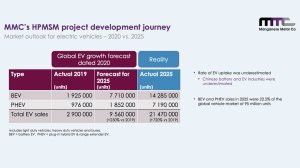
The development of the MMC project has unfolded against a backdrop of significant shifts in electric vehicle (EV) adoption and battery chemistry preferences. According to MMC, industry forecasts prepared in 2020 substantially underestimated the pace of EV penetration. Global battery electric vehicle and plug-in hybrid vehicle sales reached more than 21-million units in 2025, more than double the levels anticipated five years earlier.
Battery chemistry trends also surprised the market. While lithium iron phosphate (LFP) batteries were expected to account for only around 10% of the market by 2025, they captured roughly half of global EV battery demand last year, on account of very strong EV growth in China, reshaping assumptions about future manganese consumption.
Given these uncertainties, MMC elected in 2024 to pursue a modular ‘metal-to-crystals’ production route, for converting a small portion of its existing high-purity manganese metal into battery-grade sulphate.
The strategy leverages the company's established EMM production capacity, brownfield infrastructure and decades of manganese purification expertise while reducing capital exposure and allowing phased expansion.
"The battery market has changed dramatically since our initial studies were completed," Ruiters pointed out during his IMnI presentation. "Flexibility and optionality have become critical." The technical ability to produce material at industrial scale at the purity level demanded by the battery industry is now being matched by a requirement to be flexible and meet changing market realities.
The company argues that battery supply chains remain far from settled. While LFP cathode chemistry is expected to dominate mass-market midrange EVs and stationary energy storage systems, there is a continuing role for nickel-manganese-cobalt (NCM) cathodes, particularly as battery manufacturers increasingly adopt mid-nickel, high-voltage NCM formulations with higher manganese content.
Emerging lithium manganese-rich (LMR) technologies will further strengthen manganese demand and reduce battery cost, underscoring the continued research and development efforts by various automotive and battery companies to overcome the last technical hurdles related to commercialisation of LMR batteries.
Geopolitical developments are adding another layer of complexity – “and opportunity”, the company states in its release to Mining Weekly.
Trade restrictions, local-content requirements, export controls, and efforts to diversify supply chains are increasingly influencing investment decisions throughout the battery value chain. The need to secure processed critical materials and economic security is a strategic objective of various national governments, driving new bilaterial and multilateral agreements being concluded between countries at present.
Against this background, MMC believes its South African production base offers a strategic advantage.
For MMC, the objective is clear: align manganese supply growth with the emergence of battery manufacturing capacity while maintaining the flexibility to respond to an industry that continues to evolve at pace.
EMAIL THIS ARTICLE SAVE THIS ARTICLE ARTICLE ENQUIRY FEEDBACK
To subscribe email subscriptions@creamermedia.co.za or click here
To advertise email advertising@creamermedia.co.za or click here


