





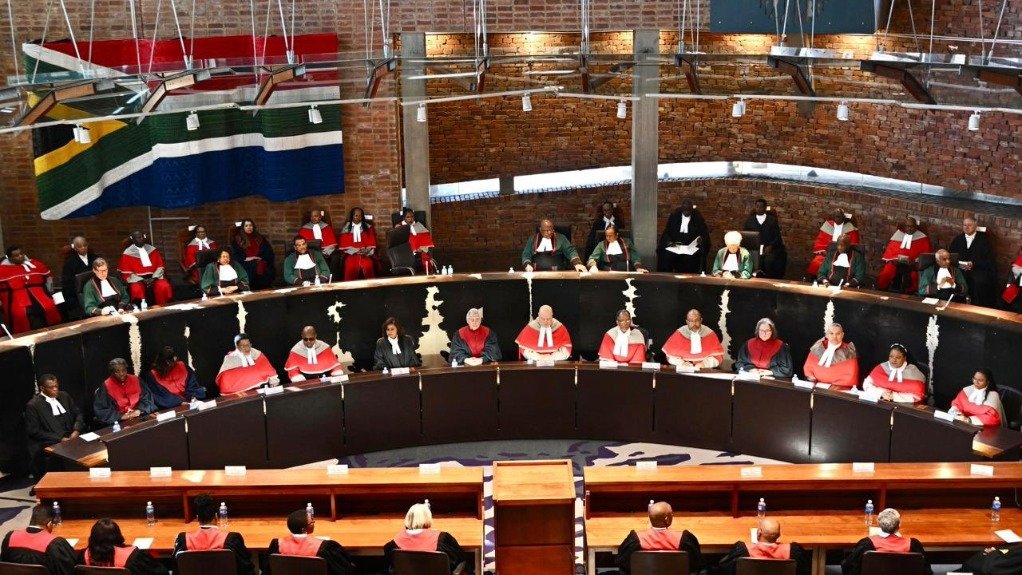
Court rulings on some of South Africa’s most contested laws could improve business sentiment after years of policy uncertainty, according to the head of one of the nation’s biggest wealth and money-management firms.
“There are over 50 challenges to various bits of legislation,” PSG Financial Services Chief Executive Officer Francois Gouws said in an interview Thursday. “It’s good that we’re getting clarity,” he said, adding that “the more these decisions are communicated, then the more people can understand what the landscape looks like. That helps people to gain confidence.”
Last month, the Constitutional Court struck down a law that would have expanded mandatory preferential-procurement rules including reserving some state contracts for Black-owned businesses. The court found lawmakers had failed to adequately consult the public before passing the legislation. The National Health Insurance Act — which critics say is unaffordable — also faces multiple constitutional challenges, with President Cyril Ramaphosa delaying its introduction in February because of litigation.
A legacy of corruption and mismanagement under Ramaphosa’s predecessor, Jacob Zuma, still dogs an economy that’s expanded less than 1% annually for more than a decade. Companies have consequently been reluctant to invest, with gross fixed capital formation at about 14% of gross domestic product in 2025, less than half the 30% target set out in a policy plan with a deadline of 2030, the president said in August.
The nation’s expropriation law — which gives the government the power to take land or property for a public purpose such as to build roads or schools, or in the public interest — was published in January last year but has yet to take effect as it’s tested in court.
The legislation provoked US President Donald Trump to halt aid to South Africa after he claimed the government was seizing the land of White farmers. While the state hasn’t taken any properties without compensation since the end of apartheid in 1994, unlawful occupation of private and state-owned land remains widespread. Official data show that about 12% of households are situated in informal settlements.
Gouws expects municipal elections on November 4 will give voters a chance to reassess how cities and towns are managed. The president in February acknowledged that scores of municipalities were deeply dysfunctional and unable to provide basic services such as water and power consistently.
“It is an opportunity for the country to reset and for us to reevaluate our position,” Gouws said.
The African National Congress, the party of Nelson Mandela, lost its parliamentary majority in the 2024 general election for the first time since the end of White-minority rule 30 years earlier. It has since governed at the national level in a coalition with smaller rivals and the Democratic Alliance, the second-largest group.
South Africa’s next national elections are due to be held in 2029.
EMAIL THIS ARTICLE SAVE THIS ARTICLE FEEDBACK
To subscribe email subscriptions@creamermedia.co.za or click here
To advertise email advertising@creamermedia.co.za or click here


