





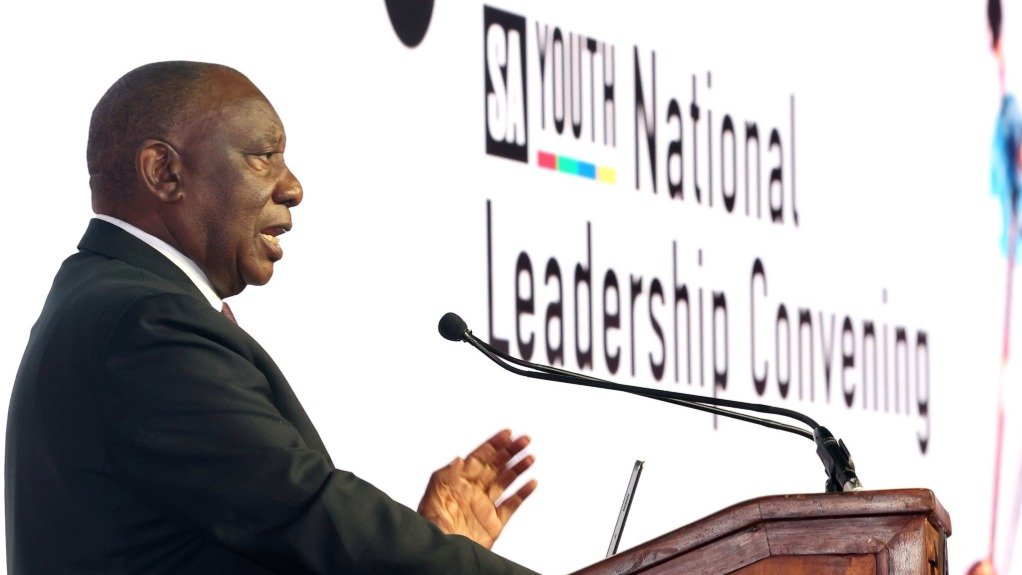
Programme Director, Ms Zengeziwe Msimang,
Minister of Employment and Labour, Ms Nomakhosazana Meth,
Minister of Higher Education and Training, Mr Buti Manamela,
Minister of Public Works and Infrastructure, Mr Dean Macpherson,
Board Chairperson of Harambee Youth Employment Accelerator, Mr Sandile Gwala,
CEO of Harambee Youth Employment Accelerator, Ms Kasthuri Soni,
President of Business Unity South Africa, Mr Mxolisi Mgojo,
Board Chairperson of MTN, Mr Mcebisi Jonas,
Executive Director of Yellowwoods, Ms Nicola Galombik,
Founder of This Day Foundation, Mr Gary Lubner,
Leaders of business, labour and civil society,
Distinguished Guests,
Members of the media,
Ladies and Gentlemen,
Good morning.
It is a pleasure to join you at this important gathering, where we have come together to confront one of the greatest challenges facing our country: the exclusion of millions of young South Africans from meaningful economic opportunity.
We are here because we share a conviction that the future of South Africa depends, to a great extent, on what we do today to create opportunities for our young people.
We are here because we recognise that youth unemployment is not merely an economic challenge.
It is a social challenge. It is a human challenge. And it is a challenge that goes to the very heart of our nation's future.
Every young person who wants to work but cannot find employment represents potential that is not being realised.
Behind every unemployed young person is a story.
It may be the story of a young woman who has completed her studies but cannot find her first job.
It may be the story of a young man who has sent out countless applications without receiving a response.
Or it may be the story of a young entrepreneur with a promising idea but without the capital, networks or support to turn that idea into a viable business.
These are not simply statistics.
These are the lives, hopes and aspirations of our young people.
And we cannot be content with a society in which so many young people stand outside the gates of economic opportunity, looking in.
We must open those gates.
Ladies and Gentlemen,
Since the beginning of our democracy, we have understood that the development of our young people is fundamental to building a prosperous and inclusive society.
We have expanded access to education, training and opportunities for personal development.
We have introduced programmes to help young people gain workplace experience, acquire skills and enter the labour market.
Yet, despite these efforts, far too many young South Africans remain unemployed.
This tells us something important.
We cannot solve the challenge of youth unemployment simply by doing more of what we have always done.
We must be prepared to do things differently.
We must be prepared to challenge established practices, remove unnecessary barriers and rethink the way we prepare young people for the world of work.
Above all, we must be prepared to work together in ways that produce results.
That is why the Government-Business Partnership is so important.
Over the past few years, this partnership has demonstrated what can be achieved when government and business work together around shared national priorities.
We have seen the value of cooperation in addressing constraints on economic growth, improving the investment environment and supporting reforms in critical sectors of our economy.
We must now bring that same spirit of cooperation, urgency and determination to the challenge of youth unemployment.
For this partnership to succeed, we must recognise that the employment of young people is not solely the responsibility of government.
Nor can it be left to business alone.
It is a shared national responsibility.
Government must create an enabling environment for investment, enterprise development and employment.
Business must invest, expand productive activity and open its workplaces to young people.
Educational institutions must equip young people with the knowledge and skills that employers need.
Labour, civil society and communities must help us ensure that opportunities are accessible, fair and inclusive.
And young people themselves must be active participants in shaping their economic future.
Ladies and Gentlemen,
One of the most important lessons we have learned is that the first opportunity is often the most difficult to obtain.
Many young people find themselves caught in a familiar predicament.
They cannot get a job because they do not have experience.
And they cannot get experience because nobody will give them a job.
We must break this cycle.
I want to make a particular appeal to the business leaders gathered here today.
Let us stop treating a lack of experience as a lack of ability.
Let us recognise potential, aptitude, determination and the willingness to learn.
Let us create more opportunities for young people to enter workplaces, develop their skills and demonstrate what they can do.
A young person should not have to spend years searching for an opportunity simply because no employer is prepared to give them a first chance.
We need employers who are willing to look beyond formal qualifications and previous employment.
We need recruitment practices that recognise talent wherever it is found.
And we need workplaces that are prepared to train, mentor and develop young people.
This is not an appeal for charity.
It is an appeal for investment in the future of our economy.
Young people bring energy, creativity, adaptability and fresh perspectives into the workplace.
They are often the first to embrace new technologies, new ways of working and new business opportunities.
In an economy being reshaped by digital innovation, artificial intelligence and the transition to cleaner forms of energy, these qualities are increasingly valuable.
Our young people should not merely be spectators to these changes.
They must be among those who drive them.
They must be innovators, entrepreneurs, technicians, researchers, artisans and business leaders in the industries of the future.
We must prepare them not only for the jobs that exist today, but also for the jobs that are yet to be created.
Ladies and Gentlemen,
We have already established important foundations on which to build.
Through the Presidential Youth Employment Intervention, the SA Youth Pathways Network, the Youth Employment Service and other initiatives, we have developed practical ways of connecting young people to opportunities.
These programmes have shown that when government, business and civil society combine their resources and capabilities, they can reach young people who would otherwise remain excluded.
Public employment programmes have also demonstrated their value.
Young people have been able to gain work experience while supporting education, food security, community safety, environmental protection and other important social needs.
These opportunities do more than provide an income.
They restore confidence, build skills and give young people the dignity that comes from being able to contribute.
But we must be clear about our ambition.
Our objective cannot simply be to place young people in temporary programmes. It must be to create pathways into sustainable livelihoods.
A public employment opportunity should be a stepping stone to further training, entrepreneurship or lasting employment.
A workplace placement should be an entry point into a career.
And a skills programme should equip a young person with capabilities that are valued in the economy.
We must therefore strengthen the connections between education, training, work experience and employment.
For too long, we have trained young people without sufficient consideration of where they will work once their training is complete.
We have produced qualifications that do not always correspond with the skills required by employers.
And we have allowed too great a distance to develop between our educational institutions and the world of work.
This must change.
That is why we are undertaking reforms to our skills development system, including the Sector Education and Training Authorities and our technical and vocational education and training colleges.
We want a system that is more responsive to the needs of industry and more effective in preparing young people for employment.
We want businesses to play a greater role in identifying skills needs, designing training programmes and providing workplace learning.
We want our colleges to become centres of practical excellence, producing young people who are ready to participate in the modern economy.
And we want young people to see vocational and technical careers as attractive and rewarding pathways to success.
Not every young person needs to attend a university to build a successful future.
Our economy needs artisans, technicians, builders, electricians, mechanics, agricultural specialists and people with a wide range of practical and technical skills.These are professions that build our country.They must be respected, supported and expanded.
Ladies and Gentlemen,
We must also recognise that the future of youth employment cannot depend entirely on the creation of traditional jobs.
South Africa needs more young entrepreneurs.
We need young people who establish businesses, develop products, provide services and create employment for others.
Across our country, young South Africans are already demonstrating remarkable enterprise and initiative.
They are starting businesses in townships and rural communities.
They are using digital platforms to reach customers.
They are finding innovative ways to solve problems in their communities.
But too many promising enterprises fail to grow because they cannot access finance, markets, business support or the infrastructure they need.
We must change this.
Government and business must work together to make it easier for young people to start and grow businesses.
We must expand access to start-up capital and working capital.
We must open procurement opportunities and supply chains to youth-owned enterprises.
We must provide mentoring, business development support and access to markets.
And we must remove unnecessary regulatory and administrative obstacles that discourage entrepreneurship.
I would particularly encourage established businesses to look at how they can bring young entrepreneurs into their value chains.
A young entrepreneur does not always need a grant.
Sometimes what that entrepreneur needs most is a customer.
A contract.
A market.
An opportunity to prove that their business can deliver.
These are opportunities that established businesses can help provide.
Ladies and Gentlemen,
The sectors that offer the greatest opportunities for young people are also sectors that can drive the next phase of South Africa's economic growth.
They include tourism, agriculture, infrastructure, manufacturing, digital services, the green economy and the creative industries.
In each of these sectors, there is potential to create new enterprises, develop new skills and expand employment.
Our task is to translate this potential into real opportunities.
This requires a more deliberate relationship between government, industry and training institutions.
We need to identify where demand for labour is growing.
We need to understand which skills are required.
And we need to ensure that young people are prepared to take up those opportunities.
The Work SA Youth Implementation Plan provides a framework for coordinating these efforts and scaling up approaches that have demonstrated their effectiveness.
But a plan, however well conceived, is only as valuable as its implementation.
We must therefore move beyond the formulation of strategies and the announcement of commitments.
We must make implementation the defining feature of this partnership.
I would like this convening to mark a turning point in how we approach youth employment.
I would like us to leave here with a common understanding of what each social partner must do.
I would like business leaders to identify practical opportunities within their companies and industries to bring more young people into employment.
I would like industry associations to work with employers, including smaller businesses, to expand workplace learning and entry-level recruitment.
I would like our education and training institutions to strengthen their relationships with employers and ensure that the skills they provide lead to real opportunities.
And I would like the relevant government departments and agencies to remove the obstacles that prevent these efforts from succeeding.
We should not be satisfied with broad undertakings.
We need clear responsibilities, practical commitments and a means of assessing whether those commitments are being fulfilled.
We need to know what is working, what is not working and what needs to change.
Where programmes are successful, we must expand them.
Where they are failing, we must improve them.
And where outdated practices stand in the way of progress, we must have the courage to change them.
Ladies and Gentlemen,
I want to emphasise that our young people are not asking for special treatment.
They are asking for a fair chance.
They are asking for the opportunity to work, to learn, to earn a living and to build a future.
They are asking for the chance to contribute to the development of their country.
We should listen to them.
We should involve them in the decisions that affect their lives.
And we should recognise that they are not merely beneficiaries of our programmes.
They are partners in the development of our nation.
The young people of South Africa have demonstrated their courage, resilience and determination throughout our history.
They have been at the forefront of struggles for freedom, justice and democracy.
Today, they must be at the forefront of our struggle for economic inclusion and shared prosperity.
Our responsibility is to ensure that their energy and talent are not wasted.
Our responsibility is to build an economy in which hard work, ability and determination are rewarded with opportunity.
An economy in which a young person's prospects are not determined by the circumstances of their birth, the community in which they live or the connections they possess.
An economy in which every young person has a genuine opportunity to succeed.
As we conclude this convening, I want to leave all of us with a challenge.
When we gather again to reflect on the progress of this partnership, let us not be remembered for the speeches we made or the declarations we adopted.
Let us be remembered for the doors we opened.
For the young people who entered workplaces for the first time.
For the entrepreneurs who were able to establish and grow their businesses.
For the young people who acquired skills that enabled them to build sustainable livelihoods.
And for the hope that we restored in communities where opportunity has been absent for far too long.
We have the institutions.
We have the partnerships.
We have the resources, the capabilities and the experience.
What we need now is the determination to act together, with greater urgency and a shared sense of purpose.
The future of our young people cannot wait.
And the future of our country cannot wait.
Let us give every young South African a reason to believe that their future can be better than their present.
Let us give them the opportunity not only to dream of a better South Africa, but to help build it.
Because when we give young people the opportunity to succeed, we give South Africa the opportunity to succeed.
I thank you.
EMAIL THIS ARTICLE SAVE THIS ARTICLE ARTICLE ENQUIRY FEEDBACK
To subscribe email subscriptions@creamermedia.co.za or click here
To advertise email advertising@creamermedia.co.za or click here


