





South Africa and SADC’s reluctance to remedy misgovernance in their neighbourhood contributes to migration, sparking xenophobia and causing diplomatic embarrassment.
South Africa has, in a sense, been hoisted on its own petard with the recent xenophobic campaign against migrants – most of whom come from Southern Africa, particularly Zimbabwe, Mozambique and Malawi.
The mobilisation stands out for its level of organisation and timing ahead of November’s local elections. March and March’s campaign prompted an exodus of over 178 000 migrants.
The threats and lawlessness of these vigilantes have caused South Africa major diplomatic embarrassment. Ghana has demanded that the country’s xenophobic violence be put on the next African Union (AU) summit agenda. Ghana said AU Commission Chairperson Mahamoud Ali Youssouf had agreed but Pretoria was frantically trying to prevent this in favour of a special summit on migration across the continent.
Pretoria would like such a conference to focus, inter alia, on migration’s push and pull factors – other countries’ political and economic conditions that prompt citizens to seek greener pastures.
But by raising these push factors, Pretoria has inadvertently raised the question of what it’s doing to mitigate them. It has long been criticised for not doing enough to restore democracy and good governance to neighbouring states.
This week, Democratic Alliance Member of Parliament Ryan Smith told President Cyril Ramaphosa in Parliament that the chickens had come home to roost because South Africa had failed to address brutal dictatorships next door.
‘When will you take seriously and actively address the backslide of democracy in our region and the growing threat of authoritarianism and state collapse that is placing the burden of mass migration on South Africa’s doorstep?’ he asked.
Ramaphosa said other countries’ governance issues were for their citizens to address and that ‘we respect their sovereignty.’ He said South Africa was ‘not a lone ranger’ and ‘where there are challenges in other countries [the regional bodies will] take a firm view of what needs to be done’ – referring to the Southern African Development Community (SADC).
But SADC’s interventions in those countries have hardly been firm and have proved largely ineffective, particularly in Zimbabwe.
South Africa’s diplomacy there under the SADC banner did lead to a unity government from 2009 to 2013. But that was effectively a reprieve for Zimbabwe’s former president Robert Mugabe after he and his Zimbabwe African National Union-Patriotic Front (ZANU-PF) lost the 2008 elections to Morgan Tsvangirai’s Movement for Democratic Change.
By then, hyperinflation had reportedly reached a monthly rate of 79.6 billion percent and by early 2009 the Zimbabwean dollar had plunged to one trillion to the United States (US) dollar. Political violence and economic collapse propelled hundreds of thousands of Zimbabweans across the border into South Africa.
The unity government helped stabilise the economy and the polity. But Zimbabwe is now back to square one economically and politically. ZANU-PF still runs a de facto one-party state, having repressed or undermined the opposition almost into oblivion.
President Emmerson Mnangagwa now seems set on being a president-for-life, having effected in July what the opposition called a ‘constitutional coup’ – an amendment giving him two extra years in power.
Institute for Security Studies Senior Research Consultant and Signal Risk Geopolitical Analyst Priyal Singh notes that SADC’s timid, consensus-based approach has prevented it from addressing democratic regression in member states such as the Democratic Republic of the Congo, Tanzania, Eswatini, Mozambique, Zimbabwe and Madagascar. Yet the ambitious plans for regional economic integration articulated at SADC’s Durban summit this month cannot take off without better governance, he said.
SADC could be said to have encouraged Zimbabwe’s undemocratic tendencies by opposing the limited residue of targeted Western sanctions against the country, and by endorsing ZANU-PF’s contention that sanctions largely caused Zimbabwe’s economic collapse. This has discouraged ZANU-PF from addressing the real problems: political and economic misgovernance.
At the SADC summit and later at the Zimbabwe-South Africa Bi-National Commission Business Forum in Pretoria, Mnangagwa thanked SADC and South Africa for their support in opposing ‘stupid illegal Western sanctions’ against Zimbabwe.
However, the few remaining sanctions have little, if any, impact on Zimbabwe’s economy. The European Union has only a ban on exporting equipment to Zimbabwe that could be used for internal repression.
The US maintains targeted financial sanctions and asset freezes against Mnangagwa and a few other political leaders and business cronies. Washington also upholds a 2001 law restricting US support for new loans or debt relief to Zimbabwe from international financial institutions until political and economic reforms are met.
Apart from SADC’s failure to help effect democratic reform in Zimbabwe, questions have been asked about whether Ramaphosa and the African National Congress (ANC) really care about Zimbabwe’s misgovernance.
The ANC, ZANU-PF and four other governing Southern African parties meet annually as an informal club of former liberation movements, mainly to compare notes on how to remain in power. Last year, Mnangagwa advised his fellow leaders: ‘We should never allow ourselves to lose power.’
In May this year, Ramaphosa made a mysterious visit to Zimbabwe, including a detour to Mnangagwa’s farm. There he met some of Mnangagwa’s controversial business cronies, including Wicknell Chivayo and Kudakwashe Tagwirei.
Ramaphosa’s office could not properly explain the visit. Zimbabwe’s opposition speculated privately that ‘deals’ were being done – possibly connected to financing the ANC’s local government campaign. And that Ramaphosa had supported Mnangagwa’s plans to extend his term.
Others speculated that Ramaphosa was advising Mnangagwa against extending his presidency. If so, the advice was clearly ignored – with no visible damage to relations.
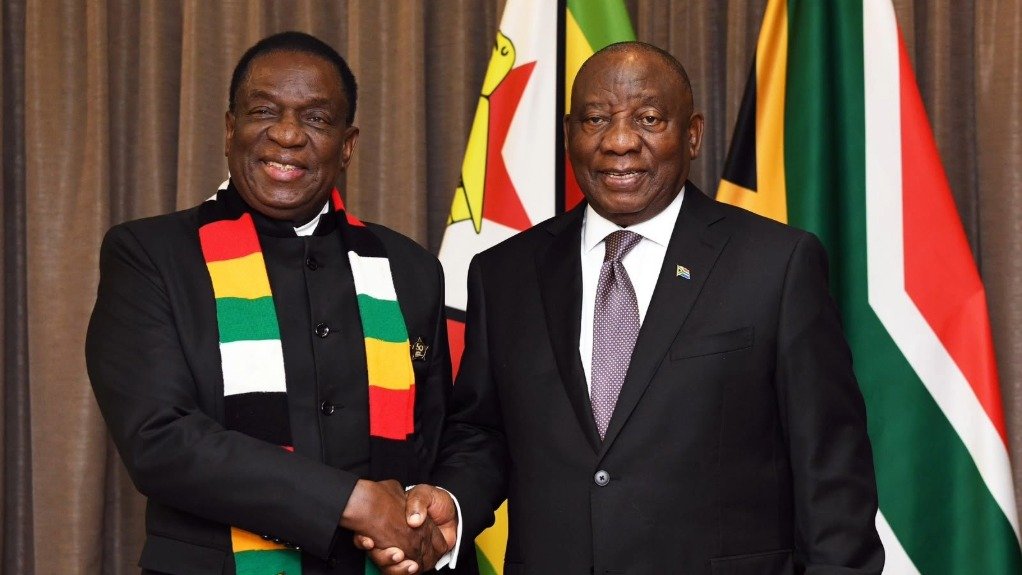
At the recent SADC summit and Bi-National Commission, Mnangagwa frequently referred patronisingly to Ramaphosa as ‘my younger brother’, and Ramaphosa played along by calling Mnangagwa ‘my elder brother.’
That familiarity suggests Mnangagwa and Ramaphosa, like their parties, are too close for anyone to realistically expect SA’s president to lecture his elder brother on democratic governance. Maybe instead, Mnangagwa gave his younger brother pointers on how to stay in power.
Written Peter Fabricius, Consultant, ISS Pretoria
EMAIL THIS ARTICLE SAVE THIS ARTICLE ARTICLE ENQUIRY FEEDBACK
To subscribe email subscriptions@creamermedia.co.za or click here
To advertise email advertising@creamermedia.co.za or click here


