





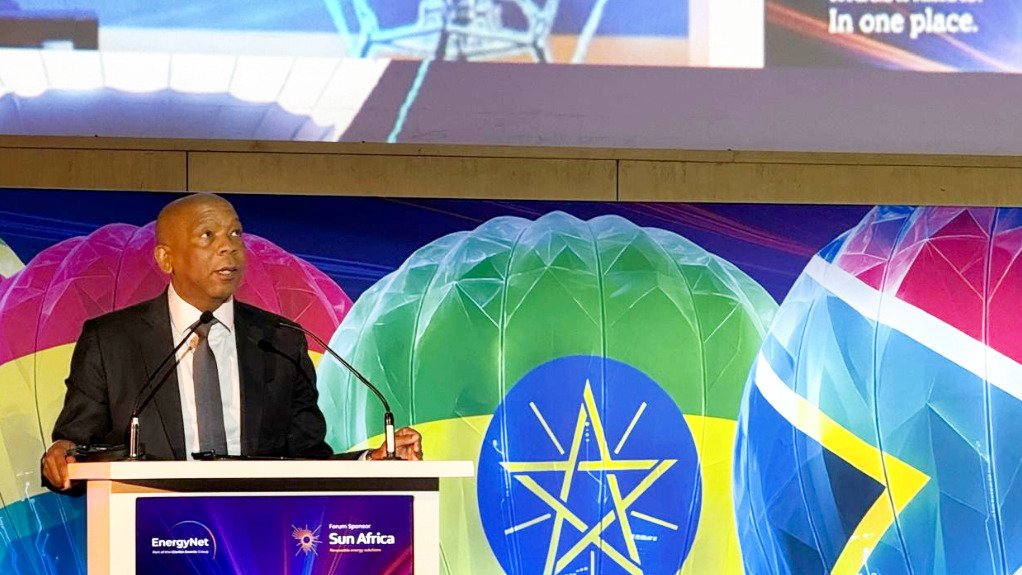
Electricity and Energy Minister Kgosientsho Ramokgopa has called for Africa to accelerate the implementation of cross-border electricity infrastructure by converting continental energy plans into bankable projects capable of attracting large-scale investment.
Addressing the opening of the Africa Energy Forum in Cape Town on Tuesday, Ramokgopa said the continent needed to accelerate implementation of the African 10-Year Infrastructure Investment Plan for cross-border interconnectivity, which is being advanced under South Africa's G20 presidency.
The plan should help move the continent “from aspiration to project pipelines, and from project pipelines to implementation”, he said.
“The immediate task is to turn this plan into a credible investment pipeline, supported by bankable projects, stronger institutions, and financing instruments that reduce risk and unlock capital at scale.”
His comments came as African governments and investors seek to strengthen regional electricity integration through the African Single Electricity Market (AfSEM) and the Continental Power System Master Plan, initiatives designed to support cross-border electricity trade, improve system reliability and catalyse investment in regional generation and transmission infrastructure.
Ramokgopa said Africa’s energy challenge was no longer solely about building generation capacity.
“This is important because Africa's energy challenge is not only a generation challenge; it is also a transmission challenge, an interconnection challenge, a project preparation challenge and a financing challenge,” he told delegates.
Ramokgopa argued that without stronger interconnectors, power pools would struggle to trade electricity at scale, limiting the effectiveness of initiatives such as AfSEM and constraining regional investment opportunities.
The Minister linked the need for greater energy investment to a broader industrialisation agenda, arguing that global electricity demand was being reshaped by AI, data centres, digitalisation, electric mobility, industrial decarbonisation and the restructuring of global supply chains.
“The energy transition is therefore no longer only a climate transition. It is an industrial race,” Ramokgopa said.
He warned that Africa faced a strategic choice over whether it would remain a supplier of raw materials and a consumer of imported technologies or use the energy transition to build manufacturing capability, industrial value chains and jobs on the continent.
Africa remained home to about 600-million people without access to electricity and close to one-billion people without access to clean cooking, he noted, despite possessing significant renewable-energy resources, gas reserves, hydropower potential and many of the minerals required for the global energy transition.
“The strategic task, therefore, is to convert Africa's resource advantage into industrial capability and to ensure that energy becomes a platform through which we build African value chains, African jobs and African ownership,” Ramokgopa said.
The Minister said achieving that objective would require closer alignment between energy, industrial, trade and infrastructure policies, as well as greater investment in manufacturing, mineral beneficiation and supplier development.
He also stressed the importance of improving Africa’s investment environment, arguing that private capital would not flow at the scale required unless projects were properly prepared, regulation was predictable, procurement processes were efficient and transmission constraints were addressed.
“Investors will not invest at scale where projects are not prepared,” he said.
“They will not invest where offtakers are weak, where regulation is uncertain, where procurement is delayed, where transmission access is constrained and where policy signals are inconsistent.”
Ramokgopa said a capable developmental State remained central to the energy transition, arguing that governments needed to provide policy certainty, coordinate implementation and ensure that energy investments delivered broader developmental outcomes.
“Markets can mobilise investment. A capable State must set direction, build confidence and ensure that energy investments serve development,” he said.
He urged delegates attending the forum to focus on implementation and delivery rather than strategy alone.
“The challenge before us is not a lack of vision. Africa has vision. The challenge is converting vision into execution, converting execution into industrial capability, and converting industrial capability into investment, jobs and inclusive growth,” Ramokgopa said.
EMAIL THIS ARTICLE SAVE THIS ARTICLE ARTICLE ENQUIRY FEEDBACK
To subscribe email subscriptions@creamermedia.co.za or click here
To advertise email advertising@creamermedia.co.za or click here


