





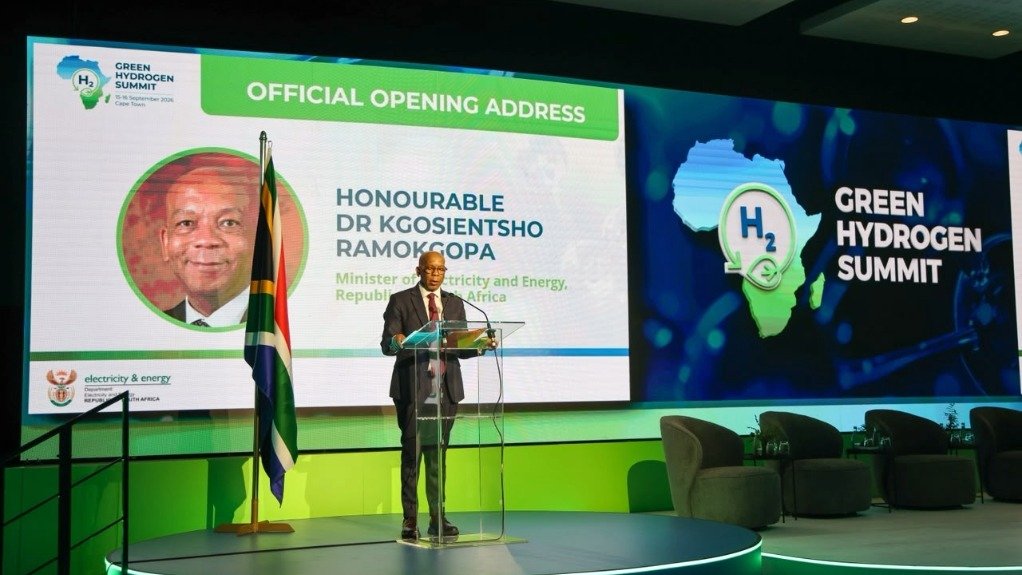
The first six priority projects have emerged from government’s national green hydrogen programme pipeline.
The projects all form part of the newly launched National Green Hydrogen Deal Book, which presents the wider pipeline of credible opportunities in South Africa’s green hydrogen sector to investors, development partners and potential customers.
The six ‘first-wave’ projects were announced on Tuesday by Minister of Electricity and Energy Dr Kgosientsho Ramokgopa at the 2026 African Green Hydrogen Summit, held in Cape Town.
President Cyril Ramaphosa was set to make the announcement, but was unwell following his trip to attend the BRICS summit in India on the weekend.
“The first wave consists of six projects that emerged from a rigorous assessment process,” said Ramokgopa.
“The process has standardised how we assess bankability and strengthen investor confidence.”
The first project is Phelan Green’s electro-sustainable aviation fuel (e-SAF) project in Saldanha Bay.
The family business has committed $100-million in equity, while also managing to snag an offtake market.
“Construction is expected to begin in the first quarter of 2027 and we expect to see the export of the first e-SAF in the first quarter of 2029,” noted Ramakgopa.
“This is an important milestone. As the World Economic Forum noted earlier this year: ‘the real bottleneck in scaling clean hydrogen is demand, not technology’. Scaling, therefore, rests on securing long-term offtake agreements.
“As a managed priority portfolio, the first wave concentrates project preparation, investment mobilisation and government coordination on credible projects with defined milestones.”
The remaining projects in the first wave reflected the depth of the value-chain, said Ramokgopa.
Hive Energy’s Coega green ammonia project in the Eastern Cape has completed early preparatory work. However, further commercial, technical and financing work is needed to reach a final investment decision (FID).
The Saldanha hydrogen direct reduced iron project on the West Coast, is at prefeasibility study (PFS) stage and will link green hydrogen to lower-emission iron and steel production.
The Prieska Power Reserve project in the Northern Cape is a green ammonia project for the domestic market, currently at development stage.
The Green e-Fuels Producers Green Methanol Corridor in Gauteng targets European demand and is at PFS stage.
Finally, the Green Hydrogen Solutions project in the Eastern Cape is a smaller-scale project directed principally towards South African demand. It has completed front-end engineering design.
“By designating these projects as priorities, government and its partners now have a mechanism to help the remaining five projects reach FID, construction and production,” said Ramokgopa.
In his own address to delegates at the 2026 Green Hydrogen Summit, Ramokgopa said there was also a ‘second wave’ of projects that had been assessed and matured for possible inclusion in the priority portfolio.
“A project’s inclusion in a Deal Book is not the same as reaching FID.
“Priority status is not the same as construction. A memorandum of understanding is not a bankable customer agreement. An expression of investment interest is not committed capital.
“The credibility of the programme depends on government, developers and partners reporting each milestone for what it is.”
Priority status must also carry obligations, as projects receiving focused institutional support would be expected to meet defined development milestones, warned Ramokgopa.
“Where milestones are repeatedly missed without a credible recovery plan, government and its partners must be prepared to redirect scarce project-preparation resources towards projects with a stronger route to implementation.”
South Africa possessed substantial advantages in the field of green hydrogen production, added Ramokgopa.
“We have high-quality renewable resources, an established industrial base, platinum group metals, ports and logistics, scientific capability, financial institutions and experience in managing complex energy and industrial systems.
“Those advantages will not convert themselves into investment. They must be organised through credible projects, coordinated infrastructure, capable institutions, competitive products and customers.
“The account we place before the summit is, therefore, not that the work is complete. It is that the delivery platform is becoming more coherent. We have introduced a common project-development standard,” explained Ramokgopa.
“We are managing the pipeline more deliberately. We are testing practical domestic applications. We are mobilising preparation finance, investment, technology and markets. We are establishing the basis for a stronger second wave.
“None of these measures, on its own, constitutes a gigawatt. Together, they create the conditions under which credible projects can reach FID, enter construction and produce at scale.”
In a panel discussion following his address, Ramokgopa admitted that project development would be able to move “much faster” were government able to better “coordinate its efforts”.
EMAIL THIS ARTICLE SAVE THIS ARTICLE ARTICLE ENQUIRY FEEDBACK
To subscribe email subscriptions@creamermedia.co.za or click here
To advertise email advertising@creamermedia.co.za or click here


