





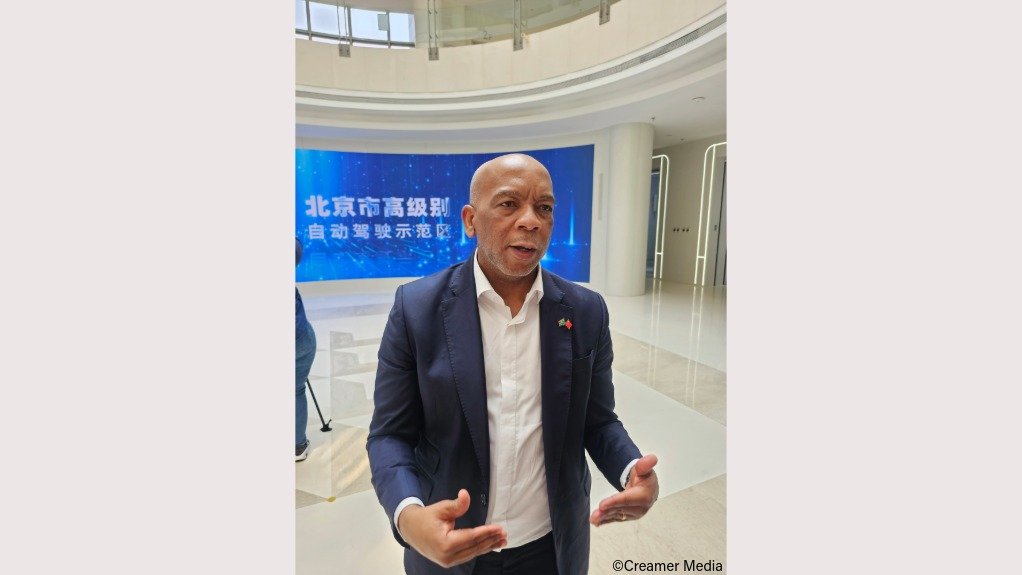
South Africa’s Electricity and Energy Minister Dr Kgosientsho Ramokgopa has welcomed tangible results emerging from the high-level investment mission that he led in Beijing, China, last week, to unlock investment in South Africa’s energy sector.
The Minister and a delegation of representatives from both the public and private sectors, undertook an investment conference, bilateral meetings and strategic site visits with Chinese stakeholders to shore up and advocate for strategic partnerships and investments for the country’s energy future.
This was a pivotal moment of seeking to balance accessibility, affordability and access, while pursuing a diversified mix of energy sources as underpinned by South Africa’s Integrated Resources Plan (IRP) 2025.
Speaking to Engineering News in China, Ramokgopa explained that further to two signing milestones achieved during the visit, three Chinese original-equipment manufacturers (OEMs) had confirmed they would be building transformer, wire and pylon manufacturing facilities in South Africa as part of the rollout of transmission infrastructure required to support new energy generation envisioned in the IRP.
Further details on these companies are expected to be unveiled when the delegation returns to South Africa, he noted.
Ramokgopa explained that prior to the mission, about six OEMs had already expressed interest in investing in the country.
Following discussions during the visit to China, which provided clarity on issues of land availability, three companies have now committed, he informed.
“It’s one year in the making,” Ramokgopa averred, noting that government is working with the city of Ekurhuleni, in Gauteng, on the process, with a site identified for rezoning.
He expressed confidence that this would materialise and optimism that more companies would soon follow.
Ramokgopa explained that one of the challenges the Chinese OEMs face is overcapacity and having to seek new places to deploy this capacity.
He averred that the machines from these plants can be easily relocated to South Africa.
A suitable temporary site is being sought for this while the site is rezoned in Ekurhuleni, Ramokgopa said.
He emphasised that an important part of the mission was to relocate this capacity to South Africa and enable the country to industrialise off the back of it.
He pointed out that there is only one dominant player on the pylon side and very few companies producing the wires, and transmission expansion demand exceeding the capacity.
Therefore, he said the Chinese OEMs have identified an opportunity for this in the country and have expressed confidence that they will produce “cheaper and greater” quality, he said.
“It doesn’t displace local capacity, all it does, is adds,” Ramokgopa assured, noting that the Transmission Development Plan (TDP) pipeline outlines about 14 500 km of new lines, and the current building pace is lagging and needs to be bolstered considerably, with current capacity insufficient.
Ramokgopa also emphasised that local content requirements would be enforced.
The Minister averred that South Africa has a pipeline of ready skills that these factories can absorb, rather than these having to be brought in by the OEMs.
He also highlighted the competitive advantage of liquidity in South Africa; the availability of support packages from entities like the Industrial Development Corporation, the Development Bank of Southern Africa and commercial banks (who also participated in the mission); and the country’s rule of law.
“That’s why South Africa is a strong, attractive destination, and that’s why the Chinese are an important partner in that conversation,” Ramokgopa acclaimed.
“I’m confident that we are going in the right direction,” he acclaimed, also alluding to other discussions during that visit that have shown the financial viability of green hydrogen projects.
Moreover, a site visit to a data centre was held to understand the infrastructure requirements to co-locate these with energy generation assets, Ramokgopa noted.
CONCRETE SIGNINGS
As alluded to, two milestone signings took place during the mission. One of these was South African chemicals company Sasol signing an agreement with Chinese green technology and renewable energy company Envision for an engineering design for its E-methanol project at its Sasolburg operation, as reported by Engineering News. (https://www.engineeringnews.co.za/article/sasol-commissions-chinas-envision-to-design-sasolburg-e-methanol-project-2026-08-05).
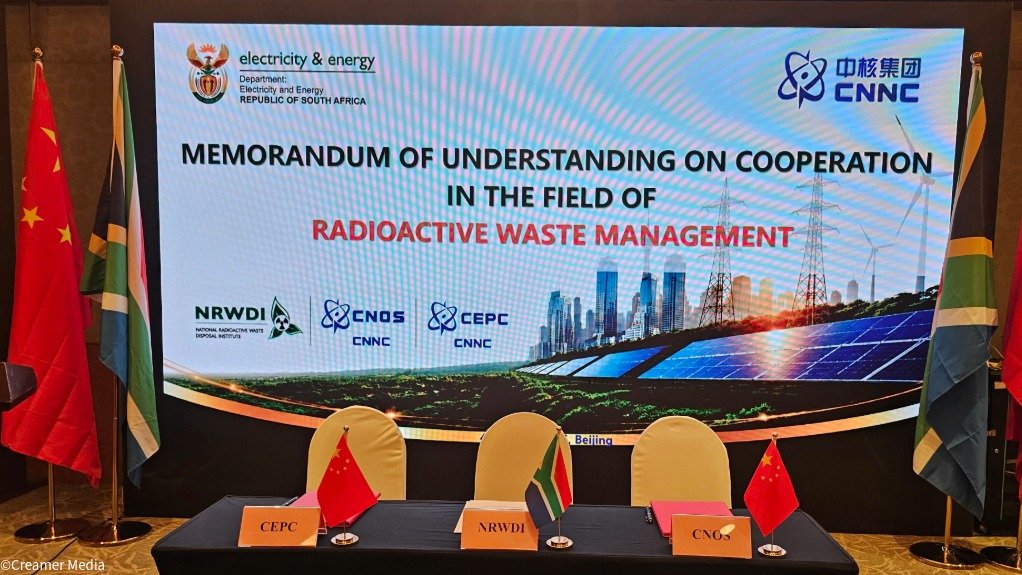
Another was the signing of a memorandum of understanding (MoU) on cooperation in the field of radioactive waste management.
Speaking to Engineering News, National Radioactive Waste Disposal Institute (NRWDI) CEO Riedewaan Bakardien informed that the MoU was between the NRWDI, and China National Nuclear Corporation and its two subsidiaries China National Nuclear Corporation Overseas and China Energy Conservation and Environmental Protection Group.
Bakardien explained that the MoU includes the sharing of information around the disposal of low-level radioactive waste, with support in operations and best practice.
While disposal of this nature is already being done in South Africa, the Chinese have additional facilities and different technologies that the country can leverage, he pointed out.
The MoU also accounts for the longer-term disposal of high-level waste, mainly spent nuclear fuel from State-owned power Eskom’s Koeberg power station and the South African Nuclear Energy Corporation’s Safari reactor.
For this, Bakardien informed that South Africa is pursuing a medium-term solution of a R2-billion central interim storage facility to store spent fuel, slated to be established by 2030.
This would act as a bridge to a longer-term solution of a deep geological repository, slated for establishment by 2065, which would be a larger and more costly undertaking, he said.
Despite long lead times, research and site identification work has already started.
Bakardien said that, with the MoU, knowledge sharing could start immediately, with the Chinese doing research and development on their underground deep geological repository facility.
Echoing Ramokgopa's sentiments, Bakardien pointed out that the process of this MoU started a while ago, with the signing milestone achieved during the visit.
Talks on this started about 18 months ago. While this preceded the IRP being approved, there was an understanding that the country is moving towards nuclear expansion, and the importance of undertaking this with the best capabilities and partners, Bakardien pointed out.
He stressed that nuclear waste is critical country’s broader nuclear programme, as, despite being smaller cost, needs dealt with properly to enable the other activities.
EMAIL THIS ARTICLE SAVE THIS ARTICLE ARTICLE ENQUIRY FEEDBACK
To subscribe email subscriptions@creamermedia.co.za or click here
To advertise email advertising@creamermedia.co.za or click here


