





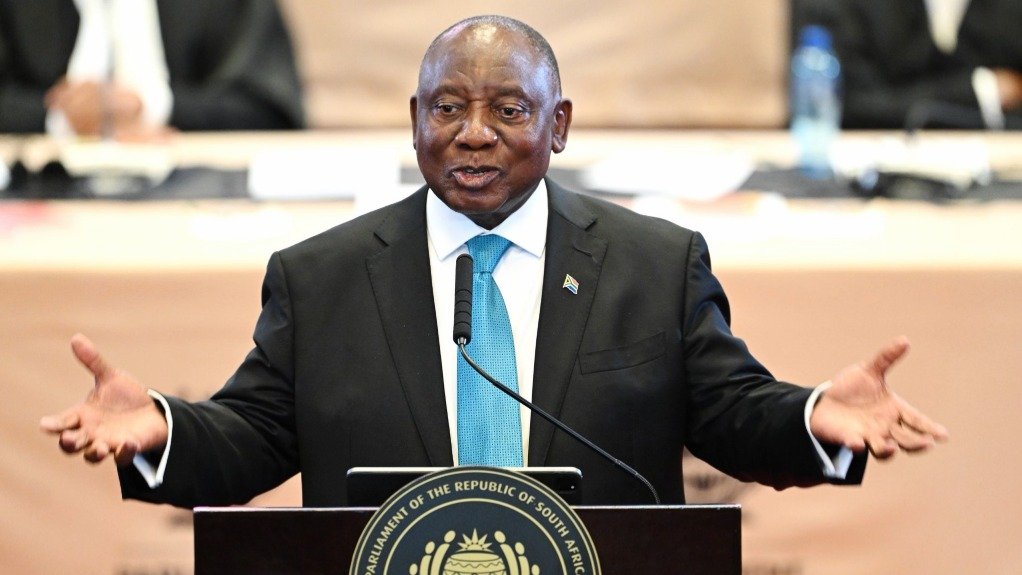
President Cyril Ramaphosa on Monday stated that the public and private health sectors cannot continue to operate in parallel, announcing that in preparation for the National Health Insurance (NHI), government is already making significant investments to strengthen public health infrastructure.
Writing his weekly letter to the nation, Ramaphosa noted the skills on display at the public Mankweng Hospital in Limpopo, and said government was committed to replicate the hospital's success.
He praised surgeons at Mankweng Hospital who successfully separated conjoined twins in a complex operation.
“We owe the medical teams that performed the operation, that helped deliver the twins and that are now caring for them our deepest admiration and gratitude,” he said.
Ramaphosa highlighted that this achievement was more than a medical milestone.
“It is proof of what our public health system is capable of. It is a reminder that South Africa possesses world-class medical expertise, not only in the private hospitals in our cities, but also in public facilities serving communities that have historically been neglected and underserved,” he noted.
He described this as an outcome of sustained national investment in cultivating medical excellence through subsidising the country’s medical schools, providing study bursaries for medical students, and providing on-the-job training through the Internship and Community Services Programme.
Ramaphosa said closing the gap between the constitutional promise of healthcare and the daily lived reality was what motivated the NHI.
The NHI was more than a funding mechanism, he said.
“It is a commitment, grounded in our constitutional values, that every South African will have access to quality health services without suffering financial hardship,” he added.
Ramaphosa said for the NHI to succeed, government needed “genuine and sustained partnerships” between the public and private health sectors, as well as academic institutions, medical professionals, pharmaceutical companies, non-governmental organisations and communities.
He noted that South Africa had a well-equipped and well-funded private healthcare sector.
“Yet only around 16% of South Africans have access to these facilities. By contrast, most of the population, some 84%, uses public health facilities. On average, the amount of money spent each year on a person who uses private healthcare is around five times what is spent on someone in the public sector,” he pointed out.
He said the private and public health systems must work together in service of one nation, noting that there were many role-players who were eager for collaboration.
“… they recognise that there is both a great need and much opportunity to build stronger partnerships in healthcare,” Ramaphosa said.
He acknowledged that more should be done to share skills and knowledge across the public-private divide, as when private specialists contributed time to public hospitals.
This meant investing in the training and retention of healthcare workers so that public facilities did not continue to lose their best people to private employers or to opportunities abroad, he stressed.
He announced that in preparation for the NHI, government was building and refurbishing clinics and hospitals, expanding community health worker programmes, working to ensure the availability of essential medicines, introducing digital systems, and improving the management of facilities.
EMAIL THIS ARTICLE SAVE THIS ARTICLE ARTICLE ENQUIRY FEEDBACK
To subscribe email subscriptions@creamermedia.co.za or click here
To advertise email advertising@creamermedia.co.za or click here


