





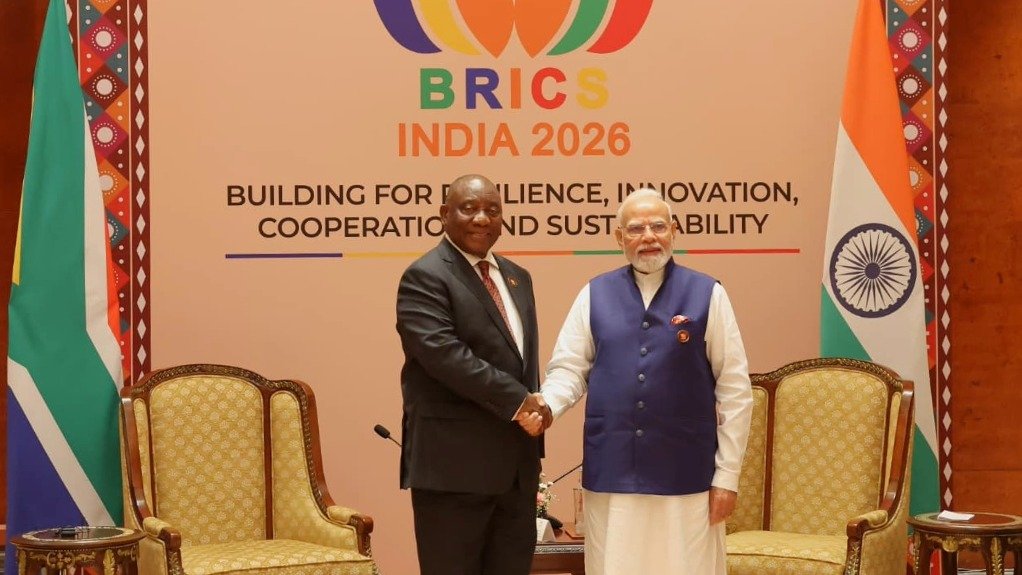
President Cyril Ramaphosa has reaffirmed South Africa's commitment to leveraging its BRICS membership to drive domestic economic growth, expand trade and solidify bilateral ties with India.
Following the conclusion of the eighteenth BRICS Summit, held over the weekend in New Delhi, in India, Ramaphosa detailed how South Africa is capitalising on its strategic partnerships to boost investment and modernise key domestic industries.
India currently stands as South Africa’s fourth-largest trading partner. The economic footprint between the two nations is already substantial, with more than 150 Indian companies investing over $10-billion in South Africa, a move that has generated more than 18 000 local jobs.
Prominent South African enterprises, including Naspers, FirstRand Bank, Sanlam, and Momentum, maintain a significant investment presence in India.
To build on this foundation, the summit hosted the South Africa-India CEOs Roundtable, bringing together captains of industry from both nations.
Ramaphosa also engaged in targeted bilateral discussions with individual Indian firms looking to either expand their footprint in South Africa or venture into new local markets.
According to the President, Indian business leaders highly commended South Africa’s ongoing structural reforms, particularly those targeting the energy, logistics, telecommunications, water, and visa sectors, as well as advancements in public digital infrastructure.
Ramaphosa emphasised that the two nations possess “highly complementary capabilities” that can unlock massive value when combined, noting that India's globally recognised strengths in pharmaceuticals, health technology, IT, and fintech are positioned to support South Africa's ambitions to localise vaccine and medicine production while modernising its public service systems.
He said South Africa’s reserves of critical minerals are primed to feed India’s rapidly expanding renewable energy, electric vehicle, and battery value chains. Ramaphosa stressed that a key priority remains ensuring the processing and beneficiation of these minerals happen on South African soil.
He explained that to translate this immense potential into reality, both nations have committed to working toward restoring direct commercial flights between South Africa and India, alongside fostering closer collaboration between their respective business chambers.
Addressing scepticism regarding the domestic relevance of international summits, Ramaphosa countered that BRICS membership yields direct, tangible rewards for South Africa's economy.
More than one-fifth of South Africa’s total global trade is conducted with fellow BRICS nations.
Furthermore, as a shareholder in the New Development Bank, South Africa directly accesses crucial development finance to fund major domestic infrastructure projects in energy, water, and transportation.
Participation in the BRICS Contingent Reserve Arrangement also secures South Africa access to a $100-billion liquidity pool in the event of a currency crisis.
Beyond the economic balance sheet, Ramaphosa underscored the geopolitical weight of the bloc, noting that BRICS provides a platform for cultivating a fairer, more inclusive multilateral world order that operates under international law with the United Nations at its centre.
Through institutional cooperation in science, research, and education, alongside grassroots platforms like the BRICS Youth Council and the BRICS Network University, the bloc continues to drive sustainable development.
"Through BRICS, we will continue to add our voice to the growing call from the Global South for an inclusive world order rooted in mutual respect and shared prosperity," Ramaphosa said. "And we will continue to use our membership of BRICS to develop our economy and improve the lives of our people."
EMAIL THIS ARTICLE SAVE THIS ARTICLE ARTICLE ENQUIRY FEEDBACK
To subscribe email subscriptions@creamermedia.co.za or click here
To advertise email advertising@creamermedia.co.za or click here


