





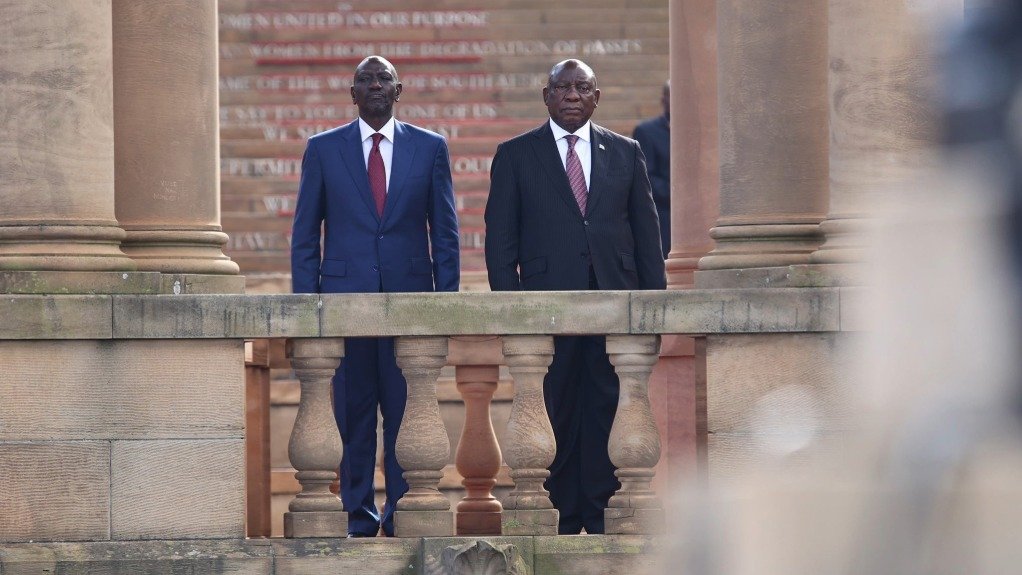
South Africa and Kenya are accelerating bilateral cooperation across emerging sectors, including green energy, AI, and digital trade to boost economic resilience and accelerate African integration.
This strategic partnership leverages the African Continental Free Trade Area (AfCFTA) to transform intra-African commerce and establish a unified continental voice on the global stage.
The partnership between two of Africa’s leading economies is moving beyond traditional agreements into future-focused industries, said President Cyril Ramaphosa.
During a State Visit by Kenyan President William Ruto to Pretoria, Ramaphosa emphasised the expansion of collaboration in green energy and e-mobility; climate-smart industrialisation; digital trade, AI, maritime cooperation and skills development.
Both countries are finalising strategic memoranda of understanding (MoUs) across tourism, ICT, agriculture, and transport. Furthermore, a proposed South African-Kenya Joint Business Council aims to empower the private sector to directly shape regional trade and investment.
Trade between the two countries continues to grow, bolstered by a 2022 agreement that granted visa-free access for up to 90 days.
The reduction of these cross-border barriers had led to a significant increase in business travel, tourism, and cultural exchanges, Ramaphosa noted.
Notably, South Africa and Kenya achieved a major milestone by launching the first consignments traded under the AfCFTA Guided Trade Initiative.
Ramaphosa said this success was being actively supported by growing logistical and commercial cooperation between Kenya Airways and South African Airways.
The partnership between South Africa and Kenya served as a blueprint for continental unity, while focusing on equitable access to climate finance, securing a just energy transition, and driving digital transformation, with the alliance placing people at the centre of its agenda, Ramaphosa noted.
GLOBAL AND REGIONAL GEOPOLITICS
This State Visit takes place against a turbulent geopolitical backdrop, marked by conflicts in the Middle East, Ukraine and various African regions. These global crises have triggered rising fuel prices, inflation and constrained economic growth across the continent.
In response, Ramaphosa and Ruto reaffirmed their commitment to multilateralism, dialogue, and diplomacy over confrontation.
Both countries continue to advocate for a rules-based international order, while championing African-led processes to resolve disputes.
South Africa and Kenya are also demanding the reform of global institutions, such as the United Nations Security Council and international financial bodies.
The leaders maintained that these institutions must be restructured to reflect modern realities and grant Africa its “rightful voice” in global governance.
EMAIL THIS ARTICLE SAVE THIS ARTICLE ARTICLE ENQUIRY FEEDBACK
To subscribe email subscriptions@creamermedia.co.za or click here
To advertise email advertising@creamermedia.co.za or click here


