





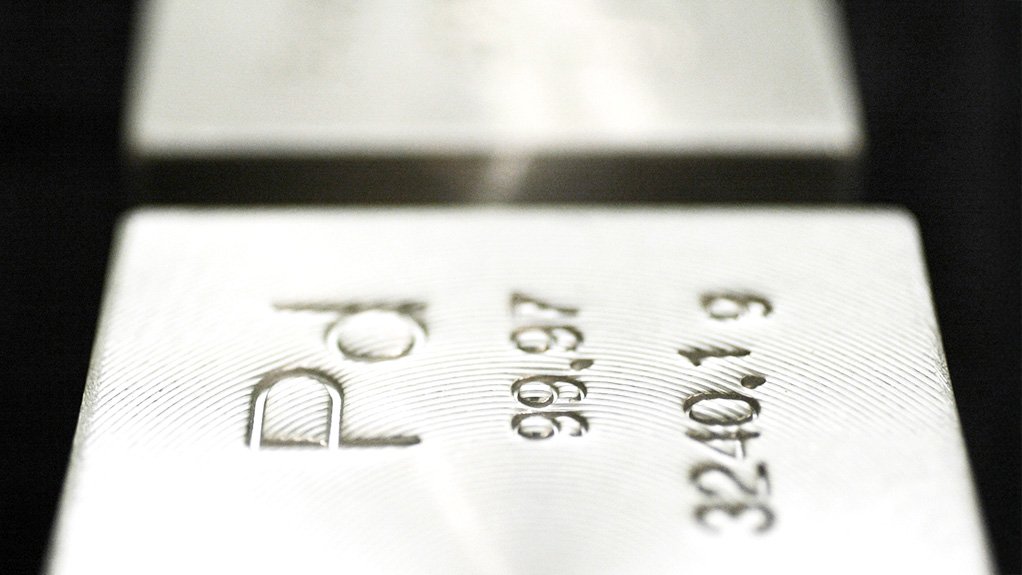

JOHANNESBURG (miningweekly.com) – The UK’s review of its zero-emission vehicle mandate could provide some support to automotive palladium demand if manufacturers are given greater flexibility over the pace of battery electric vehicle (BEV) adoption, Heraeus states in its latest precious metals review.
In a policy review that could see the UK follow the EU in easing requirements, the UK has embarked on consultation regarding the appropriateness of its current annual zero-emission targets remaining in place as BEV sales fall short.
Hybrid vehicles are likely to be among the main beneficiaries. Their 37.7% share of UK registrations in the first six months to June 30, with plug-in hybrids adding a further 13%, is already significant.
This mirrors the European market, where hybrid electric vehicles were also the most popular powertrain in the same period, with a 37.3% share of EU registrations.
Greater regulatory flexibility could therefore prolong demand for palladium-containing autocatalysts as consumers transition through hybrid vehicles rather than directly from internal combustion engine vehicles to BEVs. However, this would slow the erosion of automotive palladium demand rather than reverse its longer-term decline as the market moves towards zero-emission vehicles, Heraeus points out in a release to Mining Weekly.
Autocatalysts, also known as catalytic converters, are vehicle exhaust devices that use platinum group metals (PGMs) to transform harmful engine gases into harmless atmospheric elements.
In the first half of this year, BEVs accounted for 25% of UK new car registrations, 8% below the headline 33% mandate target for 2026, although manufacturers have several compliance flexibilities available.
Remaining unchanged are the UK commitments to phasing out new conventional petrol and diesel cars by 2030 and requiring all new cars and vans to be emission-free by 2035.
Under the current mandate, 33% of manufacturers’ new car registrations must be zero-emission in 2026, rising to 80% by 2030, with petrol, diesel, hybrid and plug-in hybrid vehicles counting as non-zero-emission vehicles.
Palladium’s recent price rally has stalled after failing to hold above resistance. The price climbed from around $1 150/oz in late June to almost $1 400/oz in early August, but has since fallen back and is currently testing resistance around $1 335/oz. Palladium’s 100-day moving average at about $1 350/oz.
PLATINUM BREAKS RESISTANCE
Platinum, Heraeus points out, broke resistance around the $1 800/oz price mark after extending its recovery from July lows. The price has risen from around $1 550/oz in early July and briefly moved above $1 900/oz last week for the first time since June, but has so far struggled to hold above this level. The 200-day moving average, currently at around $1 920/oz, could add resistance to a further move higher. A sustained move through this area would strengthen the recovery.
RHODIUM, RUTHENIUM, IRIDIUM
The prices of rhodium, ruthenium and iridium PGMs have remained flat, with rhodium at $9 200/oz, ruthenium at $1 745/oz and iridium at $8 300/oz.
Proton exchange membrane (PEM) electrolysers use iridium and platinum catalysts, while ruthenium could also benefit if emerging lower-iridium, ruthenium-based anode technologies achieve commercial adoption.
GOLD
Gold prices rallied to their highest level since early June last week after breaking above recent resistance. Gold prices topped $4 600/oz on August 21 as prices once again moved higher after a couple of weeks of consolidation.
This mirrors the early-August rally where gold prices rose around 7%, after having spent the whole of July in a tight range near their yearly lows around $4 000/oz.
The Bank of Korea has made its first gold investment in 13 years, purchasing gold shares worth around $250-million and providing gold metal equivalent exposure to roughly 62 000 oz, or 1.9 t, of gold.
The physical gold reserves of the Bank of Korea have remained unchanged at around 104.4 t since 2013.
Heraeus explains that although the move does not increase the Bank of Korea’s physical holdings, it indicates a renewed interest in gold exposure.
Separately, the central bank has announced that it will establish a framework to purchase domestically refined gold, which could eventually allow the metal’s share of reserves to increase. This would follow a trend seen globally where the proportion of central bank reserves held in gold is rising compared with those held in Treasuries.
On August 19, the US Treasury announced that it would at least double the maximum size of its buybacks of longer-dated Treasury securities from ten years to 30 years, which follows US borrowing costs rising to their highest levels in around 20 years. The buybacks will increase from $2-billion to at least $4-billion per operation between September 9 and November 4. On the current schedule, there are seven auctions for which the higher maximum will be in effect, which gives at least $14-billion in extra purchase capacity.
EMAIL THIS ARTICLE SAVE THIS ARTICLE ARTICLE ENQUIRY FEEDBACK
To subscribe email subscriptions@creamermedia.co.za or click here
To advertise email advertising@creamermedia.co.za or click here


