





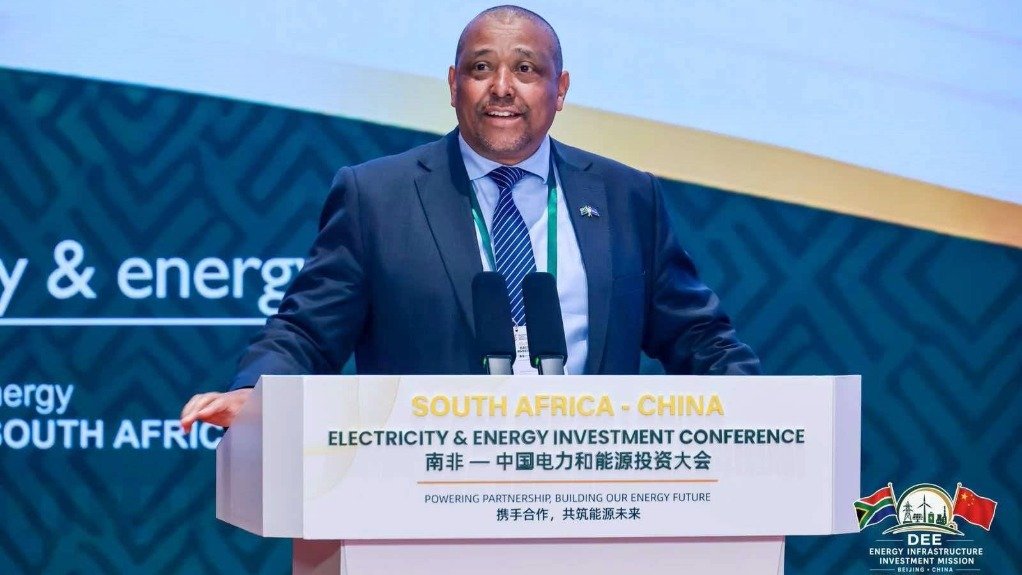
South Africa's electricity sector is facing an "interesting challenge", with the grid not designed for dispatched generation of intermittent energy sources, National Transmission Company of South Africa (NTCSA) CEO Monde Bala told delegates at the South Africa-China Electricity & Energy Investment Conference, being held in Beijing, China, this week.
To accommodate the changes in the energy mix and the change in geographical location of those energy sources, the NTCSA, a subsidiary of State-owned power utility Eskom, is undertaking the Transmission Development Plan (TDP). However, it does not have the requisite capacity to undertake the necessary expansion of the grid on its own and is calling on international partners to assist.
The high-level investment mission led by South Africa’s Electricity and Energy Minister Dr Kgosientsho Ramokgopa aims at unlocking strategic partnerships and investment for the country’s energy future.
Bala acknowledged that the TDP’s aspirations were “ambitious”, but that this was what was required. While the entity was currently “struggling” to meet the required pace, “with a lot of effort and intervention” it would be able to deliver, he assured South Africans during an interview on the sidelines of the event.
Bala pointed out that, with the TDP in its second year of implementation, with several lines having started, the pace was still a little slow as delivery mechanisms were shored up.
Bala stressed that “any tardiness” on the rollout of the TDP would impact on the rollout of the Integrated Resource Plan (IRP) 2025 and that the NTCSA was cognisant of what was at stake.
He assured that measures were in place to hold the entity accountable.
Bala explained that the IRP sets out a target of about 105 GW of new generation capacity by 2039 and that this generation required transformation of the national transmission grid to ensure the generation reached customers and supported industrial growth.
Bala highlighted that priority transmission expansion projects represented a R134-billion in investment opportunity, within a broader R440-billion decade-long programme.
This TDP programme entails the construction of about 14 500 km of new transmission lines by 2034 and the installation of about 133 000 MVA of transformer capacity.
The R134-billion figure represents prioritised NTCSA transmission expansion projects across the country and is a concrete near-term package within the broader TDP.
The TDP outlines a sequenced, decade-long response aligned to IRP 'period one' which runs from this year to 2030, and 'period two' which runs beyond 2030.
The first five years focused on about 5 000 km of lines and substantial transformer capacity to unlock about 30 GW of new generation. With the capital budget secured for this period, the NTCSA had moved into execution, Bala averred.
He noted that delivery would combine NTCSA's own investment, engineering, procurement and construction (EPC) packages and independent transmission projects, engendering multiple entry points for private capital.
Bala pointed out that the NTCSA did not have the capacity to fully execute the new lines and needed to plug the gap, adding that the conference in Beijing was a “critical engagement” to help meet the R134-billion investment target.
He posited that Chinese capital, technology, delivery capability and long-term partnership were crucial to achieve the required pace and scale.
Bala highlighted a “strategic participation” opportunity for Chinese partners, that moved beyond mere equipment supply and spanned the entire value chain.
This includes equity and project investment, EPC and project delivery, equipment and technology supply with localisation, manufacturing and localisation, financing partnerships and long-term partnerships.
He noted that, with South Africa having invested very little in transmission infrastructure in the last decade and a half, this capacity needed to be rebuilt, and Chinese expertise would supplement what the country already had.
Moreover, he noted that they had expressed willingness to support the country’s localisation and industrialisation drive.
Meanwhile, the Chinese partners were looking to build on their sizeable internal markets, by extending into new ones, Bala explained.
“What is coming out is that South Africa is a gateway into the continent. When we engage with them, it is their hope that they will use South Africa as a springboard into the continent, and we are happy to facilitate and be part of that.”
He also acknowledged that the TDP’s aspirations were “ambitious”, but that this was what was required.
He stressed that “any tardiness” on the rollout of the TDP would impact on the rollout of the IRP, and that the NTCSA was cognisant of what was at stake.
Bala indicated that greater pipeline visibility, credit enhancement and regulatory clarity were being implemented to support bankable projects at scale.
He emphasised that strong relationships with Chinese and international partners were critical to achieve the required pace and scale of the TDP, and expressed the NTCSA’s willingness to engage with investors, developers, technology partners and financiers that were keen to help deliver transmission infrastructure in this vein.
He also stressed that, while bringing in international partners, South Africa must ensure that it does not lose sight of its industrialisation targets and localisation ambitions. He pointed out that completing the TDP rollout, but not meeting these goals, would be “a considerable lost opportunity”.
*Tasneem Bulbulia is attending the South Africa-China Electricity & Energy Investment Conference as a guest of South Africa's Department of Electricity and Energy.
EMAIL THIS ARTICLE SAVE THIS ARTICLE ARTICLE ENQUIRY FEEDBACK
To subscribe email subscriptions@creamermedia.co.za or click here
To advertise email advertising@creamermedia.co.za or click here


