





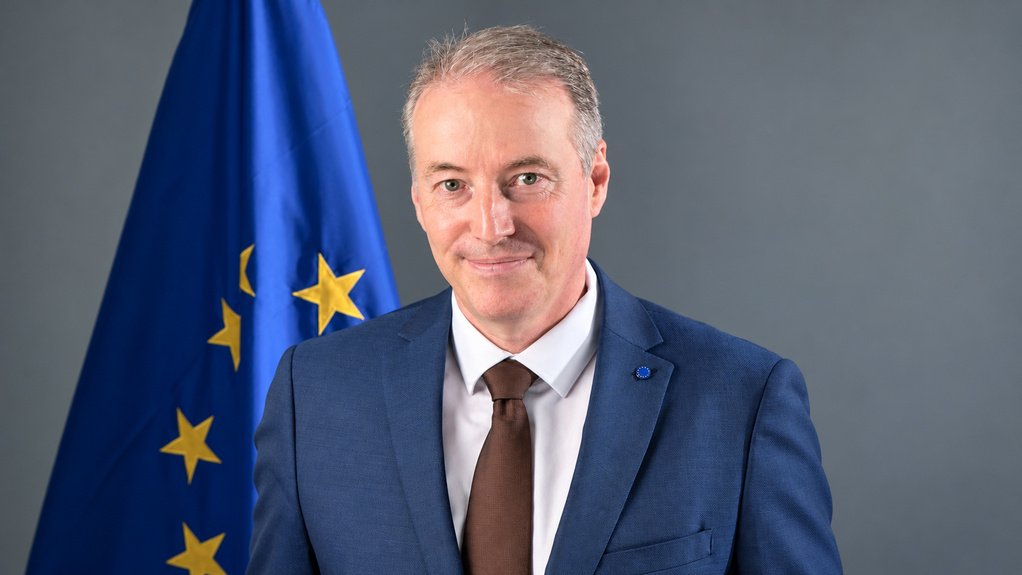
The EU’s new ambassador to South Africa, Kristian Schmidt, sees potential for South Africa to further integrate its industrial supply chains with Europe in a way that supports South Africa’s ambition to add value to its minerals ahead of export and the energy transitions under way in both territories.
Schmidt says that the 27-country bloc needs minerals for batteries and electrification that it largely lacks domestically and is actively seeking new sources of supply to reduce its dependency on China, which has imposed export restrictions on some raw materials.
South Africa is the only country in Africa with which the EU has a strategic partnership, and the ambassador believes the relationship could be leveraged to bolster domestic mineral processing on the back of dependable market demand from EU companies.
Similar models have for decades been successfully deployed in other sectors, such as the automotive industry, whereby European manufacturers have produced cars in South Africa for the domestic market and for export, including into the EU.
The Global Gateway initiative, the EU’s strategy for mobilising investment in infrastructure and industry in partner countries, could be used to facilitate technology transfer in support of minerals beneficiation and to help investors secure lower-cost capital.
The EU announced a nearly €12-billion package for South Africa under the initiative in 2025.
Schmidt also sees significant potential for the EU and South Africa to cooperate in other areas linked to the energy transition, including the production of sustainable aviation fuels in South Africa for use by European airlines and the production of cleaner bunkering fuels for the rising number of marine vessels now rounding the Cape to avoid routes prone to conflict or piracy.
The ambassador says an upscaled relationship with South Africa and other African countries on critical minerals and the broader energy transition is premised on cooperation rather than competition and will respect South Africa’s policy of non-alignment.
This includes the “reality” of South Africa’s membership of the Brics bloc and the country’s growing trade relations with China, which recently overtook Europe as South Africa’s largest trading partner.
However, the EU remains South Africa’s largest source of foreign direct investment, while South Africa’s trade with the EU is relatively diversified and includes manufactured products alongside mineral and agricultural exports.
According to the European Commission, two-way goods trade totalled €46-billion in 2025, with transport equipment accounting for €9.5-billion, or 21%, of the total. EU investment stock in South Africa stood at €40.4-billion in 2024.
Schmidt, who is Danish, also stresses that Europe’s partnership with South Africa extends to a broader agreement on principles and values, including the need for multilateralism and a rules-based international order.
He also insists the EU’s approach to South Africa will continue to be framed around dialogue and cooperation rather than coercion and is optimistic that the relationship will withstand any adverse short-term political developments in the EU or South Africa.
“We have long ago moved away from the donor-recipient relationship with South Africa . . . we are offering a partnership of mutual benefits, and that should survive, whether governments move left or right.”
EMAIL THIS ARTICLE SAVE THIS ARTICLE ARTICLE ENQUIRY FEEDBACK
To subscribe email subscriptions@creamermedia.co.za or click here
To advertise email advertising@creamermedia.co.za or click here


