





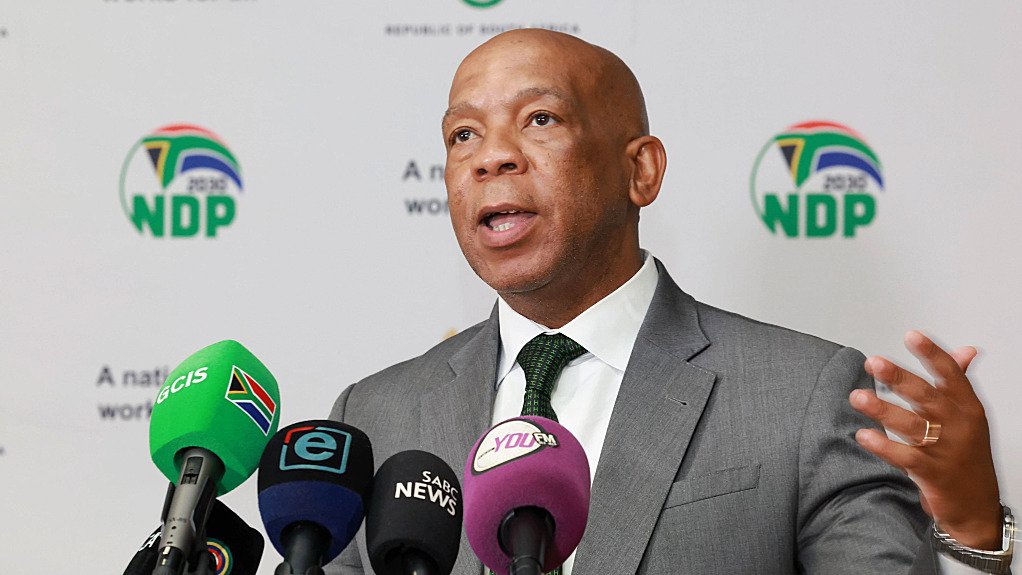
Electricity and Energy Minister Dr Kgosientsho Ramokgopa says 4 600 MW of battery energy storage systems (BESS) and 5 000 MW of gas-to-power (GtP) have been prioritised in a new Ministerial determination that opens the way for new public-procurement bidding rounds.
He has also confirmed that the procurement processes facilitated by the determination will be implemented by the Independent Power Producer Office (IPPO) and be open to all market participants, including Eskom.
The State-owned enterprise has hitherto been excluded from bidding in public procurement rounds, but has stated GtP ambitions and is in the process of incorporating Eskom Green as a subsidiary to partner with private entities on new renewables and BESS projects.
Eskom is currently in the process of prequalifying partners for a 6 GW Eskom Green pipeline that includes BESS projects with a capacity of 1 000 MW/4 000 MWh.
No energy storage figure was immediately provided for the 4 600 MW of BESS outlined in the determination, and no capacity factor for the GtP plants was immediately disclosed.
The Section 34 Determination, which is being published in line with the Electricity Regulation Act, also makes no provision for new wind or solar capacity, much of which is currently being procured by private companies on the basis of bilateral power purchase agreements.
However, the Minister said there would be a subsequent determination that would include new variable renewables capacity, as well as hybrid renewables-storage projects and pumped storage.
SYSTEM PRIORITIES
Ramokgopa indicated that the front-loading of BESS and GtP procurement had been informed by priorities outlined by the System Operator, which had identified a need for greater flexibility and for dispatchable plants.
It is also a response to a material increase in curtailment, which is implemented by the System Operator when available generation cannot be accommodated because of network constraints or operating conditions, including periods when supply exceeds demand.
Ramokgopa indicated that BESS was central to seeking ways to address curtailment and the associated rise in compensation payments by the National Transmission Company South Africa (NTCSA) to renewables independent power producers selected during previous public procurement rounds.
Batteries, he said, could charge from electricity that would otherwise be curtailed and discharge during evening peaks or other periods of need.
PROCUREMENT TEMPLATE
He added that South Africa already had a template for procuring BESS, pointing to the approach taken by the IPPO, which had to date conducted three bidding rounds for BESS based on substation sites selected by the NTCSA.
A total of 1 744 MW/6 976 MWh of BESS has been procured to date, and all five projects from the first bidding round, involving 513 MW/2 052 MWh and combined investments of more than R15-billion, have advanced to construction. The 4 600 MW outlined in the determination represents a significant scale-up, however.
South African Energy Storage Association (SAESA) chairperson Joanne Dean immediately welcomed the Minister's recognition of BESS within South Africa's future procurement programme.
She said that BESS could strengthen grid stability and resilience, defer costly transmission and distribution upgrades, facilitate higher penetrations of renewable generation and create opportunities for manufacturing, localisation and skills development.
“Storage is increasingly becoming the infrastructure that connects generation, transmission, distribution and demand into a modern electricity system,” she added, arguing that SAESA believed that energy storage should be recognised as a strategic sector in its own right, rather than as a supporting component of wind and solar projects.
Meanwhile, Ramokgopa said the 5 000 MW GtP allocation would complement storage by providing dispatchable electricity when renewable output fell or demand rose.
He indicated that the procurement design would address startup times, ramping capability and minimum operating levels, which was also the case during the first GtP bidding round, the evaluation process for which was yet to be concluded.
“Fuel availability, delivered gas prices, supporting port and pipeline infrastructure, grid connections and commissioning schedules will be assessed together,” he added.
Both the BESS and GtP procurement programmes would also be designed to support local manufacturing and construction, and incorporate measurable commitments aimed at broadening ownership of energy infrastructure by black South Africans.
EMAIL THIS ARTICLE SAVE THIS ARTICLE ARTICLE ENQUIRY FEEDBACK
To subscribe email subscriptions@creamermedia.co.za or click here
To advertise email advertising@creamermedia.co.za or click here


