





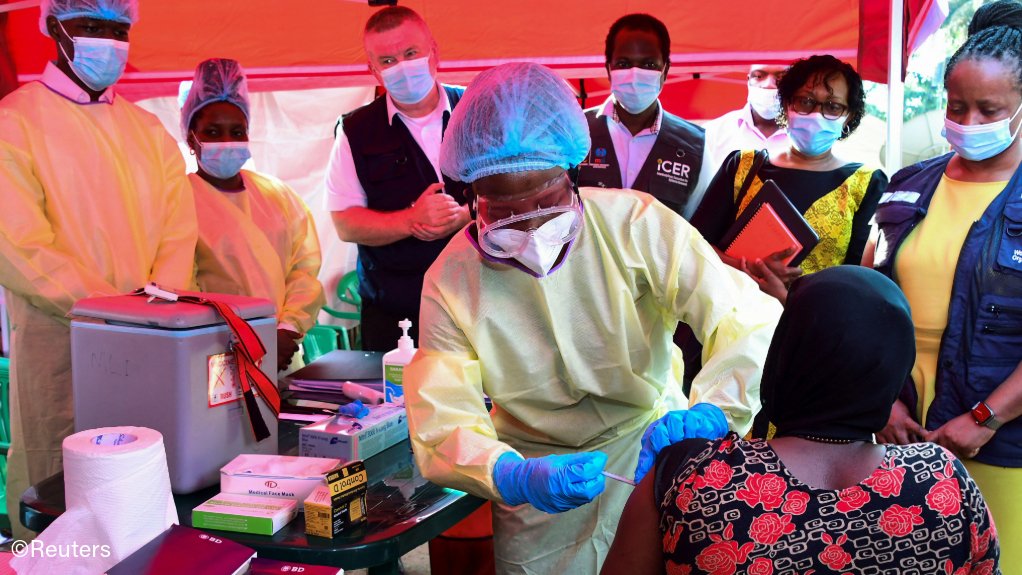
All 29 beds were full this week at the Kitatumba Ebola treatment centre in Congos North Kivu province, where surging cases have overwhelmed health facilities even as the deadly virus shows signs of easing elsewhere.
In one room, a critically ill patient lay on oxygen support, crying out as medical staff in masks, gloves and plastic aprons rushed past him at the centre in Butembo, a city of 2-million people.
"Over the past two weeks, we've seen a very sharp increase," said Stephanie Hoffmann, project coordinator for the international medical charity Medecins Sans Frontieres (MSF) in the city.
"There are sometimes patients who know they have Ebola but cannot find a bed."
City authorities announced the opening of two new treatment centres this week to deal with the demand, bringing the total to four.
But some patients arrive so unwell, there is nothing doctors can do, said Hoffmann, speaking at the Kitatumba centre.
She described the case of a 10-year-old boy who died in triage before doctors could admit him to the facility on Tuesday.
The scenes underscore the difficulty of containing Ebola across a stretch of eastern Congo that is bigger than France – one where medical resources are stretched thin.
Researchers believe the rare Bundibugyo species of the virus was spreading for months before the first cases were confirmed in Ituri, a province that neighbours North Kivu, in May. Aid cuts, surveillance system gaps and the absence of approved vaccines and treatments hampered the response, along with armed conflict in the region.
As of Tuesday, Congo had confirmed 7 820 cases and 3 779 deaths, according to government data.
While Ituri remains the worst-affected province, North Kivu's share of new infections increased sharply this month, the data shows. The province now accounts for around a third of newly confirmed cases and deaths, the World Health Organization (WHO) said in a report on Sunday.
Last week, South Ubangi became the seventh province affected, another sign of what WHO described as a "pronounced geographic redistribution of transmission."
United Nations and Congolese government officials said last week there were signs transmission is slowing in some of the worst-affected parts of Ituri, where responders have been racing to set up treatment facilities, identify victims, trace contacts and educate people on how to protect themselves. But it remains a "massive" outbreak, UN Special Ebola Coordinator Julien Harneis told reporters in Geneva.
Frontline workers say cases continue to emerge in new and underprepared areas.
"Assuming the outbreak is under control because some Ebola treatment centres are admitting fewer patients would be a mistake," Anthony Kergosien, MSF's emergency coordinator in Congo, said in a September 18 statement. "The outbreak is not shrinking; it is moving."
DEEP MISTRUST
Interviews with residents, health workers and local leaders suggest shortages of funding and skilled personnel, together with deep-seated mistrust of Ebola responders, are making the virus difficult to contain in North Kivu.
Just over 60% of people diagnosed there are dying, significantly higher than the national average of 48%, the data shows. Medical staff say there has not yet been enough education about the virus, and patients are avoiding health facilities. That complicates efforts to identify cases and start treatment before the disease reaches its most dangerous stages.
By the time Ebola patients reach Dr Michel Paluku Mukuloli's hospital in Butembo, it is often too late.
"Patients think that if they arrive at the hospital, they will be immediately sent to the treatment centre to die," he said.
In Butembo, one of the region's largest cities and a major trading hub, there are few signs that mitigation measures are being widely adopted. Overcrowded minibuses criss-cross the city. Markets remain packed.
Some residents refuse to have their temperature checked or wash their hands at entry points to the city and outside public buildings, according to the head doctor in the Butembo health zone, Pablo Paluku Lwanzo.
Only two of the zone's nine health checkpoints are operating due to staffing constraints, he added.
Other residents question whether Ebola is real. One local welder said his 12-year-old son, who suffered from respiratory problems, died the day he was transferred to an Ebola treatment centre. Because none of the relatives and neighbours who accompanied the boy became sick, he became convinced doctors had wrongly diagnosed the case.
"For me, Ebola does not exist," the man told Reuters on condition of anonymity.
Frightened and angry residents have attacked teams sent to decontaminate their homes and safely bury people suspected of having died of Ebola.
One person "came at me with a machete," said Lambert Maboko, a member of a burial team, as he recovered at home from the attack, which fractured his knee.
Ahead of each deployment, members of the team hold a prayer session for their safety.
Earlier this month, residents set fire to a health post they accused of collaborating with Ebola responders, sending patients fleeing into the community, staff said. Microscopes and solar panels were lost in the attack.
"I'm at a loss for words," Kakule Mahamba, head of the Hope health post, said as he surveyed the charred wreckage. "Even the hospital beds were burned, as well as the medicines."
Congolese authorities and WHO say they are working on building trust through awareness campaigns, household visits and engagement with religious and local leaders.
Speaking after meeting with the North Kivu governor and WHO representatives on Wednesday, Congo's incident manager for the Ebola outbreak, Steve Ahuka, said authorities had gained more access over the past four weeks.
"While pockets of resistance remain, we believe that with the involvement of traditional, religious and neighbourhood leaders … we can make progress."
Responding to Reuters questions, WHO said cases declined in North Kivu in recent days after several weeks of marked increases. But funding and staffing constraints remain significant challenges across affected areas.
"The pressure is particularly acute in North Kivu, which … has seen a significant increase in transmission with limited bed capacity for patient care," the statement said.
MEMORIES OF PAST OUTBREAKS
North Kivu was the epicentre of three previous Ebola outbreaks, including one in 2018-2020, which until this year was Congo's largest and deadliest. Those outbreaks, however, were caused by a different type of Ebola virus, known as the Zaire species.
Much less is known about the Bundibugyo species. But responders say in the early stages of infection, patients often experience milder symptoms easily mistaken for more common diseases such as malaria and typhoid fever.
Unlike the more common Zaire species, there are no approved vaccines or treatments. That is contributing to suspicions the outbreak might be a hoax, according to local authorities.
"People remember the 2018 outbreak and ask why vaccines and treatments existed then but not today," said Pepin Kavota, a civil society coordinator in the nearby city of Beni.
Cases of sexual abuse and exploitation on the part of responders during the 2018-2020 outbreak, including some employed by WHO, further eroded public trust, Kavota added.
In the statement to Reuters, WHO said it recognises that "trust must be continually earned," adding it has significantly strengthened efforts to prevent and respond to abuses since the previous outbreak.
Last month, provincial authorities recruited pro-government fighters known as Wazalendo to help protect responders and improve adherence to prevention measures. On some roads leading to Butembo, armed men now operate handwashing stations.
A leader of the force warned that people who repeatedly refused to comply with Ebola control measures could be forcibly taken to treatment centres and whipped.
Others worry such coercive tactics could worsen the very problem they are trying to address: mistrust.
"We should not need to use the police or the army in a response," Lwanzo said. "The population must be sensitised and willingly adopt the measures that are being put in place to protect them."
EMAIL THIS ARTICLE SAVE THIS ARTICLE FEEDBACK
To subscribe email subscriptions@creamermedia.co.za or click here
To advertise email advertising@creamermedia.co.za or click here


