





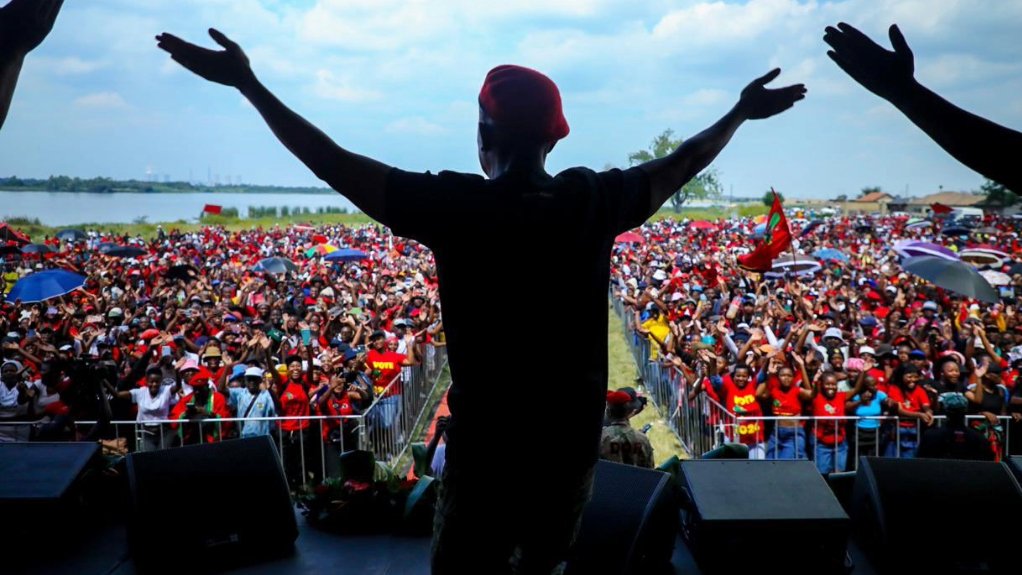
Mixed reactions have emerged following the sentencing of Economic Freedom Fighters (EFF) leader Julius Malema in his 2018 firearm case, with some opposition parties and civil society organisations stating that the ruling affirmed that no public official is above the law.
The East London Magistrate's Court on Thursday sentenced Malema to five years imprisonment for discharging a firearm in public.
Critics have emphasised the importance of holding politicians accountable for their words and actions, particularly regarding the unlawful discharge of firearms.
In September, Malema was found guilty on five charges under the Firearms Control Act, including discharging a firearm in a built-up or public area without sufficient reason, unlawful possession of a firearm and unlawful possession of ammunition.
Malema’s legal team will appeal the conviction and the sentence, with the EFF leadership labelling the case a “provocation” against their supporters.
Civil rights organisation AfriForum said Malema’s sentence was an important step in restoring public confidence in the criminal justice system.
The organisation said this confirmed that no one, regardless of their status or political affiliation, was above the law.
“The reckless discharge of a firearm in a busy public space posed a real and unacceptable risk to human life. It is good to see that this type of behaviour is not normalised or justified under any circumstances,” said AfriForum chief spokesperson for community safety Jacques Broodryk.
He stated that when the law was applied consistently and without fear or favouritism, public confidence in the justice system was strengthened.
“Malema’s actions have gone unpunished for too long. It was essential that the court send a clear message that no one is above the law. Although it took eight years for justice to prevail, today’s outcome shows that perseverance matters,” he added.
Democratic Alliance (DA) leader Geordin Hill-Lewis reiterated AfriForum’s sentiments that the sentence sent a clear message that nobody was above the law.
Hill-Lewis said gun violence was “out of control” in South Africa, so any crime involving illegal gunfire was extremely serious.
“It's important to punish illegal firearm crimes harshly. Only when people understand that there are consequences for crime, will we get gun violence under control in South Africa,” he said.
The think tank and advocacy group, Lex Libertas said this case reaffirmed its argument for decentralisation and self-governance so that organisations could play a major role in ensuring law and order.
“This outcome reaffirms that elected leaders are not immune from legal accountability,” said Lex Libertas executive director Dr Ernst Roets.
Civil Society South Africa (CSSA) pointed out that South Africa faces a serious and ongoing crisis of illegal firearms and violent crime, noting that individuals who possessed and used firearms unlawfully, particularly in ways that endangered others, must be prosecuted decisively and to the full extent of the law.
“The unlawful use of a firearm is not a minor technical offence. It is conduct that places lives at risk and contributes to a broader climate of lawlessness. Where individuals contravene the law with a firearm, there must be real consequences,” said CSSA spokesperson Reece Clark.
Clark explained that public leaders carried a heightened responsibility, noting that their conduct did not occur in isolation.
“… it is observed, repeated, and often normalised by those who follow them. In a country already grappling with high levels of violence, rhetoric that leans toward incitement, combined with the unlawful discharge of a firearm, sets a dangerous precedent. It risks reinforcing the idea that firearms can be used irresponsibly, without consequence,” he said.
The organisation stated that accountability must be “real and visible and it must apply equally”.
“This case reinforces a simple principle: the unlawful use of a firearm, regardless of who commits it, carries serious consequences,” it said.
CRITICS
The EFF viewed Malema’s conviction and sentencing as “political persecution”, aimed at silencing the party’s radical agenda ahead of the 2026 local government elections
The party reiterated its belief that this case had been pursued in a “highly politicised environment, with clear intentions to criminalise a revolutionary political voice that represents the aspirations of the oppressed and marginalised”.
The EFF further noted the imposition of a custodial sentence, which it viewed as “disproportionate and inconsistent” with the facts and context of the incident.
The party accused the National Prosecuting Authority (NPA) of displaying a "suspicious appetite for imprisonment".
“This is the same prosecuting authority that routinely fails to secure convictions in cases of violent crime, including murder, rape, and armed robbery, where victims suffer irreversible harm.
“Yet, in a case where no one was injured, the NPA mobilised its full capacity to ensure that president Malema is incarcerated,” the EFF said.
The party claimed that during sentencing proceedings, the defence, led by Advocate Tembeka Ngcukaitobi, advanced compelling arguments which exposed the “weakness and excesses” of the State's case.
The party pointed out that the State lacked thoroughness in handling evidence while pursuing the harshest possible sentence against Malema.
“The EFF is particularly concerned that these well-reasoned arguments were not sufficiently weighed in the outcome, reinforcing our long-held view that this prosecution has been driven not by a neutral application of the law, but by a desire to make an example of president Malema,” it explained.
The party claimed that Malema had long been the target of sustained campaigns by right-wing organisations such as AfriForum, whose litigation strategy it believed was aimed at silencing a "radical opponent of white supremacy and land dispossession".
“President Malema's sentencing must therefore be understood within this historical continuum: as part of a broader effort by white capital and its allies to discipline and silence those who refuse to abandon the struggle for land, dignity, and economic emancipation,” the party said.
Meanwhile, GOOD party secretary general Brett Herron has criticised Malema’s five-year prison term, describing it as “harsh.”
Herron pointed out that an equally vital principle is that the State must wield its power “fairly, consistently, and without fear or favour, saying justice must not concede to public pressure or to achieve political ends, whether the individual in the dock is Jacob Zuma, Helen Zille, or Malema”.
He characterised the State’s request for a 15-year imprisonment sentence against Malema as "performative rather than restorative", claiming the State knew such a lengthy term would never be legally upheld for Malema’s crime.
Herron said in a constitutional democracy, the law must be "a shield for the public and a stabiliser for society".
“It is important that the application of the law, without fear or favour, does not martyr a political figure,” he added.
EMAIL THIS ARTICLE SAVE THIS ARTICLE ARTICLE ENQUIRY FEEDBACK
To subscribe email subscriptions@creamermedia.co.za or click here
To advertise email advertising@creamermedia.co.za or click here


