





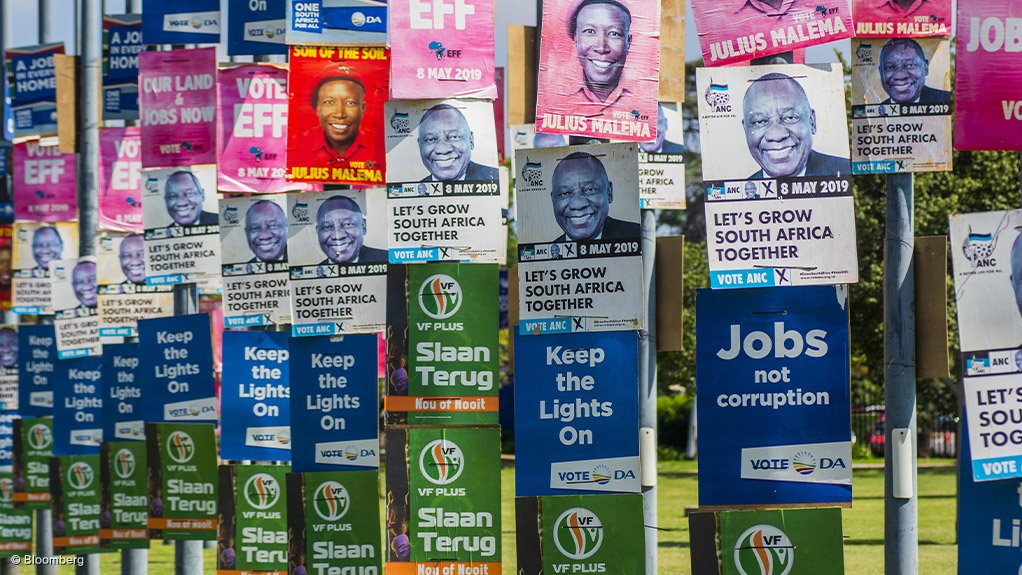
The Mapungubwe Institute for Strategic Reflection (Mistra) released the third edition of its Coalitions Barometer, on Wednesday, revealing a surprising decoupling between local political instability and municipal audit outcomes.
Despite a chaotic political landscape with routine Motions of No Confidence (MONCs) and shifting alliances since the 2021 local government elections (LGE), technical municipal structures have shown unexpected resilience, the institute said.
However, it warned that ahead of the upcoming LGEs, coalition politics is poised to become even more complex.
The central finding of its Coalitions Barometer report challenges the conventional narrative that political chaos directly degrades municipal administration.
Mistra noted that it was unable to find reliable evidence that coalition instability has a harmful effect on audit outcomes.
Data from the barometer indicated that municipalities experiencing high numbers of coalition collapses between 2021 and 2025 did not yield significantly worse audit results at the end of the period than those that remained stable.
“This could mean that local governments have done a better-than-expected job of insulating their technical capacity from instability at the political level. It could also mean that new variables or a different research design will be needed to understand how coalition instability affects the quality of governance – this is only a first look,” the institute said.
The report highlighted a stark divergence between local political and national dynamics following the watershed 2024 national elections.
Mistra noted that while South African politics was radically reshaped by the formation of the Government of National Unity (GNU), the ANC and the DA remained somewhat untouched by this spirit of cooperation.
Mistra pointed out that the ANC and the DA have continued to actively topple each other via MONCs, even if the frequency of these manoeuvres has slowed down recently.
Mistra said the EFF’s strategic reorientation toward the ANC stood as the most consequential local realignment since 2021.
“Yet, throughout this period, the EFF maintained its position in the opposition benches against the ANC within the National Assembly,” the institute said.
Mistra explained that while media coverage often portrays hung councils as inherently dysfunctional, the Coalitions Barometer dataset painted a more complex picture of governance survival.
Out of 70 administrations initially formed in hung councils, 23 administrations remained in office in their original format by the data cutoff point, while 22 administrations suffered complete collapses.
Mistra explained that the remainder adapted by rebuilding coalitions around the same anchor party.
A true collapse, defined as the largest governing party losing office entirely, occurred in only 46 out of the 80 municipalities tracked, proving less common than public perception suggests, it said.
Mistra’s findings highlighted how South Africa’s major political parties navigate their constrained choices to advance distinct strategic interests, noting that the ANC demonstrated flexibility by occasionally agreeing to serve under a smaller partner's mayor, even when it is the largest member of the coalition.
It also highlighted that the DA is unwilling to cede executive mayoral leadership to smaller partners within its coalition structures, while the IFP successfully leverages its geographically concentrated support base to join and directly lead local governments.
Mistra said the EFF uses its geographically dispersed support base to project power and exert external influence over coalitions it does not directly lead.
Meanwhile, looking ahead to the upcoming LGEs Mistra emphasised that the ultimate driver of coalition politics is the electorate, not politicians.
It said voters have spent several election cycles dividing their support among an expanding fragment of parties.
“If this fragmentation continues into the 2026 elections, hung councils will multiply, requiring even more complex negotiations to reach a governance threshold.”
To ensure functional local governance moving forward, Mistra pointed out that political parties must urgently develop stronger collective habits of inter-party cooperation and clear norms for crafting formal agreements and sticking to them, while practising total transparency with the public regarding the exact terms of these coalition agreements.
EMAIL THIS ARTICLE SAVE THIS ARTICLE ARTICLE ENQUIRY FEEDBACK
To subscribe email subscriptions@creamermedia.co.za or click here
To advertise email advertising@creamermedia.co.za or click here


