





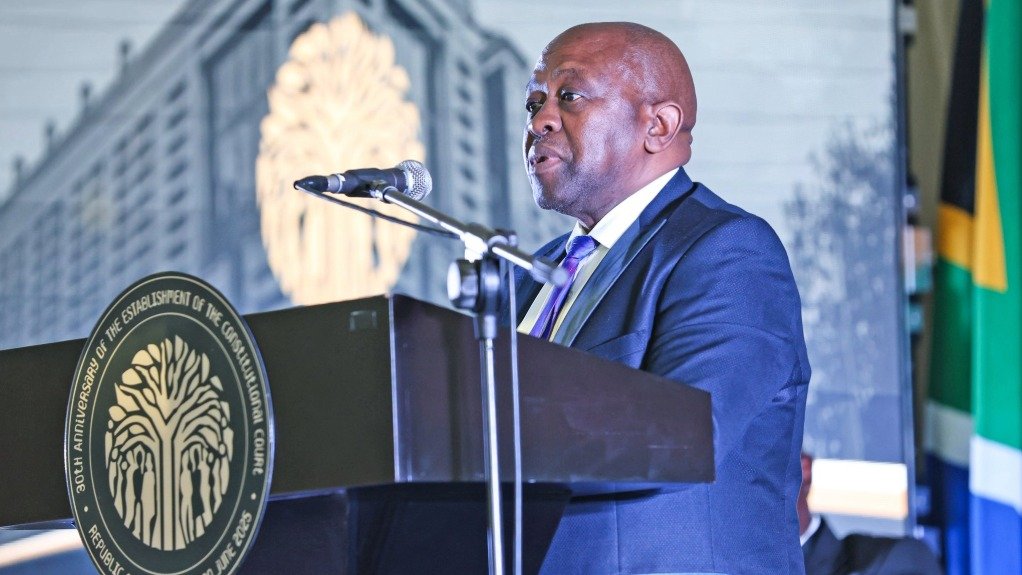
The Madlanga Commission marks its one-year milestone with “tangible results” having exposed deep institutional corruption, according to Commission spokesperson Jeremy Michaels, who said the commission was a shot in the arm for accountability in South Africa.
He noted that the inquiry is yielding real-world consequences while its work continues.
“Numerous individuals who have appeared before the Commission have been arrested, are facing criminal charges, have appeared in court, have been suspended or have resigned from their jobs,” Michaels confirmed, underscoring that the commission is successfully breaking the cycle of impunity.
The commission was established by President Cyril Ramaphosa on July 13, 2025 following explosive allegations of institutional rot in the police, made by Lieutenant General Nhlanhla Mkhwanazi.
To spearhead the crucial investigation, President Ramaphosa appointed Justice Mbuyiseli Madlanga, who was serving as the Acting Deputy Chief Justice at the time.
The commission’s expansive terms of reference mandate it to investigate whether sophisticated criminal syndicates, including powerful drug cartels, have infiltrated or exerted undue influence over South Africa's primary law enforcement and legal structures.
The scope of the probe spans a wide array of critical State institutions, including the South African Police Service (SAPS), Directorate for Priority Crime Investigation (DPCI / Hawks), National Prosecuting Authority (NPA), State Security Agency (SSA), and the Independent Police Investigative Directorate (IPID).
The commission also investigates the metropolitan police departments in Ekurhuleni (EMPD), Johannesburg (JMPD), and Tshwane (TMPD), the Department of Correctional Services (DCS) and the Judiciary itself.
Despite its successes, the one-year anniversary is also marked by solemn reflection.
The Commission called on all South Africans to pause and remember Marius van der Merwe, a whistleblower who testified before the inquiry as "Witness D."
On December 5, 2025, Van der Merwe was brutally assassinated in full view of his family in an apparent retaliation for his testimony.
The commission formally extended its gratitude to Van der Merwe and other individuals who have chosen to assist the inquiry by offering information and testifying, often doing so at immense risk to their personal safety and livelihoods.
Over the past 174 days of hearings leading up to September 16, the commission has maintained an exhaustive schedule, processing critical testimonies from a diverse cross-section of society.
In total, 110 witnesses have taken the stand, including: 36 SAPS officers; 25 DPCI / Hawks officers; 18 metropolitan and provincial traffic officials (eight EMPD staff, six TMPD staff, four JMPD officers, and two Gauteng Traffic Department officers); 12 accountability and oversight officials (seven IDAC and NPA officials, alongside five IPID officials); 11 private individuals; three political figures (two Members of Parliament and one Cabinet Minister); and three legal and systemic experts tasked with helping formulate institutional reforms.
The Commission has been party to three applications in the High Court.
An application brought by Suliman Carrim was dismissed. Two separate applications brought by Major General Feroz Khan and Sergeant Fannie Nkosi were withdrawn.
Michaels explained that one recusal application was brought against an evidence leader and was dismissed.
He noted that approximately 22 in-camera applications were considered, of which 19 were granted.
“One of these was revoked, with the result that the witness concerned testified openly. Eight hearings were conducted fully in camera, one of which was subsequently made available to the public through the publication of a redacted transcript. Eleven hearings were conducted partially in camera,” he explained.
EMAIL THIS ARTICLE SAVE THIS ARTICLE ARTICLE ENQUIRY FEEDBACK
To subscribe email subscriptions@creamermedia.co.za or click here
To advertise email advertising@creamermedia.co.za or click here


