





South Africa’s electricity grid has been more stable in recent months, but ageing local infrastructure and rising costs mean the country’s electricity problems now extend beyond issues with national generation.
Delays in restoring power after unplanned outages can disrupt water pumps in high-rise buildings, force households and businesses to spend more on generator fuel and lead to food spoilage, among other things.
Ahead of the local government elections on 4 November 2026, political parties are proposing various solutions, including upgrading infrastructure, reducing outages and expanding renewable energy.
In this factsheet, we look at the latest data on electricity, including where issues remain.
Who has access to mains electricity?
Statistics South Africa (Stats SA) collects data on the country’s access to electricity through its General Household Survey (GHS).
The latest survey covers 2025 and found that 90.6% of South African households were connected to mains electricity. This includes electricity supplied by municipalities or Eskom, the state-owned power utility.
This is up from 76.7% in 2002, when Stats SA began collecting this data.
Niël Roux, service delivery statistics manager at Stats SA, told Africa Check that the figure may also include a small number of households obtaining mains electricity through neighbours or landlords, including through unauthorised connections.
“We did not ask whether the source of the energy obtained from the neighbour or landlord was legitimate because respondents might not know and might not answer honestly,” he said.
Who doesn’t have access to mains electricity?
Data provided to Africa Check by Stats SA shows that 75.7% of households without mains electricity were in urban areas. Just over half - 51.6% - were in Gauteng.
Almost 95% of households without mains electricity were headed by black African people. A further 2.8% were headed by people who identified as coloured, 0.3% by Indian or Asian people and 2.3% by white people.
How does access differ across provinces?
The Western Cape had the highest proportion of households connected to mains electricity in 2025, at 96.5%, followed by the Northern Cape at 95.6%.

Gauteng had the lowest share, at 84.2%, down from 87.2% in 2002.
Roux previously told Africa Check that the decline in Gauteng was most likely linked to the rapid growth in the number of households in the province.
How has access to electricity changed since the early 1990s?
South Africa’s 1996 census, the first of the democratic era, found that 58.2% of households used electricity as their main source of lighting, while 47.4% used electricity for cooking and 46.5% for heating.
An earlier survey of 9 000 households, conducted at the end of 1993 by the Southern Africa Labour and Development Research Unit, found that 54% of households had mains electricity. The proportion of white households connected to the grid was almost 100%, compared with only 37% of households headed by black African people.
But statistics from the early 1990s should be compared cautiously with current data because the surveys used different samples, definitions and methods.
What about load shedding?
Load shedding, or rolling blackouts, was first introduced in 2007 as a demand-management measure to protect the national grid when electricity supply could not meet demand.
The frequency and severity of electricity interruptions have fallen substantially in recent years. According to the 2025 GHS, the proportion of households reporting interruptions fell from 92.1% in 2023 to 35.9% in 2024 and 31% in 2025.
But some households still experience frequent interruptions.

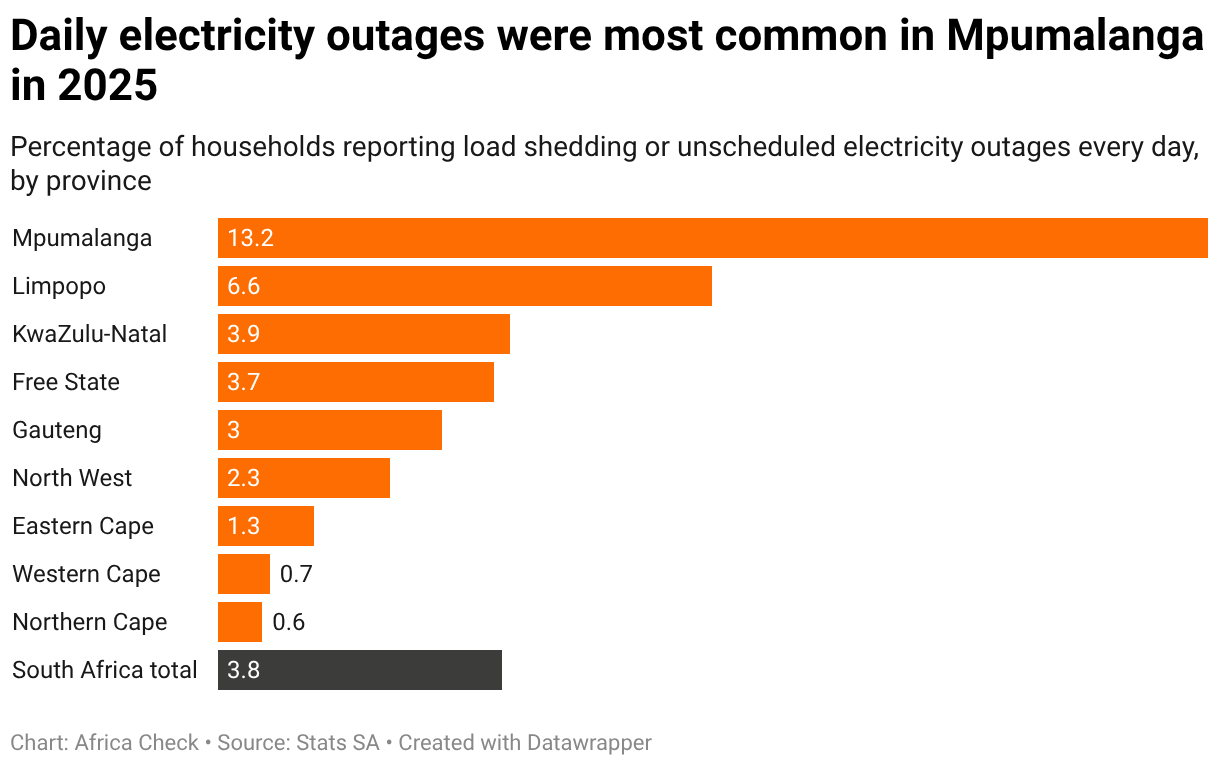
Almost 4% of households reported interruptions every day, while 18.7% experienced them for one or two days per week.
Daily interruptions were most common in Mpumalanga (13.2%), followed by Limpopo at 6.6%. They were least common in the Northern Cape, at 0.6%, and the Western Cape, at 0.7%.
Misinformation about electricity
With the local elections just weeks away, false or misleading claims about electricity may circulate online. Some frequent examples include:
- Claims that power utility companies like Eskom are offering rewards for reporting illegal connections
- Hyperrealistic deepfakes of political leaders or synthetic voice notes spreading false information about electricity
- Fake outage warnings that take the form of notices warning social media users about planned power outages
- Claims that prepaid electricity can be bought through unverified WhatsApp numbers or that Eskom is giving away free electricity units online
Such misinformation can confuse people about the state of the country’s electricity supply and lead to mistrust in authorities.
Scam messages may also be designed to steal personal information or directly ask for money.
How can you protect yourself?
- Check official sources: Updates about anything from power outages to job opportunities are posted on Eskom’s verified platforms or your municipality’s verified website. Don't trust random social media accounts.
- Be wary of forwarded messages: Misinformation such as false load-shedding or maintenance schedules travels fastest via family or neighbourhood group chats on encrypted platforms like WhatsApp. Always question a claim you receive before believing it.
- Report any false information: If you come across suspicious audio, video or articles, you can flag them directly with the Independent Electoral Commission.
- Send the claim to us: If you are unsure about a claim, send it to us on WhatsApp or follow our channel for weekly debunks.


