





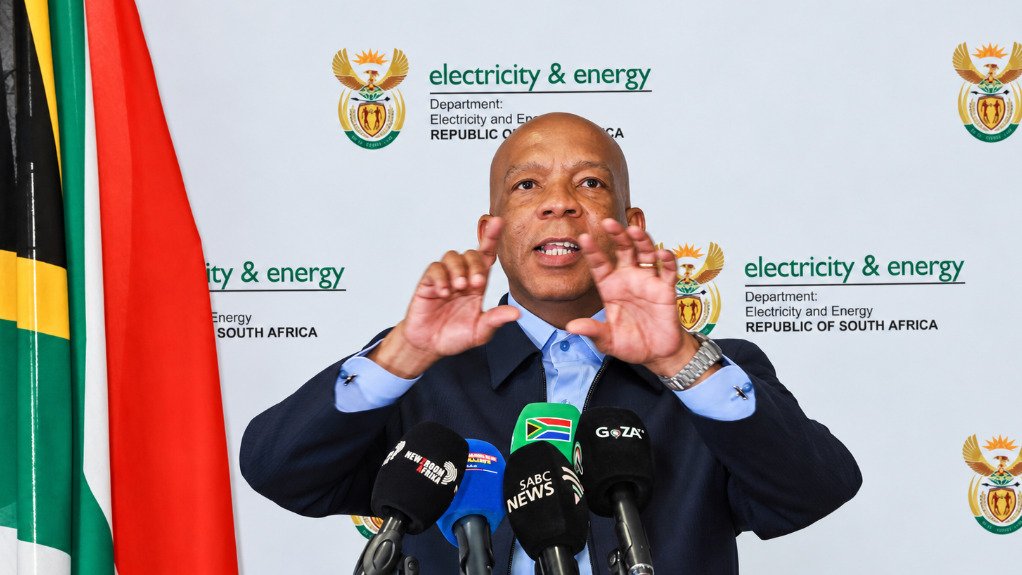
Electricity and Energy Minister Dr Kgosientsho Ramokgopa has confirmed that none of the four bidders that made submissions under South Africa’s inaugural gas-to-power bidding round has been appointed as a preferred bidder. This, after none of the bidders were able to provide the gas-supply assurances required by the tender.
Through the first bid window of the Gas Independent Power Producer Procurement Programme, or GASIPPPP, government was aiming to procure 2 000 MW of generation capacity in line with the country’s Integrated Resource Plan for electricity.
The Department of Electricity and Energy issued a revised request for proposals (RFP) on October 20, 2025, following consultations with potential bidders, and received four bids offering a total of 2 830 MW on May 29 this year.
The bidders were the Khanyazwe Flexpower (440 MW), in Mpumalanga, the Pictor GTP Consortium (990 MW), in KwaZulu-Natal, the Kelvin Redevelopment (600 MW), in Gauteng, and Komatipoort Power (800 MW), in Mpumalanga.
However, the department reported on October 28 that the bidders were unable to provide gas-supply assurances to the level required in the RFP, which meant that none of the bidders satisfied the mandatory functional criteria.
“Consequently, no preferred Bidders were appointed and no generation capacity was awarded for the GASIPPPP BW1,” the Minister said in a statement.
He added that South Africa would not retreat from it gas-to-power objectives, but that it was necessary to address the infrastructure, commercial and institutional conditions required to translate market interest into viable and deliverable projects.
Continued structured engagement involving relevant market participants would now be prioritised "to inform consideration of the programme's future direction".
"Any subsequent procurement process, including its requirements and timelines, will be subject to the necessary statutory, governance and procurement approvals.
"The Department will communicate further information through the appropriate official channels before the end of the calendar year," the statement reads.
The statement also makes reference to what it calls BW1.5, but sets no firm timeframe for its launch. Engineering News & Mining Weekly understands that the four unsuccessful bidders will not be precluded from participating in this new round should it be launched.
FlexED, which participated in BW1 through the Khanyazwe FlexPower project, acknowledged the department's commitment to strengthening the framework for a future procurement process, but warned against any prolonged delay to the resumption of a gas-to-power procurement process.
Besides the need for flexible dispatchable electricity capacity, FlexED stressed that the gas-to-power programme could be a catalyst for broader gas market development and for addressing the supply cliff that is poised to arise as production from the Pande and Temane gasfields in southern Mozambique begins to decline.
"The task before all stakeholders now is to build on the lessons of Bid Window 1 and ensure that momentum is not lost. South Africa cannot afford a prolonged pause in addressing the challenges of energy security, system flexibility and future gas supply," FlexED said in a statement.
Meanwhile, EE Business Intelligence MD Chris Yelland described the development as another setback in more than a decade of government efforts to procure gas-fired electricity generation, noting in a commentary article that the first attempt dated back to 2015. This had been followed by the aborted plan to introduce powerships that would have used gas to produce electricity.
Yelland concludes that the failure of the GASIPPPP bid window points to the need for an entirely new approach; one that involves a fundamental reassessment of the institutional coordination, infrastructure development, risk allocation and procurement model underlying South Africa’s gas-to-power strategy.
He adds that the economic case for gas-to-power also needs to be evaluated against alternative technologies, including battery energy storage, pumped storage, demand response and other sources of flexible electricity supply.
"Gas-fired generation may have a useful role in providing flexibility and system adequacy. However, the extent of this role, its cost and its emissions implications require transparent evaluation within South Africa’s evolving electricity market," Yelland adds.
EMAIL THIS ARTICLE SAVE THIS ARTICLE ARTICLE ENQUIRY FEEDBACK
To subscribe email subscriptions@creamermedia.co.za or click here
To advertise email advertising@creamermedia.co.za or click here


