





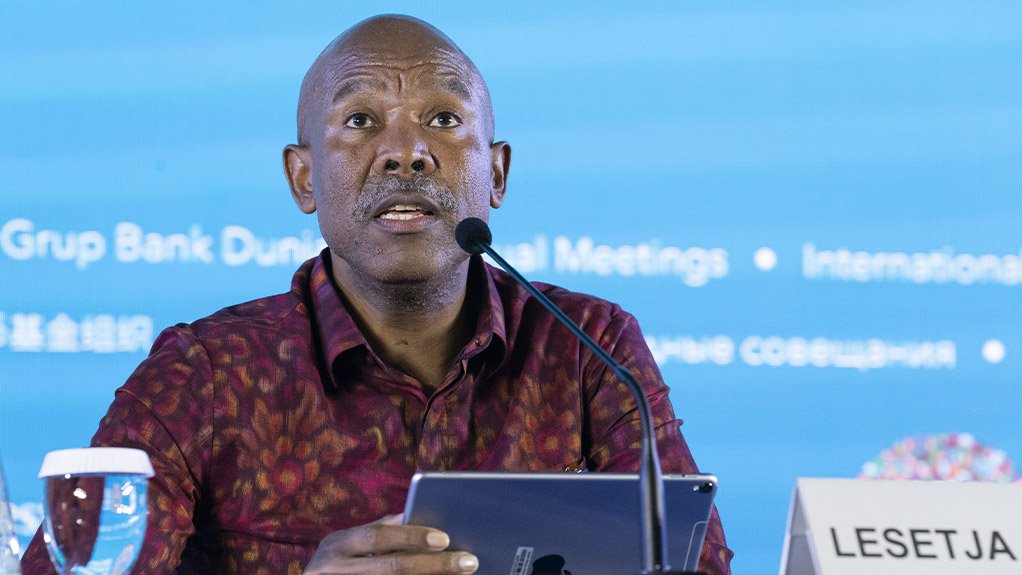
Reserve Bank Governor Lesetja Kganyago said the Iran war’s impact on oil prices has validated wariness over inflation, without giving a clear signal on what that means for interest rates.
“You are seeing the adverse scenario playing itself, although not fully,” Kganyago told Bloomberg Thursday on the sidelines of the Spring Meetings of the International Monetary Fund and World Bank in Washington. “I don’t think that we are far off with what we said would happen with the oil price.”
Kganyago and his colleagues held their policy benchmark at 6.75% last month while outlining two adverse scenarios of what the conflict could mean for South African price pressures and rates.
In the first, the conflict lasted another two months and oil prices averaged around $100 per barrel, pushing inflation above 4%. In the second it dragged on for over a year and inflation exceeded 5%.
The SARB targets inflation at 3%, and under both scenarios a rate increase would be warranted this year, with one hike in the first case and several more in the second. Traders are currently pricing in one quarter-point interest-rate increase next month and another by year-end.
Kganyago was careful not to signal where policymakers were leaning ahead of the SARB’s next rate decision, which will be announced on May 28, while repeating that officials will monitor so-called second round effects from higher fuel prices on other parts of the economy.
“We are not going to try and be pre-emptive,” he said. “But neither can we afford to be complacent and say we’ve got to wait for the second-round effects to arrive before we actually take an appropriate policy response.”
He did acknowledge that officials will likely lower their growth forecast because of the oil-price shock’s impact on global growth and domestic spending, which might be a dampening influence on price pressures if it reduces demand in the economy.
The SARB in March projected South African growth would edge up to 1.4% in 2026 from 1.1% last year. It saw inflation averaging 3.7% for 2026. South African inflation slowed to 3% in February.
Striking a more hawkish tone, the governor warned that markets may be underestimating how long damage to refineries in the Persian Gulf could constrain physical oil supply — even if shipping through the Strait of Hormuz is restored.
Kganyago also added that any reduction in fuel levies to cushion a sharp rise in petrol and diesel prices should be temporary, pointing to lessons from the pandemic, when emergency social support measures introduced at the time are still in place years later.
Finance Minister Enoch Godongwana has cut the fuel levy by R3 a litre on both petrol and diesel for April and said he would review whether to extend the relief through June, signalling that the three-month window may be all South Africa can afford.
EMAIL THIS ARTICLE SAVE THIS ARTICLE FEEDBACK
To subscribe email subscriptions@creamermedia.co.za or click here
To advertise email advertising@creamermedia.co.za or click here


