





By the time Kenya's first Ebola patient was whisked to a hospital by relatives straight after landing at Nairobi airport, he was already exhibiting some classic symptoms - fever, chills, muscle pain and bleeding beneath the skin.
Two days later he was dead, leaving public health experts to piece together how he had managed to transit through three countries and evade layers of screening meant to stop the ongoing outbreak in Democratic Republic of Congo from spreading to neighbouring states.
Details about the man, a Kenyan national whose identity has not been made public, remain scant, but Kenyan officials have confirmed he travelled overland from the city of Beni, in northeastern Congo, to Uganda's capital Kampala, where he stayed one night before flying to Kenya.
The itinerary required traversing the border between Congo and Uganda, which has been closed since May.
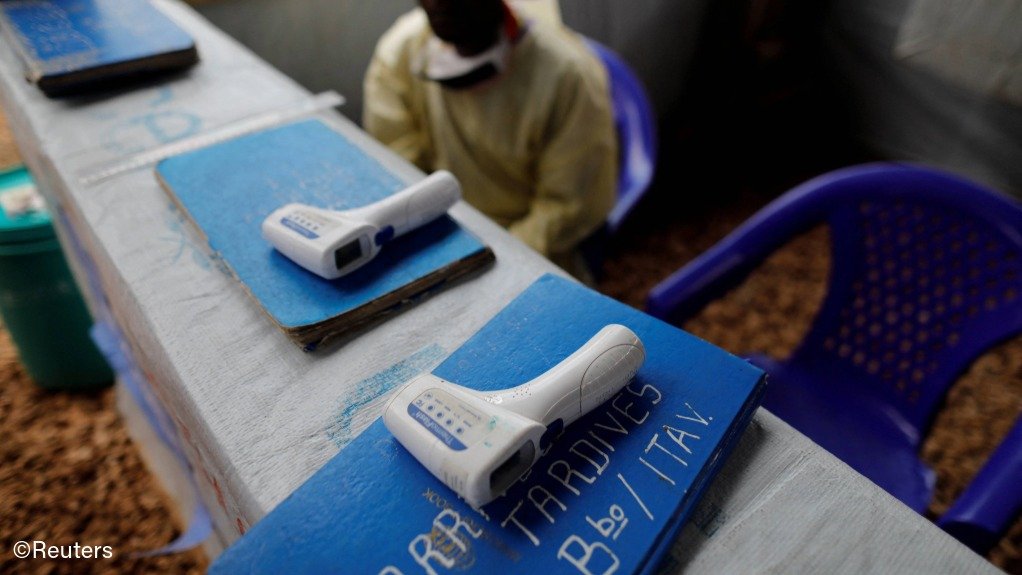
The man would also have had to pass through multiple airport temperature checks - in Nairobi and Entebbe - and fill out at least two digital forms intended to flag any potential exposure to Ebola in Congo.
The case underscores the lapses in border screening systems in Africa and beyond that depend on effective implementation and honest disclosure on the part of travellers, according to health experts and officials who spoke to Reuters.
"This underlines the need (to strengthen) screening procedures, including know-how on posing the 'right' questions," said Thomas Paerisch, a public health specialist recently deployed to Congo with medical charity Medecins Sans Frontieres.
A POROUS BORDER CROSSING
Kenya's Health Minister Aden Duale said on Tuesday the man had been living in Congo for seven years and fell ill there about a month before arriving in Nairobi, though it is unclear when exactly he became infected with Ebola.
An itinerary shared by the Africa Centres for Disease Control and Prevention showed his recent travels included a domestic flight in Congo across three Ebola-affected provinces before he moved by road from Beni to Kampala.
Uganda closed its border with Congo in late May to limit the spread of Ebola after recording several cases linked to individuals who had crossed from Congo. Ugandan authorities declared the country Ebola-free in late July.
But a Ugandan health ministry source involved in Ebola preparedness efforts acknowledged that the porous nature of the border made it impossible to make the closure watertight.
Ugandan government spokesperson Alan Kasujja said Kampala was not to blame.
"Leave Uganda out of this conversation. We don't have Ebola here," he said in a post on X.
A health ministry statement on Tuesday said the man had "normal temperature" when he was screened at Entebbe airport. Kenyan authorities have also said he could have taken medication to mask his symptoms when he was screened at Nairobi airport.
"We are trying to retrieve the digital form he would have filled out at Entebbe airport when he went through the thermal scanning process to see what he declared in that form. The form includes questions about recent health problems but also whether a traveller was recently in DRC," Dr. Richard Mugahi, a senior Ugandan health official, told Reuters.
"We are also going through airport security camera footage to see if we can identify the driver who dropped him at the airport so we can trace any contacts here."
Duale, Kenya's health minister, said on Wednesday 57 contacts of the dead man had been listed, including 10 who had been quarantined. "Efforts to trace the rest have been intensified," he said.
A dedicated gate for screening passengers arriving from Congo and other countries potentially linked to the Ebola outbreak has now been set up at Nairobi's Jomo Kenyatta International Airport, Duale added.
SYMPTOMS HARD TO DETECT
The current Ebola outbreak, Congo's worst on record, has infected more than 8 000 people and killed more than 4 000. It is caused by the rare Bundibugyo species, for which there is no known treatment or vaccine.
Experts said early symptoms may be hard to detect and medication including paracetamol can foil temperature checks.
Infrared thermometers used in airports measure surface rather than core body temperature, which can cause them to miss some infections, said Kamran Khan, an infectious disease physician and professor at the University of Toronto.
Screening also involves health declarations and visual assessments, but travellers may choose not to disclose symptoms.
Rose Tchwenko, DRC Country Director at Prosper Global, flew from Kinshasa to Nairobi last month and said border surveillance measures at both airports were very limited.
Before boarding, she was asked to fill out an online form about her health status and any symptoms to generate a QR code. On arrival, she underwent a temperature check and handed over the QR code. "The whole process takes less than two minutes, then you leave. Since then, no one has contacted me to check if I have developed symptoms."
EMAIL THIS ARTICLE SAVE THIS ARTICLE FEEDBACK
To subscribe email subscriptions@creamermedia.co.za or click here
To advertise email advertising@creamermedia.co.za or click here


