





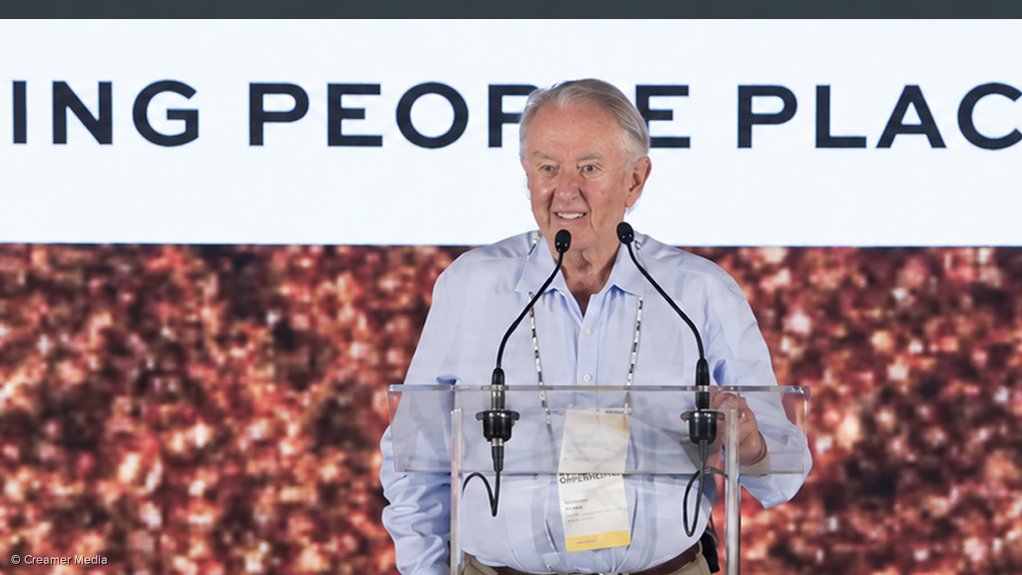

JOHANNESBURG (miningweekly.com) – With the prospect of even more extreme climate change, with the challenges faced in the environmental space worldwide, the importance of a holistic, joined-up, collective understanding of ecological science grows daily, Oppenheimer Generations executive chairperson Jonathan Oppenheimer said in opening the fifteenth Oppenheimer Research Conference on Wednesday, October 7.
“We are, I believe, very close, if not at, a tipping point in terms of what happens going forward,” Oppenheimer told a full house at the Randjesfontein Cricket Ground in Midrand. (Also watch attached Creamer Media video.)
“As we know, in science nothing happens overnight. It's not something that we can measure and produce a set of results and correct in 24 months, let alone over 12 or six, and we live in a world that is looking for instant action.
“So, we here are critically challenged to try and make what we do, which is longitudinally complex and inevitably takes time, immediately and vitally important to what happens to society as a whole. Making that connection between the science here and the science that's done globally, and what that means for society and humankind itself, is somehow critical.
“The narrower and the more precise and the more specific we become around our own particular research topics, is in many respects, incredibly valuable for us as individuals, but fails in our ability to communicate and carry that message to a much larger audience.
“I don't need to persuade you here in this room that conservation is the way we ensure our species' survival, but I do need us to find a way to carry that message beyond these two and a half days,” said Oppenheimer in pointing out that it was the majority that drove public opinion and the only way to get most people to back conservation was to make it relevant to them.
“What we do is longitudinal in its nature. It takes time. What they want is an Instagram post for 30 seconds and we bridge that gap in the first instance by being able to sell our ideas to each of us who are open-minded and already curious and interested, and then once we've done that, we have to refine it further to sell that message to a larger and larger audience, until in the end we sell this message to 100% of the public in the world. That is the challenge of this conference,” Oppenheimer added during the event covered by Mining Weekly.
Former De Beers and Anglo American leading light Nicky Oppenheimer, in a joint programme document, joined his son in pointing out that the research presented at the multi-day conference fostered collaboration not only across disciplines but also across scales, from microscopic to landscape and global.
“In doing so, we're bringing African voices to global conversations on environment, conservation and sustainability,” it was noted.
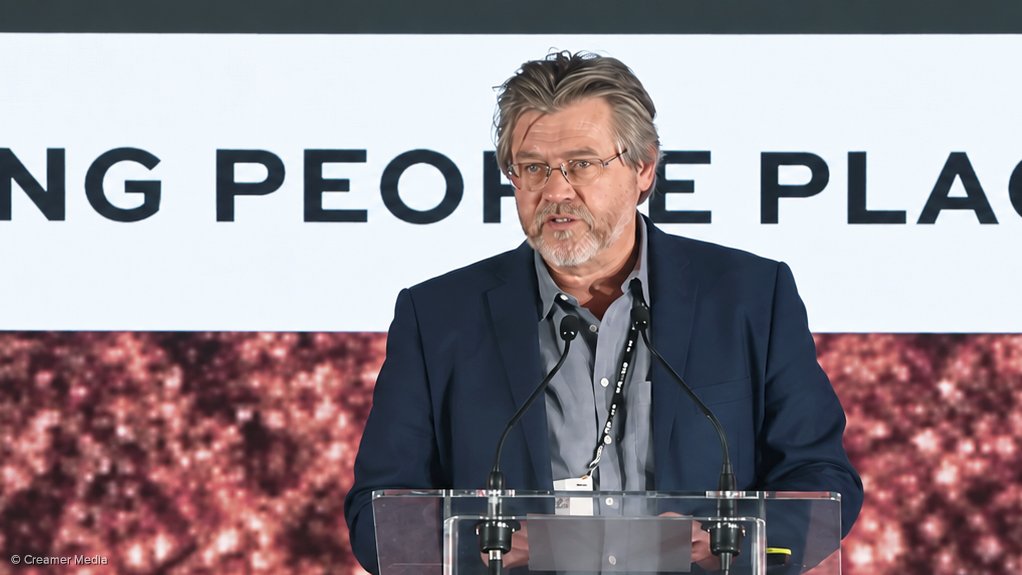
In his keynote address, Nobel Peace Prize winner for global climate action Professor Guy Midgley, the director of the School for Climate Studies at Stellenbosch University, pointed out that before the Paris Accord, the world was heading for a global warming level of 4o. “Now our projections are much closer to 2.5o. Not good enough yet, but a huge advance,” Midgley highlighted adding that the highest carbon emission trajectories that the Intergovernmental Panel on Climate Change once projected “are now no longer plausible”, which he described as being “huge for the planet”.
“In Africa, our median age is about 19; in Europe, it's over 40. We still have a demographic dividend ahead of us. Unlike the developed world, we are urbanising faster than anywhere on the planet, and our cities are expected to add a billion people by mid-century.
“Yet we’ve managed to keep remarkably large wild landscapes intact. We must now answer the question of how to build cities for a billion people while conserving the landscapes that sustain us.
“Roughly three-quarters of the infrastructure in Africa by 2050 that is needed has yet to be built. What an incredible challenge, but what an amazing opportunity.
“What we now have that no earlier generation has had is the potential of artificial intelligence (AI), assisted intelligence, to help us find our way.
“AI can sort millions of camera trap images in hours. It can track forest loss and forest and settlement growth from space in near real time. It can help us plan cities that grow and connect without swallowing the corridors and catchments around them, and it can translate knowledge and put it in the hands of communities in their own languages.
“Used well, AI may be the most powerful tool after our own ingenuity that we may yet have had for making the connections that we're talking about. In Africa, we mustn't receive it; we must shape it,” Midgley urged.
Professor Stuart Pimm of Duke University, whose research covered reasons why species became extinct, highlighted the first eight Kunming-Montreal conference’s biodiversity targets of protecting 30% of land and fresh water and oceans, stopping species extinction and restoring degraded ecosystems.
“So, okay, we're losing a lot of species. So, what are we doing about it? And the answer is, we're actually doing quite a lot about it. We have greatly increased the amount of land that is set aside for protection globally,” Pimm reported.
“If we look at our neighbours – Namibia, Botswana, Zimbabwe, Mozambique, Zambia – all have met the 30% target. South Africa hasn't. In fact, South Africa is a very long way away from meeting that target.
“Now, I think there can be a poison chalice in the 30%,” he said in reference to countries attaining the 30% assuming they could then do what they liked with their land, “and that clearly is not true. We need to recognise that there is fine print in that Kunming-Montreal target, and that fine print says we have to stop extinctions… we have to restore,” he explained.
EMAIL THIS ARTICLE SAVE THIS ARTICLE ARTICLE ENQUIRY FEEDBACK
To subscribe email subscriptions@creamermedia.co.za or click here
To advertise email advertising@creamermedia.co.za or click here


