





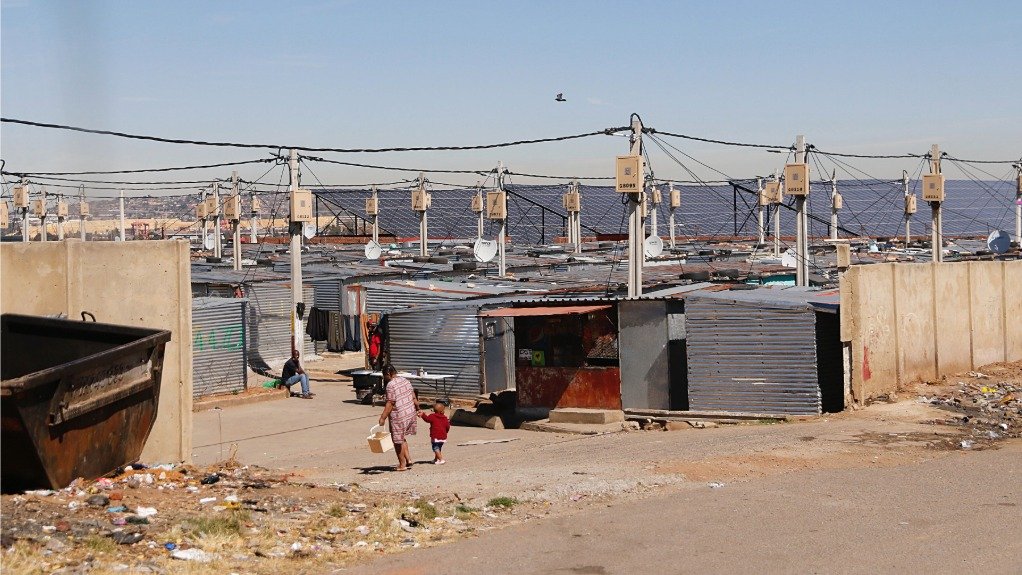
Johannesburg is investing R517.8-million in solar-powered microgrids that roll out renewable energy in five informal settlements, Thabo Molelekwa reports.
Johannesburg is turning to solar power and battery storage to address one of the city’s most persistent electricity challenges: how to provide safe, reliable and legal electricity to informal settlements where conventional grid connections are not viable.
City Power, the power utility wholly owned by the Johannesburg municipality, is investing R517.8-million in solar microgrids across five Johannesburg informal settlements, saying the systems can provide safer, legal electricity where conventional grid connections are difficult.
The alternative electrification programme currently covers five settlements: Amarasta and Vukani in Alexandra, Shalazile in Denver, The View in Booysens and Vlakfontein in southern Johannesburg. The projects have combined approved budgets of R517.8-million.
Two projects, Amarasta and Shalazile, are complete and operational. Vlakfontein and Vukani are under construction, while The View is partially complete.
Isaac Mangena, City Power’s general manager for public relations and communication, told #PowerTracker that Johannesburg has more than 300 informal settlements and that illegal connections, electricity theft, meter tampering and unmetered consumption contribute significantly to its electricity losses. City Power’s non-technical losses are estimated at approximately R4.5-billion, he added.
“Providing households with legal electricity connections and meters could help reduce illegal connections and improve safety, reliability and revenue collection,” Mangena said.
The microgrids are not intended as a replacement for conventional electricity infrastructure, he explained. The technology is selected where conventional grid electrification is constrained by factors such as limited bulk infrastructure, land availability, safety considerations and technical feasibility.
Amarasta pilot
#PowerTracker visited Amarasta and Shalazile in mid-August 2026, as part of a Just Energy Transition Learning Exchange with high-ranking Senegalese delegates hosted by the New Economy Hub, an independent initiative driving a just, climate-resilient and inclusive economic transition.
Amarasta in Alexandra was the starting point for Johannesburg’s microgrid programme. City Power developed the project as an alternative because conventional grid electrification was not immediately feasible. The pilot was installed during the 2023/4 financial year, with lessons from Amarasta informing the subsequent projects in other informal settlements.
Shalazile in Denver was established after the 2023 Usindiso Building fire in Johannesburg, which killed 77 people and displaced hundreds of residents. The displaced residents were relocated to the Shalazile site.
According to Mangena, households connected to the solar microgrids still pay electricity tariffs. Qualifying vulnerable and indigent households can receive support through the City’s Expanded Social Package, which provides assistance with municipal services, while the Free Basic Electricity programme provides qualifying households with a basic allocation of electricity.
The electrification programme began with funding through the Gauteng government’s Energy Emergency Response Plan. After the Amarasta pilot, the City of Johannesburg’s Human Settlements Department became involved in identifying and prioritising settlements requiring electricity services.
“City Power provided technical support, planning and implementation, while Human Settlements drove the timelines,” Mangena said.
The city originally planned to roll out the programme to 21 informal settlements during the 2024/5 and 2025/6 financial years. Mangena said the budget was later transferred to Human Settlements and future projects would depend on budget availability, procurement processes and the department’s
A service that works
Zakhele Khanyile, a resident of the Shalazile settlement, said when residents arrived at the site the government made sure they had electricity, although other services, including running water, are still a work in progress.
“We have reliable electricity and it’s even better for us because when the city is out of power the mini-grids are always online,” Khanyile said. “We can light, cook, use the fridge and iron our children’s school clothes.”
He said living in informal settlements can be expensive if households have to pay for paraffin and candles. Shalazile residents now pay less for electricity through meter boxes connected to the City Power microgrids.
He added that informal settlements are unlikely to disappear quickly in a city such as Johannesburg, which attracts people in search of employment. The government should work towards formalising informal settlements and extending solar mini-grid systems to areas where conventional Eskom electricity is unavailable, he said.
Tracking expenditure
Mangena told #PowerTracker that expenditure on the project to date could not be disclosed because three of the projects are incomplete and their final financial obligations have not been settled. The R517.8-million is therefore not the final amount spent on the five projects, he said.
It is not possible from the information provided by City Power to calculate the final cost per household, or compare the completed projects’ costs with conventional electrification.
Frank Spencer, a spokesperson for the South African Photovoltaic Industry Association (SAPVIA), said municipal mini-grid budgets could cover very different components: “Costs differ because budgets may include generation and storage only, or reticulation, household connections, smart meters, streetlights, fencing, security, roads and civil works.”
He said municipalities should publish component-level cost breakdowns to allow meaningful comparisons with other projects and conventional grid electrification. A comparison with conventional connections is also needed to account for upstream network strengthening that might otherwise be excluded from a simple connection-cost calculation, he said.
SAPVIA does not have a benchmark to assess whether Johannesburg’s specific costs were high or low, he said. The generation and storage component should instead be assessed over its lifetime against alternatives, including bulk electricity purchases, independent power producers and larger municipal solar and storage projects.
Operational projects
The two operational projects provide the first available indication of how the technology is performing.
At Amarasta, the system generated 68,725.8kWh in 2024 and 133,107.2kWh in 2025. But reported system availability fell from 88.61% in 2024 to 50.96% in 2025.
Mangena said Amarasta experienced a high number of outages, primarily because of illegal electricity connections.
At Shalazile, system availability was reported at 100% in both 2024 and 2025, with no outages. Electricity supplied at Shalazile rose from 41 100kWh in 2024 to 500 086.5kWh in 2025.
Illegal connections remain one of the biggest challenges facing City Power, according to Mangena. The same challenge affects the microgrids.
Vandalism, theft and security are also identified as ongoing concerns. Mangena said local community members are involved in project implementation and employment opportunities as part of efforts to promote community ownership and protect infrastructure.
Costs after construction
The capital investment is only one part of the programme’s financial equation.
City Power estimates the systems will have lifespans of approximately 20 to 30 years. It expects revenue from electricity purchases, together with future operations and maintenance budgets, to contribute towards maintaining the systems and replacing major components over their lifetimes.
Maintenance is already required. Mangena said monthly work orders cover inspection, testing and servicing of solar PV modules, inverters, battery energy storage systems and energy management systems. He also identified specialised technical expertise, spare parts and timely maintenance as ongoing challenges.
The long-term sustainability of the programme therefore depends not only on whether the systems can be constructed within their approved budgets, but on whether the municipality can fund their operation, maintenance and eventual component replacement.
According to Mangena, the five informal settlements are classified as Category B settlements, meaning they are considered suitable for in-situ upgrading and are expected to remain in their current locations.
The systems are modular and containerised, allowing capacity to be expanded or upgraded as demand increases, and components can potentially be repurposed if circumstances change, subject to technical and site assessments.
He stressed that not every informal settlement is suitable for similar electrification. Land-use restrictions, unsafe locations, environmental risks and inadequate infrastructure are factors that must be assessed before microgrids can be provided.
The decisions have to be made case-by-case and in coordination with Human Settlements, he said.
#PowerTracker sent separate media queries to City Power and the City of Johannesburg in early September, as the two entities play different roles in the project. The City of Johannesburg said its Human Settlements Department would attend to them.
After several follow-ups, the City responded on September 17, saying City Power would be the only entity responding to the queries, without providing reasons for this decision. Besides answering the queries, City Power assisted #PowerTracker in identifying end users in the informal settlements for the story.
UPDATE:
On September 25, two days after publication, the City of Johannesburg responded to #PowerTracker’s media query, saying the microgrid programme was introduced in response to limited and unreliable bulk electricity supply from Eskom.
Spokesperson Penwell Dlamini said the City’s decisions on electrifying informal settlements were guided by the Policy on Electrification of Unproclaimed Areas, which applies to informal settlements that have not gone through the normal formal township and proclamation process. The City also considers each settlement’s categorisation and future development plans when deciding whether to invest in electricity infrastructure.
“In terms of the applicable policy approach, informal settlements that are planned for relocation within three years are not considered for electrification. This is further informed by the categorisation of informal settlements,” Dlamini said.
“For settlements intended for in-situ upgrading, the City seeks to align electricity infrastructure with the anticipated future layout of the settlement. This is important because, once township establishment and formalisation take place, the infrastructure can continue to serve the formalised settlement with minimal relocation or disruption of installed,” he said.
According to him, the five projects demonstrated that microgrids could provide a sustainable alternative for informal settlements where bulk electricity supply was constrained. Although initial capital costs were high, he said operating and maintenance costs were relatively low and rising conventional electricity tariffs could improve their long-term viability.
This investigation is part of the Oxpeckers #PowerTracker programme, supported by the New Economy Hub and Ford Foundation
EMAIL THIS ARTICLE SAVE THIS ARTICLE ARTICLE ENQUIRY FEEDBACK
To subscribe email subscriptions@creamermedia.co.za or click here
To advertise email advertising@creamermedia.co.za or click here


