





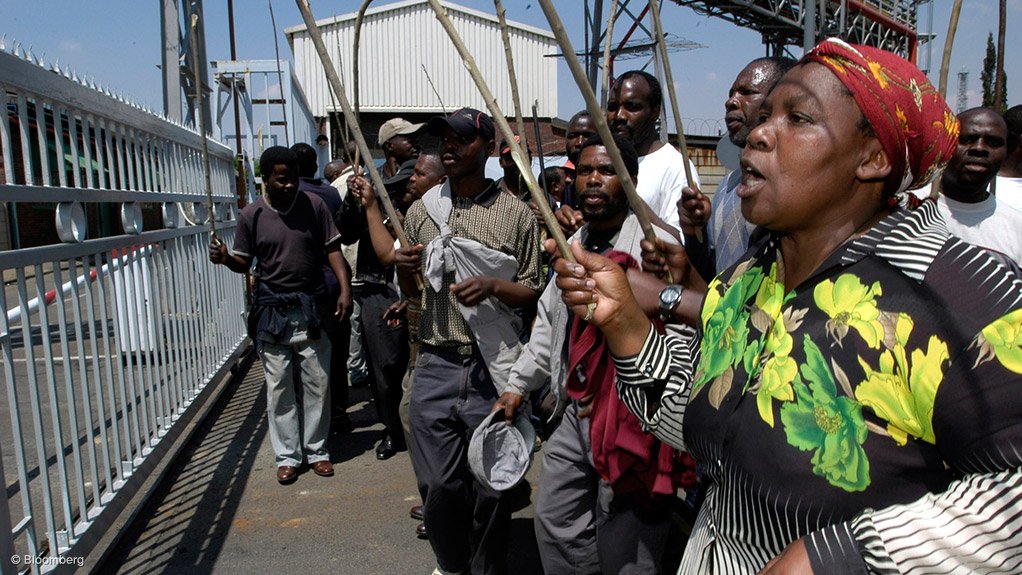
The game of chicken continues amidst high stakes as the Association of Mineworkers and Construction Union (AMCU) continues in week eight with its costly strike at South Africa’s three biggest platinum miners Anglo American Platinum, Impala Platinum and Lonmin. It now boils down to who will hold out the longest or blink and give in first.
No end to possibly biggest mining strike since 1994
With the two sides poles apart and no end in sight, the strike may yet become the biggest single strike in the mining sector since the mining strike of 1987, even bigger than the wildcat strikes on the platinum belt in 2012 which were separate strikes at different times at different mines. It is also threatening the viability and survival of an industry already under immense pressure on various fronts.
In general the mining companies and market analysts seem to have incorrectly anticipated that the 6-week mark would be breaking point for the strikers. Instead AMCU claims the strike is being stepped up, more workers are joining it, none have indicated they want to return to work, and many of its striking members have gone back to their rural homes where they can feed themselves and their families off the land to sit out the strike.
But many striking workers who do not have rural lifelines are also under pressure as there have been no pay checks. Contrary to AMCU’s boastful claims there have been reports of some striking workers wanting to return to work but fear for their safety if they do. Others are under pressure to re-join the National Union of Mineworkers (NUM) which has been trying to cash in on the conditions created by the protracted strikes to win back the members it lost to AMCU.
Stockpiles running out
And while the mining companies initially seemed to have sufficient stockpiles of mined or above-ground platinum giving them hefty war chests with which to ride out the strike, concerns are now starting to show as to whether these stockpiles will last beyond the end of this month.
In late February Impala Platinum, the world’s second largest platinum producer, told the media it could guarantee deliveries to offshore customers only until the end of March; In January Anglo Platinum, the largest producer, said it could deliver on customer orders for six to eight weeks; and in November it was reported that Lonmin had stockpiled 42,000 ounces of unrefined metal in the year through September and had an additional 13,000 ounces of unsold refined platinum.
New complications
To complicate matters, some former NUM union officials have launched a new union, the Workers’ Association Union (WAU), that is trying to cash in on the situation, seeking support on both sides of the strike with a back-to-work message. The new union claims 8,000 members on the affected platinum mines. There are of course suspicions – unconfirmed - in AMCU quarters that this union may have been set up by the mining companies as a strike-breaking ploy, or that it is a recruitment front for the NUM.
Meanwhile the mediation talks also remain deadlocked after the Commission for Conciliation, Mediation and Arbitration (CCMA) took exception to the Chamber of Mines’ chief negotiator accusing it of not being up to the task and accusing both the CCMA and AMCU of not having the necessary understanding of the economics involved.
While the CCMA’s head Nerine Kahn reportedly rejects the assertion that her mediators are incompetent, she did, according to one report, acknowledge that there are many more broader political and social issues at play in the strike than just the R12,500 pay demand and that the CCMA was not sufficiently set up to deal with these.
Gold sector strike could worsen situation
The situation for South Africa’s stressed mining sector could have been considerably worsened had AMCU been allowed to go ahead with a planned strike in the gold sector as well. After AMCU had issued strike notices for both the platinum and gold sectors in January, the Labour Court issued an interim interdict preventing a strike in the gold sector.
Last Friday the Labour Court extended the return date for AMCU to give reasons why it should not be made a permanent interdict from March 14 to June 5. After that date, should the platinum strike still not be resolved, a strike in the gold sector could bring further misery to the industry. AMCU has vowed to fight in court for its right to strike.
Strike cost
The cost of the current platinum strike is enormous. Some sources indicated that already the lost production of 499,000 ounces by last week exceeded the lost production of 496,359 ounces of output of 2012 when wildcat strikes and labour unrest led to the Marikana tragedy. However, according to information given to Reuters by mining companies and Reuters’ own estimates, the strike has so far cost lost production of 440,000 ounces, while 544,000 were lost by the three mining companies during the 2012 wildcat strikes. Even if one takes the latter set of figures, the current strike’s losses will surpass those of 2012 within days.
In week eight of the strike it is estimated that already one fifth of South Africa’s annual platinum production has been lost and market concerns are starting to affect prices. The mining companies have already lost an estimated more than R9bn in earnings while striking workers are said to have already lost almost R4bn in wages to date. The losses are currently running at approximately R200-million per day.
Worse longer-term costs
But the longer term cost will be considerably higher if stockpiles are depleted and slow start-ups of shafts and operations delay new production. Apart from sourcing platinum from Zimbabwe and Russia, international industrial markets have also found innovative ways of lessening dependence on South African platinum such as recycling and substitution, reports Business Day. As a result, it says, South Africa produces only 53% of the world’s platinum rather than the commonly stated 80%.
In addition, once settlement is reached, the higher pay costs as well as possible back pay for lost wages during the strike, may also kick in…which could be a very hefty additional bill.
Then there is the difficult-to-quantify overall harm to the economy due to the losses of export production and wages, the potential for job losses as miners turn to less labour-intensive and therefore less vulnerable production methods, and the potential loss of investment as investors turn to more secure and stable destinations.
Already the damage to the economy has led President Jacob Zuma and Finance Minister Pravin Gordhan among many others to call for an urgent end to the strikes in the mining sector and a return to full production, with both stressing the importance of the sector for the overall economy.
The social cost and another Marikana
Even higher could be the potential cost of another Marikana situation. With squalid conditions remaining in shanty towns surrounding much of the affected mines and high unemployment levels making more people dependent on mineworkers’ wages, the impact of the strike is multiplied throughout these communities. By now the loss of income will be sorely felt and will heighten frustration levels inn these communities where crime and violence is high and service delivery is just about non-existent.
With striking workers on the lookout for strike breakers and with at least three unions competing for membership and attention, the potential for an outbreak of violence and unrest is high. This comes when the inquiry into the Marikana tragedy is far from completed and at a time when Deputy President Kgalema Motlanthe, who brokered a peace deal among all the stakeholders in the mining sector after Marikana, is about to exit the political stage after the May 7 general election.
The election campaigning itself is already fraught with tensions and violence across the country, and with escalating township protests and imminent labour-led mass action about to be launched this week, the potential for another round of highly damaging unrest in the mining sector is high.
In the meantime the postponement of the court return date for AMCU regarding a gold sector strike is heightening and prolonging unwelcome uncertainty in the sector, something it can ill afford.
International impacts
South Africa’s mining sector has already suffered many recent setbacks in the recent past with low prices and low demand for platinum, electricity blackouts and high electricity costs, labour unrest and strikes, regulatory and policy uncertainties, and missing out on the last resources boom.
The current strike is adding to the pressures at a time when European markets have not yet fully recovered; sentiment towards emerging markets could be adversely affected by South Africa’s BRICS partner Russia’s designs on the Crimea; the tapering of quantitative easing by the US Federal Reserve continues; and the Chinese economy remains in slowdown mode. All of these could impact negatively on South Africa’s mining industry and combined all of these developments raise the spectre of further credit downgradings.
Written by Stef Terblanche, Political Analyst & Editor, Africa-International Communications
EMAIL THIS ARTICLE SAVE THIS ARTICLE FEEDBACK
To subscribe email subscriptions@creamermedia.co.za or click here
To advertise email advertising@creamermedia.co.za or click here


