





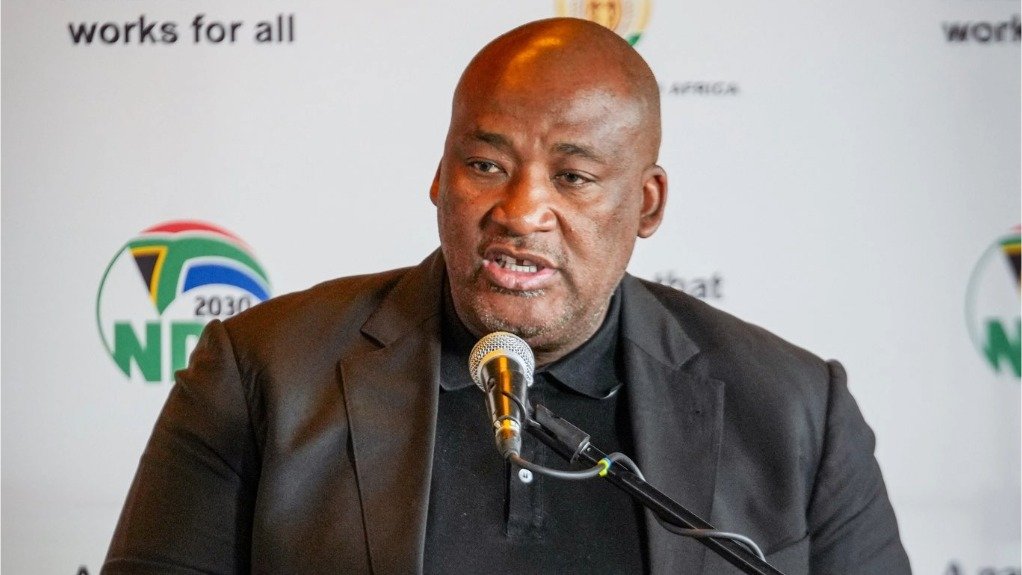
In an historic step towards healing the wounds of the liberation struggle, Minister of Sports, Arts and Culture Gayton McKenzie, announced on Friday that government has identified more than 400 graves across Angola for potential recovery and repatriation.
Speaking at a media briefing, McKenzie made a plea to the public, urging families who lost loved ones in Angolan exile to come forward and formally apply for their exhumation, forensic examination, identification, and repatriation.
McKenzie warned that the recovery mission will be one of the most logistically difficult operations the country has ever attempted.
The project spans Luanda alongside the northern, eastern, and southern provinces of Angola.
The landscape of the former war zone presents severe dangers and obstacles, McKenzie said, noting that many of the target regions still contain unexploded landmines, requiring intensive demining before personnel can set foot on the ground.
A significant number of the burials were wartime mass graves, completed without names, markings, or official records.
He said numerous burials are located in informal village cemeteries or remote bush areas where freedom fighters fell, requiring heavy land clearance and road access across the regions is poor and severely limited by seasonal weather changes.
“No South African team will enter ground that has not been declared safe. That is an absolute condition of this operation,” McKenzie stressed, emphasising that safety is the government’s priority.
The journey to this announcement began in November 2019, when military veterans approached President Cyril Ramaphosa to request that the remains of fallen comrades who perished in exile be brought back to South Africa.
Following an influx of requests, the government established a Presidential Task Team.
This culminated in the National Policy on the Repatriation and Restitution of Human Remains and Heritage Objects in 2021, followed by a Country-to-Country Repatriation Model in 2023.
In September 2024, Ramaphosa received the remains of 42 liberation heroes from Zambia and Zimbabwe, promising that the government would keep going back until everyone was accounted for.
To fulfil this promise, a comprehensive Five-Year Plan for the Exile Repatriation of Human Remains was designed alongside the departments of Defence, Military Veterans, and Justice and Constitutional Development, achieving Cabinet approval in March 2026.
Because decades have passed and local Angolan records are routinely recycled every five years, Justice and Constitutional Development Deputy Minister Andries Nel noted that finding exact locations is highly difficult.
Therefore, government will rely heavily on forensic science and voluntary DNA reference samples provided by families. But McKenzie warned that families must brace for the limits of modern science.
"Even with the best science available to us, some remains will not be identified, and some will not be found at all," he explained, though he vowed the government will bring back every person it can.
Crucially, the government highlighted two non-negotiable pillars for the process: that the entire application and repatriation process is hosted and controlled by the South African Heritage Resources Agency (SAHRA) and is 100% free.
McKenzie warns families against scams: “If a person asks you for money to bring your child home, that person is stealing from you. Report them.”
No exhumation or forensic work will proceed without explicit family agreement. The State will support and fund the traditional rituals chosen by the families rather than substituting them with State alternatives.
For families whose loved ones cannot be physically located or recovered owing to the passage of time or geography, the government will facilitate "spiritual repatriation".
This practice involves visiting the site or region where the freedom fighter died to perform specific cultural and religious rituals.
Nel noted that groups of families will soon travel to the historical sites of the camps in Angola.
He added that the timing is symbolic, as the nation honours the 50th anniversary of the 1976 Soweto Uprising, the historic event that prompted many of these very young men and women to flee into exile and join the armed struggle.
Shedding light on the national weight of the initiative, ANC secretary-general Fikile Mbalula described the repatriation as a pivotal moment in South African history.
Echoing the department's call, Mbalula asked families to make use of official government platforms to log their applications.
"We do not pretend that this work is simple," Mbalula said.
"Our recovery teams must contend with minefields, with unmarked graves, and with a landscape reshaped by nearly three decades that have passed since the wars in Angola ended."
EMAIL THIS ARTICLE SAVE THIS ARTICLE ARTICLE ENQUIRY FEEDBACK
To subscribe email subscriptions@creamermedia.co.za or click here
To advertise email advertising@creamermedia.co.za or click here


