





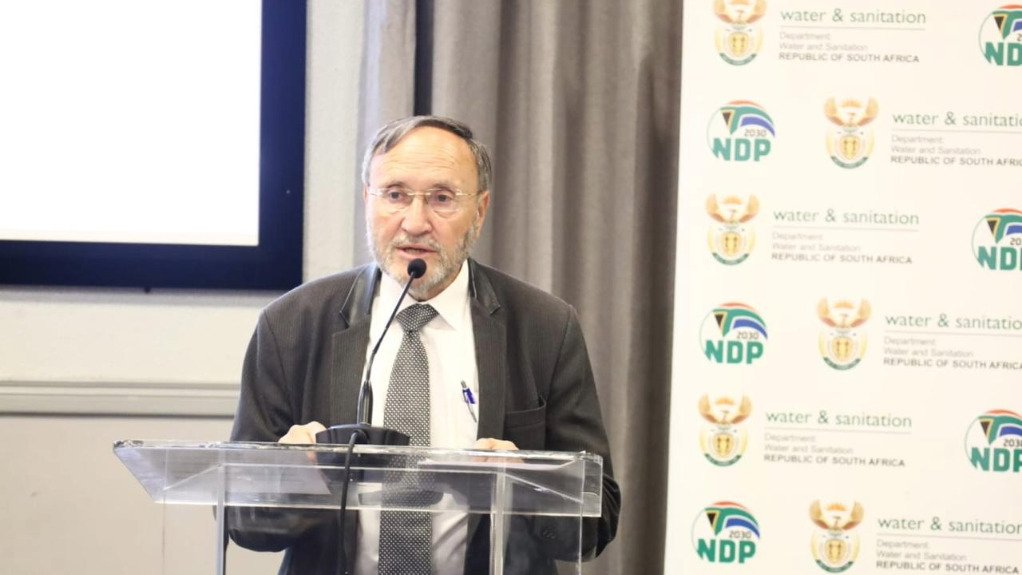
Gauteng’s nonrevenue water levels are equivalent to the volumes of treated water supplying the Western Cape, Water and Sanitation Deputy Minister Dr Jack Bloom said on Tuesday.
Speaking at the public consultations for the Gauteng Provincial Workshop to review the updated draft Strategic Framework for Water and Sanitation Services, he highlighted how about one in two litres of Gauteng’s treated water supply did not generate revenue.
“We are in a province with a water crisis. Many people do not have reliable water in their tanks. They have intermittent supply or low pressure. Their suburbs may be throttled,” he said.
Nonrevenue water, water that is not accurately billed, is stolen, unaccounted for or physically lost through leaks, accounts for nearly half, currently about 49%, of all the supplied treated water in Gauteng.
While the figure fluctuates, this is a significant surge on the 42.5% reported in 2023/24.
The physical water losses through leaking pipes amount to about 20%, with Gauteng losing about 431-billion litres a year.
“It is roughly the same amount of treated water that is supplied to the whole of the Western Cape every year,” Bloom continued.
Using Rand Water charges – the cost for municipalities to buy water – for the volume of water lost, wasted treated water equated to R7-billion. At municipal water rates, which were higher and calculated at different rates, it was “easily” more than R14-billion rand a year wasted from leaking pipes, he pointed out.
The City of Johannesburg’s nonrevenue water is at 49%, of which 26% is physical losses, while Tshwane’s nonrevenue water sits at 45%, of which 34% is physical losses, and Ekurhuleni’s nonrevenue water is about 30%, of which 22% is physically lost. Emfuleni local municipality has more than 70% nonrevenue water and Mogale City has more than 60% nonrevenue water.
“You can see where we need to work very hard. Basically fix the leaks and we will have all this water equivalent to what the entire Western Cape uses every year.”
He further noted that access to a tap was not the same thing as access to water.
“A household that has a tap that only gets water intermittently cannot be counted as a success. They do not get water in their taps, but there is water flowing down their streets from broken pipes. Some areas are still reliant on water tankers.”
The Department of Water and Sanitation has published a new framework that sets out how this will be fixed: reliable taps and working sanitation, infrastructure that is maintained and renewed, protected water resources and stronger, more capable municipalities.
This follows a review of the first Strategic Framework for Water Services, which was published in 2003, to provide a comprehensive and coordinated approach to the provision of water services across the full spectrum of settlement types in South Africa.
The updated draft Strategic Framework for Water Services aims to close the gaps by taking into account the major shifts seen since, including new national policies, standards and legislation that strengthen economic regulation, sanitation, tariff governance and water resource management.
The 60-day public consultations period started on September 11, following Cabinet approval in July and its gazette for consultation in August.
The department ams to publish the final revised framework for implementation in August 2027.
The framework shifts its focus from basic access to reliable, lasting service.
“Whereas the old framework was a catch-up plan for basic services, the new one is a turnaround plan for a strained system that brings in best practices and modern technology to address the remaining delivery gaps,” Bloom noted.
The new framework added reliability, quality, SANS 241 drinking water standard, wastewater standards and services that could be maintained over time.
“Climate is a core requirement now. The old document did not focus much on droughts, floods and climate risks. This framework requires climate risk assessments, adaptation strategies, and climate-proof planning and infrastructure.”
Further, the new framework wrote in digital tools, he said, noting that technology advances, smart meters, integrated data systems, digital asset registers and open reporting were treated as part of how the water sector should run, and not as optional exports.
In addition, the framework promotes stronger regulation in institutions, pushing the establishment of an independent water economic regulator, performance-based regulations, licensing of providers, clearer separation of regulator and operator and tighter accountability.
There is also a strong focus on monitoring and valuation, including outcome-based indicators, public reporting, certification and independent audits, as well as peer learning, scenario planning and digital platforms ensuring the framework is responsive to change.
In addition to this there is a focus on effective funding, ringfencing of water revenue, lifecycle costing and blended finance.
“Grants must fund repairs and renewal, not only new projects. This addresses a major failing where we have expensive facilities, we hand them over and they deteriorate because they are not maintained.”
Further, the framework’s targets have been reset, owing to the mixed results and partly missed deadlines of the 2003 edition.
Among the dozens of new sector targets is the requirement to reduce water losses to below 25%, requiring every water services authority (WSA) to renew at least 10% of its highest risk aging assets every single year, ensuring 80% of urban households in South Africa have smart meters by 2032, and ensuring that, by 2035, at least 30% of end-of-ife pipelines, pumps, and process units are replaced.
Further, the framework seeks, by 2025, to grow investment in water-services infrastructure to at least 0.75% of GDP, ensure all schools and clinics have adequate and safe water and sanitation services, implement free basic water and sanitation policies in all WSAs and meet 100% compliance with SANS 241 potable-water standards by 2035, besides others.
EMAIL THIS ARTICLE SAVE THIS ARTICLE ARTICLE ENQUIRY FEEDBACK
To subscribe email subscriptions@creamermedia.co.za or click here
To advertise email advertising@creamermedia.co.za or click here


