





The minerals that keep the world’s digital infrastructure running are extracted from communities where many young people still struggle to access reliable internet. Sakhile Dube investigates.
For many young people in the mining towns of North West province, employment opportunities via internet access remain out of reach. Yet these are the places where the minerals needed to power every search query, artificial intelligence (AI) prompt and cloud upload are extracted.
Among these minerals are platinum group metals (PMGs) mined in communities like Marikana and Kroondal. South Africa holds the world’s largest known PGM reserves, accounting for about 88% of the global supply, according to the Department of Mineral and Petroleum Resources.
The most important PGMs in this chain are platinum, palladium, ruthenium and iridium, which have become central to the clean energy transition, supporting systems that power data centres, the physical infrastructure behind the cloud, the internet and AI.
Most of the towns’ digital infrastructure sits far from the mines, with investment programmes going to places that already have good connectivity. The communities where the minerals for this infrastructure are mined say they are left out, with no help to ensure that they share in the benefits of digital development.
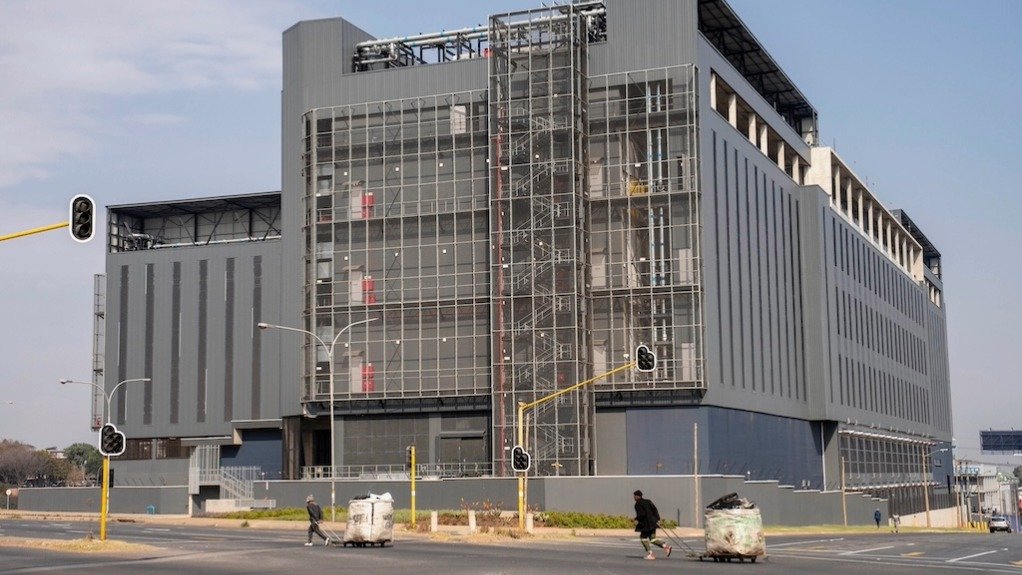
Teraco, which is owned by the American firm Digital Realty, has a campus in Johannesburg that is South Africa’s largest data centre. Its communications department told Oxpeckers that its community investment programmes are directed at the areas where it operates – Johannesburg, Cape Town and Durban – rather than mining communities in the North West.
But many of these cities already benefit from extensive fibre infrastructure and reliable mobile connectivity. By contrast, communities living in Marikana and Kroondal continue to rely largely on LTE networks with limited fibre rollout.
Energy guzzlers
Data centres are expanding rapidly globally and in South Africa, with more than 50 already in operation, mostly in Johannesburg and Cape Town, and new ones are being built to meet the growing digital demand.
These centres are among the country’s fastest-growing energy users, with a combined capacity of 350 megawatts – which is less than 1% of the global total. According to the International Energy Agency, global data centre energy consumption could double by 2030, and local data centres are already feeling the pressure of resource constraints.
To secure more reliable and low-carbon energy sources, they are turning to renewable options, testing or investing in hydrogen fuel cells and backup systems that support solar, wind and other clean technologies.
As South Africa’s digital economy expands, demand for PGMs in clean energy systems grows, highlighting a deeper dependence on the communities where these minerals are mined.
The same critical minerals extracted from the North West are central to South Africa’s Just Energy Transition (JET). Yet policy discussions around the transition have so far concentrated almost entirely on coal-dependent regions such as Mpumalanga, where the debate focuses on power station closure, worker re-skilling and economic diversification.
PGM-mining communities producing the inputs for that same transition have largely fallen outside of that conversation, according to a recent report by the Trade & Industrial Policy Strategies.
Companies in the digital supply chain increasingly market themselves as drivers of sustainable development, yet the communities supplying the minerals that make that development possible continue to face basic barriers to digital inclusion, A report by the Intergovernmental Forum on Mining, Minerals, Metals and Sustainable Development (IGF) says this raises hard questions about what a just transition should actually look like.
Digital divide
Most of the young people Oxpeckers met in Marikana and Kroondal own smartphones, but that does not mean they have meaningful internet access.
Many rely on expensive mobile data, unstable network coverage or public Wi-Fi hotspots that are difficult to access, unsafe to use or located inside private facilities.
Youth unemployment remains high across Bojanala District Municipality, which includes Marikana and Kroondal, with an unemployment rate of 27.6%, according to the municipality.
For these unemployed young people, purchasing mobile data is often unaffordable, turning connectivity into yet another barrier to finding employment.
“There is a high rate of youth unemployment here. How can young people afford data to search for job opportunities when they have no income?” said Karabo Molebatsi, secretary of the Marikana branch of the Mining Affected Communities United in Action (MACUA).
In Marikana, many residents gather outside a bank outlet to access free Wi-Fi. Others connect at a nearby community centre, known as Choppies.
The people we spoke to said they use the internet to apply for jobs, search for tenders, follow current affairs and post content on social media. But without stable internet access or digital skills training, many remain limited to basic online participation. They are connected enough to scroll, but not enough to fully learn, earn or build.
In Ikemeleng, a settlement in Kroondal, a growing number of young people are trying to build careers in digital content creation. They hope to tell their own stories, generate income online and develop new skills. However, unreliable network coverage continues to hold them back.
Most residents rely on free Wi-Fi at Ikemeleng Clinic, installed by Glencore, a coal and ferroalloys mining company with local operations.
“I am a music creator and often do not have the internet to upload my music,” said Graciano Jose. “I sometimes connect at Ikemeleng Clinic, but the area is not always safe because phones are often stolen, especially by people struggling with substance abuse.”
Shifting the blame
Young people in Marikana and Kroondal said “accountability fragments at every stage”: mining companies point to their legally mandated community investments; data centre operators point to their customers; and technology companies depend on global hardware manufacturers, which source components assembled across multiple countries using minerals refined through international supply chains.
The result is a digital economy in which every actor occupies one part of the supply chain, but no single organisation is accountable for ensuring that the communities supplying its critical minerals share meaningfully in the benefits of digital development, they said.
Teraco’s JB4 Bredell campus, situated in Johannesburg, is the largest standalone data centre in Africa, at 80 000m². It provides 50 megawatts of “critical IT energy load”, which powers the centre’s hardware. This is enough to run anywhere between 25 000 and 50 000 average South African households, according to calculations by GSL Energy.
Teraco told Oxpeckers that it is an infrastructure company and its role is limited to building and operating data centres. The company does not manufacture, own or procure the servers and other IT equipment housed inside its facilities.
“The IT equipment within our data halls belongs to our clients,” their communications department said via email. Those clients include global companies whose cloud platforms rely on servers and hardware containing minerals such as PGMs.
When asked for comment regarding their accountably, the major tech giants offered varying degrees of deferral by the time of publishing. Google stated it would not respond. Amazon indicated any official feedback requires approval from its American parent company. Microsoft noted it would provide inputs after consulting with its key contact person.
Locally, Teraco said its facilities use less resource‑intensive technology because they focus on inference AI — running models that are already trained and fine-tuned, close to users and data for fast, efficient results — rather than the heavy computing needed for AI training.
The company uses power from the national grid, as well as diesel generators for backup. It is also busy building a 120MW utility-scale solar farm in the Free State, which will feed back into the grid when it begins operating in 2027. According to a press release, Teraco has set a target of 50% renewable energy use by 2027 and 100% by 2035.
But Marikana and Kroondal communities remain excluded from that digital opportunity.
Development commitments
Marikana and Kroondal are surrounded by PGM mining operations dominated by Sibanye-Stillwater, alongside mines operated by Tharisa and Glencore.
Oxpeckers reviewed the companies’ social and labour plans (SLPs), which outline legally required community development commitments.
Sibanye-Stillwater’s 2021-2025 SLP, citing 2016 community survey data, shows that only 8.47% of households in Rustenburg municipality, which includes Marikana and Kroondal, had internet access.
The plan lists community-based digital resource centres as one of its intended interventions: “Establishment of community-based digital resource centres, accessible to the community at large, as one of its key proposed interventions.”
One such project is the Marikana Youth Centre, developed in partnership with Afrika Tikkun, Scania South Africa and the Get It Done Foundation. Although the centre is open, residents say its location and programme limitations prevent many young people in surrounding areas from using it.
“The Marikana Youth Centre is outside the community radius and not located where everyone can access it,” said Molebatsi, of MACUA.
Sibanye-Stillwater says it is also working to improve digital access in schools. “We are providing free Wi-Fi to 18 schools in the Bojanala District, enabling access to learning materials, supporting the teaching of specialised subjects and giving learners access to online resources for research and learning,” said company spokesperson Jana Marais.
However, community members say these efforts do not go far enough to close the digital gap.
“Most schools still do not have Wi-Fi or computers, so learners are forced to rely on internet cafés if they need to go online,” said community activist Sabelo Njemla.
Fragmented regulations
The South African Human Rights Commission (SAHRC) has launched an inquiry into data centres and human rights in South Africa.
While comments are still being collected, Eileen Carter, national coordinator: human rights and developing technologies, noted that many submissions point to fragmented regulation governing digital infrastructure.
“The Department of Communications and Digital Technologies has what they call a cloud policy in place. This policy speaks to digital infrastructure and what may be the gaps in the regulatory frameworks, or the concerns and challenges when we speak about regulatory frameworks. One of these concerns that they themselves point out is a fragmented set of regulations,” she said.
Among the policy’s own concerns, Carter noted, is that the fragmented nature of this regulatory framework raises broader questions about who is responsible for ensuring that the country’s digital transition is both inclusive and equitable.
UPDATE: On August 13 2026 Microsoft South Africa, which houses its Microsoft Azure ExpressRoute and cloud on-ramps inside Teraco’s data centre facilities in South Africa, responded to Oxpeckers’ questions via email.
The company said that in the North West province it engages with the provincial government on its digital transformation programme, by “supporting the modernisation of government systems”. This includes the adoption of its software and Azure cloud services.
“More broadly, Microsoft supports programmes across South Africa that are designed to help people build digital and AI skills, enhance workforce readiness, and strengthen economic participation through technology.”
A spokesperson added that the company “does not publicly disclose detailed information about the material composition of specific hardware, equipment or infrastructure deployed in its data centres, including those located in South Africa”.
“Across its global operations, Microsoft’s infrastructure and hardware decisions are guided by a range of considerations, including performance, reliability, security, sustainability, availability and supply chain requirements.”
Find the data for this investigation in the Oxpeckers Get the Data section.
This investigation is part of the Oxpeckers #PowerTracker programme, supported by the New Economy Hub and Ford Foundation
EMAIL THIS ARTICLE SAVE THIS ARTICLE ARTICLE ENQUIRY FEEDBACK
To subscribe email subscriptions@creamermedia.co.za or click here
To advertise email advertising@creamermedia.co.za or click here


