





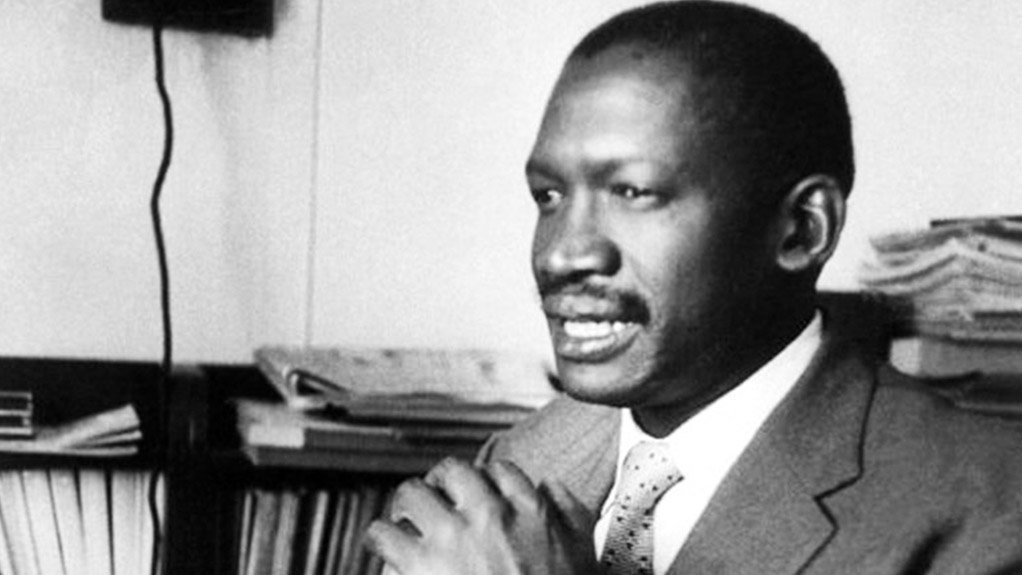
A three-month exhibition on the life and times of struggle stalwart Robert Sobukwe is being held at Freedom Park in Tshwane.
In a highly emotive opening of the exhibition on Wednesday evening, famed South African poet Don Mattera asked why the people of South Africa chose to forget Sobukwe, affectionately known as "the Prof".
"Why are you forgetting Sobukwe? Why don't you laud him as you do others? " Mattera asked.
Thando Sipuye of the Sobukwe Family Trust attempted to answer Mattera's question in an in an interview with News24.
"I think it's the tragedy of how we approach historical narratives in 1994 South Africa. We tell history in a singular political trajectory and particularly, we celebrate leaders from the ANC [African National Congress]," said Sipuye.
He added that Sobukwe was also not honoured because of what he represented, because of his Africanist philosophy that was in stark contradiction to ANC ideals.
"I think the current leadership of the ANC detests the idea of Africanism that Sobukwe propagated; the idea of an African personality, the idea of the rise of Africa or the return of Africa to its rightful owners."
"Sobukwe represented a completely different ideal; an Africa for Africans."
Sipuye pointed out, however, that this did not mean that Sobukwe hated white people.
Disingenuous to forget certain voices
The Sobukwe Family Trust also felt that it was dangerous and disingenuous to tell history from a single narrative.
"It is a tragedy, because when you tell history singular perspective, you are basically constructing incomplete histories number one, and secondly, you are silencing, you are erasing particular voices while you are lauding other voices," Sipuye added.
"I think when you tell history from that perspective, it means that we have not learnt any lessons from our erstwhile oppressors who told history from their own singular perspective as European colonialists, and that is a tragedy."
"You are denying posterity, you are denying future generations access to other channels of intellectual knowledge and political ideas."
Sipuye said the trust was grateful that an institution such as Freedom Park would take the initiative to honour Sobukwe who would otherwise be a silenced voice for the liberation of South Africa and its people.
Who was Sobukwe?
Sobukwe, a politician, teacher, academic and lawyer was born on December 5, 1924 and died of lung cancer on February 27, 1978. He founded and was the first president of the Pan Africanist Congress (PAC).
In 1960, Sobukwe was sentenced to three years in prison for inciting Africans to demand the repeal of the pass laws.
He marched to Orlando police station where he was arrested for sedition. On the same day, March 21, 1960, about 5000 marchers reached Sharpeville police station, where police opened fire and killed 69 people. It became known as the Sharpeville massacre.
At the end of Sobukwe's three-year sentence, a new law was enacted which included what is known as the Sobukwe clause, which empowered the Minister of Justice to indefinitely prolong the detention of any political prisoner.
This clause was never enacted on any other prisoner and Sobukwe was transferred to Robben Island where he was detained for a further six years in solitary confinement.
Sobukwe was released from prison in 1969 and banished to Kimberley in the Northern Cape where he was kept under house arrest.
When the PAC leader fell ill, the government made it difficult for him to get access to treatment by forcing him to comply with the conditions of his release.
EMAIL THIS ARTICLE SAVE THIS ARTICLE FEEDBACK
To subscribe email subscriptions@creamermedia.co.za or click here
To advertise email advertising@creamermedia.co.za or click here


