





- To download a copy of the Finance Minister's 2026 MTBPS speech, click here1.00 MB
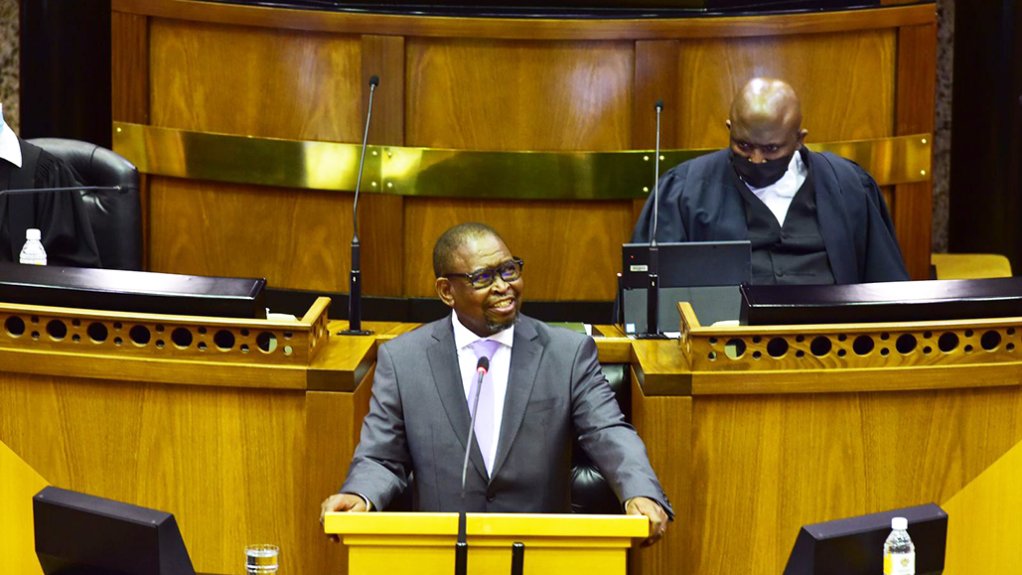
Finance Minister Enoch Godongwana used the occasion of the 2026 Medium-Term Budget Policy Statement (MTBPS) to release draft legislation for public comment aimed at integrating a principles-based fiscal anchor as a requirement for future administrations, but without introducing a rigid numerical rule.
Speaking to lawmakers against the backdrop of a narrowing in the main Budget deficit and a stabilisation in the debt-to-GDP ratio, Godongwana argued that the “hard-won gains we have made must be protected”.
Debt had stabilised at 78.4% of GDP and was forecast to decline further, the main budget deficit of 3.7% of GDP in the current year was forecast to decline to 2.5% in 2029/30, and the primary surplus is expected to reach 1.7% of GDP in 2026/27.
The National Treasury has also made a R70.8-billion upward revision to its main budget revenue estimates over the next two years on the back of stronger-than-expected tax revenue projections.
“That is why this Medium-Term Budget Policy Statement proposes a new set of fiscal guardrails to strengthen discipline, improve accountability and support responsible budgeting into the future,” the Minister said.
The proposed legislation would seek to prevent any return to the fiscal deterioration that characterised the period from the global financial crisis to the early 2020s.
The fiscal anchor formed part of what the National Treasury described as the most extensive reconfiguration of the public finance system since 1999.
Director-general Dr Duncan Pieterse said the draft legislation aimed at giving effect to the fiscal-sustainability standard had been approved for release by Cabinet.
It included proposed amendments to the Public Finance Management Act (PFMA) of 1999, as well as the legislation governing Money Bill procedures and the Financial and Fiscal Commission, which would be expected to assess future fiscal plans.
The instrument would seek to embed prudent management of the public finances across administrations by requiring the incoming Cabinet assembled following a general election to approve a fiscal plan that sets out its objectives, strategy, main assumptions and risks.
Government would be required to explain how its policy choices supported fiscal sustainability and report against the plan through the Budget Review and MTBPS, including reasons for and responses to any material departures.
“The framework establishes binding duties to disclose, assess and explain. Each government will retain responsibility for its fiscal choices,” the MTBPS states.
However, Godongwana stressed that it would not impose a strict numerical rule so as to “preserve flexibility in changing economic conditions while strengthening transparency, accountability and fiscal discipline”.
“Most importantly, it helps to ensure that developmental priorities and constitutional obligations are pursued at a pace that public finances can sustain,” he added.
Under the framework, fiscal sustainability would be defined as the ability of the State, under reasonable macroeconomic and fiscal assumptions, to meet its present and future expenditure and debt-service obligations and to manage its fiscal risks. And doing so without undermining macroeconomic stability or requiring abrupt corrections to revenue or expenditure.
The fiscal sustainability standard would be introduced alongside additional updates to modernise the PFMA, drawing on two decades of experience and including lessons from the State Capture Commission.
The changes would clarify the duties of accounting officers and boards, strengthen action on financial misconduct, reinforce governance and accountability in public entities, and improve support for distressed entities.
EMAIL THIS ARTICLE SAVE THIS ARTICLE ARTICLE ENQUIRY FEEDBACK
To subscribe email subscriptions@creamermedia.co.za or click here
To advertise email advertising@creamermedia.co.za or click here


