





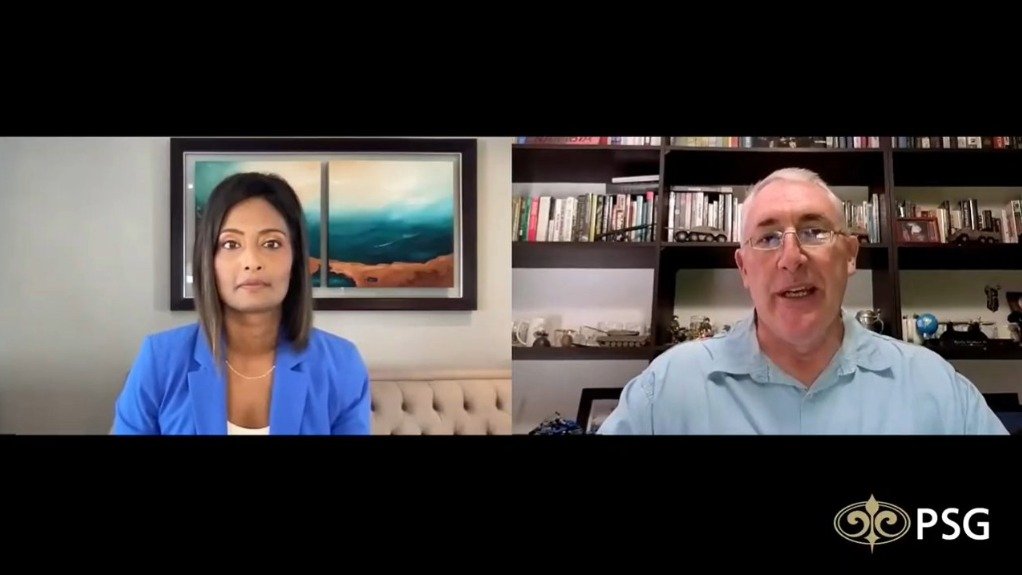

As the joint US-Israeli military campaign against Iran enters its second month, Stellenbosch University Professor of Military Science Abel Esterhuyse on Tuesday warned that the conflict is shifting toward a critical new phase: a limited ground offensive to secure the global economy.
Speaking at the PSG Think Big Series, Esterhuyse noted that the US is preparing to deploy forces along the coastal regions of the Persian Gulf.
This move, he argued, was a “pragmatic response” to a "strategic predicament" created by Iranian efforts to block international oil shipping.
The conflict, dubbed Operation Epic Fury, began in late February with a staggering opening salvo of about 900 coordinated strikes.
While the initial focus was on "offensive air power" to degrade Iranian leadership and military infrastructure, Esterhuyse noted a pivot in American strategy over the past week.
"The American focus appears almost exclusively on the economic realities of oil flow," he explained.
He highlighted that as the confrontation dragged on, keeping the Strait of Hormuz open became the primary driver of military necessity.
Esterhuyse provided an evaluation of the geopolitical alliance driving the war, particularly the role of Israel's intelligence in Iran. He described a collaboration where Israel provided the “nail” for the US “hammer” to strike.
“I think the Israelis led the decision in many ways and have brought the US to the point of acting in Iran," he said.
He emphasised that the roles of the two nations were now “inseparable”, noting that Israel's initial actions were the catalyst for current American engagement.
Esterhuyse said the geopolitical landscape of the Middle East had shifted from a regional skirmish to a global economic bottleneck.
He explained that the current friction between Iran, Israel, and the US was no longer just about ideology or "clean hands”, but about the physical mechanics of global survival.
Esterhuyse said the weapons being used in this standoff were as much logistical as they were military, adding that Iran currently held the strategic initiative with the Strait of Hormuz.
He argued that while 20% to 25% of global oil production was at stake, the crisis lay in its distribution and secondary impacts.
“The first major issue is that this supply is not spread evenly across the globe; it disproportionately affects Asian markets. For instance, China relies on this region for 40% of its oil, while South Korea depends on it for 70%, and Japan for a staggering 95%. This concentration makes it nearly impossible for the world to simply ‘adjust’ to the loss,” he explained.
The second problem, he added, was the halted flow of fertiliser from the Gulf, which was beginning to cripple global agricultural production.
Thirdly, the Persian Gulf faced a critical oil storage crisis.
“Because oil wells cannot simply be switched off, producers must keep pumping, but they are rapidly hitting their storage limits. Operating on a ‘just-in-time’ delivery model, these States have minimal surplus capacity – roughly only 20% remains,” Esterhuyse added.
He pointed out that this lack of storage was not just a logistical bottleneck but a massive security vulnerability.
“A single drone strike on a saturated storage facility could trigger an economic and environmental catastrophe, creating a profound conundrum for the Gulf States and a major economic headache for the Americans,” he stated.
TRUMP’S ECONOMIC BATTLEFIELD
Meanwhile, Esterhuyse said the war had taken on an economic reality dimension that was a challenge for US President Donald Trump.
For Trump, the war had shifted from the battlefield realities of Iran to global economic realities, he pointed out, while Israel was now focused on intelligence-driven operations in Iran.
He said Iran had created a predicament for the US with the regionalisation and globalisation of this war, with a closure of the Strait of Hormuz.
This had created a strategic conundrum for the US, giving Iran the initiative in this war, he argued, adding that, as a result, the US was in a reactive mode.
“And then perhaps a lost variable that we need to consider is the Arab nations here of the Middle East, the Sunni nations, that are being affected by this war and that are placing a lot of pressure on both Israel and America.
“And let me say this, those nations are as fearful of the rise of Israel as they are of the prominent power projection capability of Iran,” Esterhuyse said.
EMAIL THIS ARTICLE SAVE THIS ARTICLE ARTICLE ENQUIRY FEEDBACK
To subscribe email subscriptions@creamermedia.co.za or click here
To advertise email advertising@creamermedia.co.za or click here


