





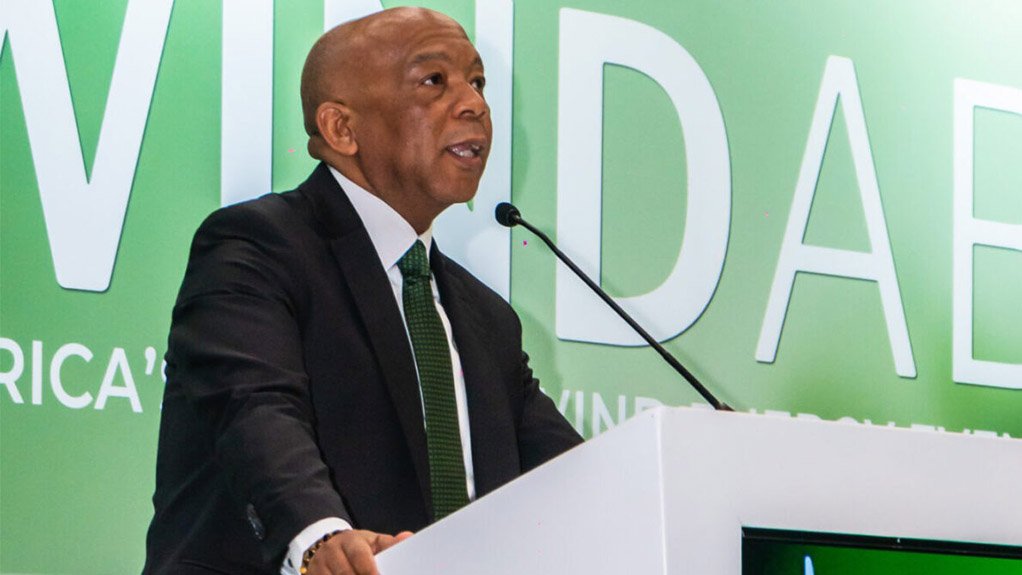
Power utility Eskom will soon make a major announcement about facilitating the construction of data centres in South Africa. This was announced by Electricity and Energy Minister Dr Kgosientsho Ramokgopa in his keynote address to the Windaba 2026 wind power conference, being held at the Cape Town International Convention Centre.
He assured that the water issues associated with data centres had been taken into account and indicated that the water they would use would be recycled.
Government believes that South Africa can secure 0.4 GW of the growing global data centre demand. Indeed, it could be more than that. The country has strong fibre connectivity and all African network operators are represented in South Africa. Consequently the country could act as a gateway to Africa, for the sector.
He pointed out that data centres were one of the main drivers of growing electricity demand, globally. Other sectors driving this growth were transport, industry, building and cooling. The relative contributions of each of these sectors varied from region to region, country to country.
All regions will see continuing significant growth in electricity demand, but only in Africa and Latin America will this growth continue to accelerate over the period 2030 to 2039. In all other regions growth will be slower than for the period 2020 to 2029. Still, global electricity demand is expected to increase by 7.4 PWh between now and 2039.
Regarding Africa, the continent's high electricity access and consumption countries are South Africa, Egypt, Morocco, Tunisia and, in fifth place, Ghana. South Africa represents 22% of total African (including North African) electricity demand.
So, he highlighted, sub-Saharan Africa was energy-starved. There was not much industrial development. That was why the region was thirsty for electricity.
He noted that 30% of the world's critical mineral reserves were in Southern Africa. Critical minerals included battery minerals. But without electricity, there could be no minerals beneficiation.
South Africa could act as a hub for the development of these minerals. The country was going to sign a contract to supply major mining country Zambia with 5 000 MW of electricity (which would help South Africa deal with its emerging problem of renewable energy generation exceeding grid capacity). Zambia's own, hydropower-centred generation capacity had been badly affected by droughts, and the emerging strong El Niño phenomenon only promised to make things worse, he pointed out.
This deal is also a harbinger of the "new markets" South Africa needs to develop for its growing electricity sector. Key to these markets is the network of regional interconnectors, creating an enormous network stretching from Cape Town to the Zambian Copperbelt.
EMAIL THIS ARTICLE SAVE THIS ARTICLE ARTICLE ENQUIRY FEEDBACK
To subscribe email subscriptions@creamermedia.co.za or click here
To advertise email advertising@creamermedia.co.za or click here


