





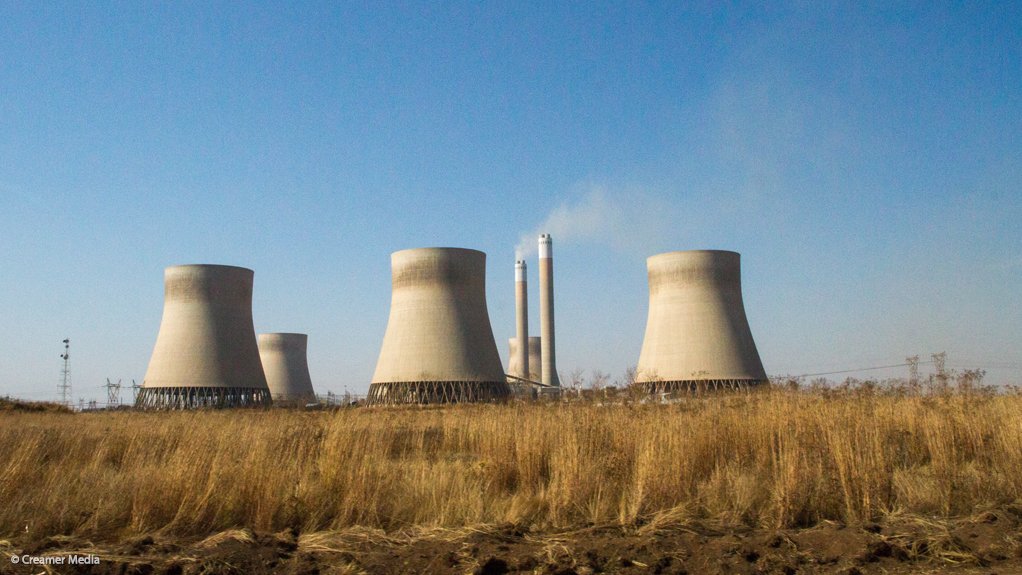
Eskom Holdings CEO Dan Marokane says the State-owned utility will outline its proposed approach in September in relation to the decommissioning of coal-fired power stations beyond 2030.
Eskom has secured limited exemptions from minimum emission standards for eight of its coal-fired power stations.
Six power stations – Kendal, Lethabo, Majuba, Matimba, Medupi and Tutuka – have been granted five-year minimum emission standards exemptions until April 1, 2030. Duvha and Matla have been granted nine-year minimum emission standards exemptions until their planned decommissioning dates in 2034.
Speaking at the Coal and Energy Transition Day in Johannesburg, Marokane argued that “timing matters” for ensuring security of supply, while indicating that Eskom’s plan was likely to propose a delay to the closure of the coal stations.
“The orderly shutdown, repowering, and repurposing of older coal-fired power stations must be informed by evidence, must be informed by system adequacy, by new generation delivery and by the readiness of the grid,” Marokane stated.
He argued that, if generation capacity was not contractually secured and demonstrably available, a closure timetable could not be considered a transition plan, but rather a “timetable to a supply crunch”.
“Eskom will therefore continue to apply a rigorous, evidence-based assessment to ensure that energy security gains are not reversed and that critical capacity for economic growth is protected.”
Marokane noted that Eskom had previously advocated for the continued operation of five coal stations slated for closure during the 2020s while still meeting the country’s emissions targets, including the carbon emission target linked to Just Energy Transition Investment Plan funding.
Marokane said the cost and system implications of full compliance with minimum emission standards should be assessed within the context of energy security, affordability and industrial competitiveness.
“This is not an argument against environmental responsibility. It is an argument for a balanced, evidence-based approach that reduces emissions while avoiding unintended consequences for security of supply and electricity affordability.”
Beyond 2030, a “very frank conversation” was needed to assess system adequacy should coal stations be closed before other new generation, including the proposed gas-to-power projects, was in place.
“We'll pronounce ourselves by September,” he stated.
“We have started with the internal governance aspects, but we are happily part of a broader discussion within the country, led by the Energy Council of South Africa. That will really look at all the facts and advise on how best we navigate that period beyond 2030.”
He argued, too, that without energy security, it would be difficult to pursue decarbonisation, as “renewable energy cannot be integrated into a weak or an unstable system”.
“Our task is therefore not to abandon coal irresponsibly. Our task is to reduce emissions while building technologies, infrastructure, and market mechanisms that enable a lower-carbon future. This is a pragmatic transition, not an ideological one.”
EMAIL THIS ARTICLE SAVE THIS ARTICLE ARTICLE ENQUIRY FEEDBACK
To subscribe email subscriptions@creamermedia.co.za or click here
To advertise email advertising@creamermedia.co.za or click here


