





The Bundibugyo Ebola outbreak in the Democratic Republic of the Congo (DRC) and Uganda presents an urgent public health and development challenge for the Great Lakes region. Although smaller so far than the 2014-2016 West Africa Ebola epidemic, history shows how quickly localised outbreaks can escalate when containment is delayed, and health systems are strained.
The immediate policy priority is containment. Failure to control transmission would not only increase mortality but also impose high economic costs through reduced productivity, heightened fiscal burdens and disruptions to trade, investment and development.
As of 7 July, the DRC had reported 1 759 confirmed cases and 600 confirmed Ebola-related deaths, while Uganda reported 20 confirmed cases and two deaths. Mortality figures should be interpreted cautiously due to possible under-reporting in remote areas.
No confirmed cases have been reported in neighbouring Rwanda or Burundi. Both countries have, nevertheless, heightened surveillance and preparedness given the extended connections with eastern DRC, especially through the Goma-Rubavu border crossing.
Ebola outbreaks can disrupt healthcare services and weaken health systems’ capacity. As resources are redirected towards emergency responses, the handling of other communicable diseases may suffer, leading to higher overall incidence and mortality rates. This can reverse hard-won gains and strain already struggling health systems, underscoring the importance of swift containment.
In June, the Institute for Security Studies African Futures and Innovation (AFI) programme modelled the impact of a ‘Containment’ scenario against the ‘Current Path’ (business-as-usual) forecast. The International Futures modelling platform’s ‘other communicable diseases’ category includes Ebola and was used to model the associated effect.
AFI analysis indicates that on the Current Path, fatalities could reach 3 360 in the DRC and 520 in Uganda by the end of 2026, compared to 490 in DRC and 30 in Uganda under the Containment forecast. (Actual Ebola deaths are already higher than the Containment forecast, indicating the gravity of the situation.) The outcome may worsen in 2027, rising to about 4 340 additional deaths in the DRC and 750 in Uganda.
Chart 1: Impact of containment on Ebola-related mortality, 2026
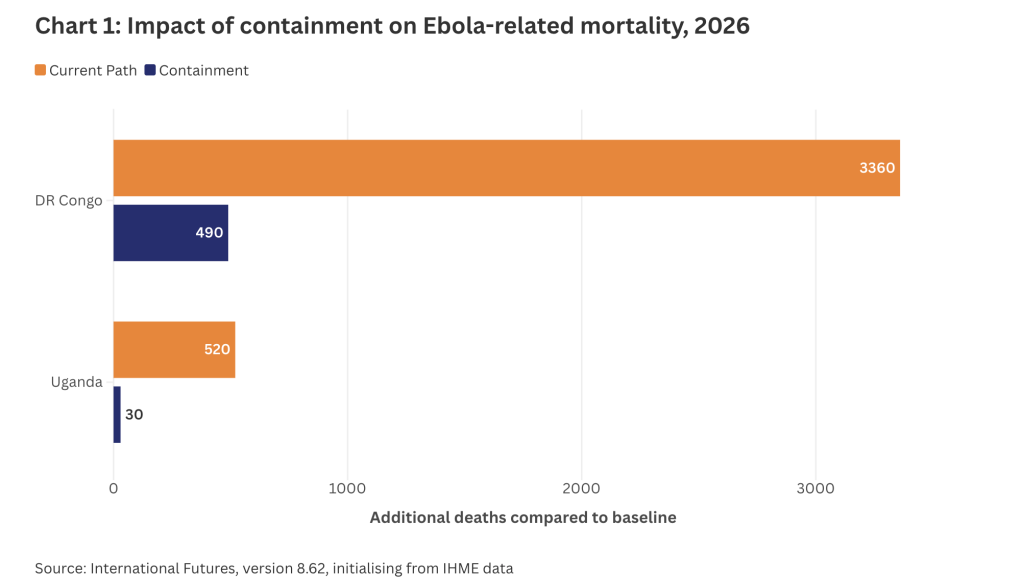
These figures are well below the 2014-2016 West Africa Ebola epidemic, which resulted in about 11 325 deaths, but they underscore the risks of delayed intervention.
Containing the outbreak will require a significant increase in public health expenditure to enable better disease surveillance, laboratory testing, treatment facilities, community outreach and emergency response systems. These interventions would not only limit transmission but restore public confidence and maintain economic activity.
AFI’s Containment scenario indicates that government health expenditure in 2026 would need to rise to at least US$1.82 billion in the DRC and US$1.17 billion in Uganda. This represents an increase of over US$540 million above the Current Path forecast in the DRC and US$170 million in Uganda. Taken together, at least US$710 million in additional health financing would be required to effectively contain the outbreak.
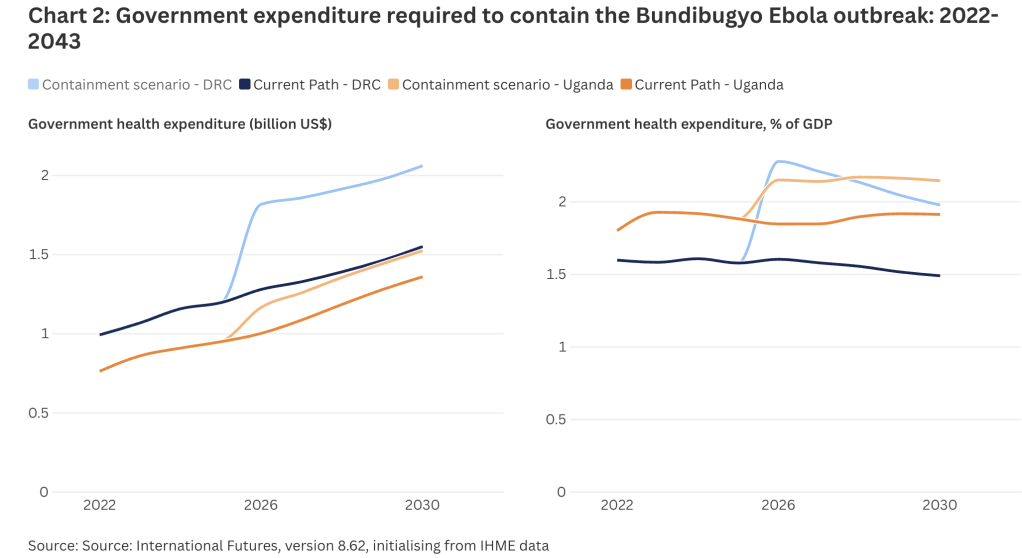
The benefits of early intervention would be substantial in terms of lives saved. Rapid containment is also significantly less costly than responding to a larger, more entrenched epidemic later.
The estimated financing requirement is broadly consistent with the US$518 million emergency appeal the United Nations and humanitarian partners launched on 5 June. Several governments and development partners have already pledged support, but crisis financing is often reactive and temporary.
The current outbreak highlights the need for more systematic investment in epidemic preparedness, surveillance systems, laboratory infrastructure, community health workers and rapid-response capacity.
However, additional health spending should not come at the expense of other development priorities. African governments are often forced to divert resources from education, social protection, food security and infrastructure during crises. This risks undermining long-term development outcomes and shifting the burden of the emergency onto vulnerable populations.
The challenge is not only to mobilise emergency financing, but to secure additional, flexible resources that allow governments to respond without compromising broader development objectives.
Ebola can also discourage market participation due to uncertainty and fear of infection. Border restrictions, reduced travel and disruptions to transport networks constrain trade, services and agricultural activity. These effects are particularly significant in the Great Lakes region, where communities rely on cross-border economic and social ties. If containment is further delayed, the region could face rising communicable disease fatalities alongside slower economic growth.
Often, economic activity does not disappear entirely but shifts into informal, unmonitored channels as households try to preserve their incomes and livelihoods. As informality increases, governments collect less revenue from customs duties, corporate taxes and other domestic sources.
AFI modelling shows that in 2026, the DRC and Uganda could lose around US$70 million and US$60 million in government revenue, respectively, due to reduced formal economic activity, increased informality and the fiscal strain of financing the outbreak response. Both governments are already under pressure to finance emergency health interventions while sustaining critical development spending.
Four key policy implications emerge from these findings.
First, early containment would be far less costly than the burden of uncontrolled escalation. Rapid intervention saves lives, reduces economic disruption and lowers long-term fiscal costs. Second, emergency health financing must be mobilised quickly and should be additional to existing development resources.
Third, responses should protect livelihoods and formal economic activity wherever possible, particularly in border communities relying on trade and mobility. Finally, the outbreak reinforces the importance of investing in resilient health systems before crises occur. Strong surveillance networks, laboratory systems, community health workers and cross-border preparedness mechanisms are the most effective safeguards against future epidemics.
The African Development Bank and other development partners can mobilise rapid-response financing, support health-system resilience and strengthen regional preparedness. Epidemic preparedness must be recognised not just as a health priority, but as a development, fiscal stability and regional resilience imperative.
This article was first published in the ISS African Futures & Innovation’s Africa Tomorrow blog.
Written by Marvellous Ngundu, Research Consultant, African Futures and Innovation, ISS; Blessing Chipanda, Senior Research Consultant, African Futures and Innovation, ISS. and Jakkie Cilliers, Head, African Futures and Innovation, ISS Pretoria
EMAIL THIS ARTICLE SAVE THIS ARTICLE ARTICLE ENQUIRY FEEDBACK
To subscribe email subscriptions@creamermedia.co.za or click here
To advertise email advertising@creamermedia.co.za or click here


