





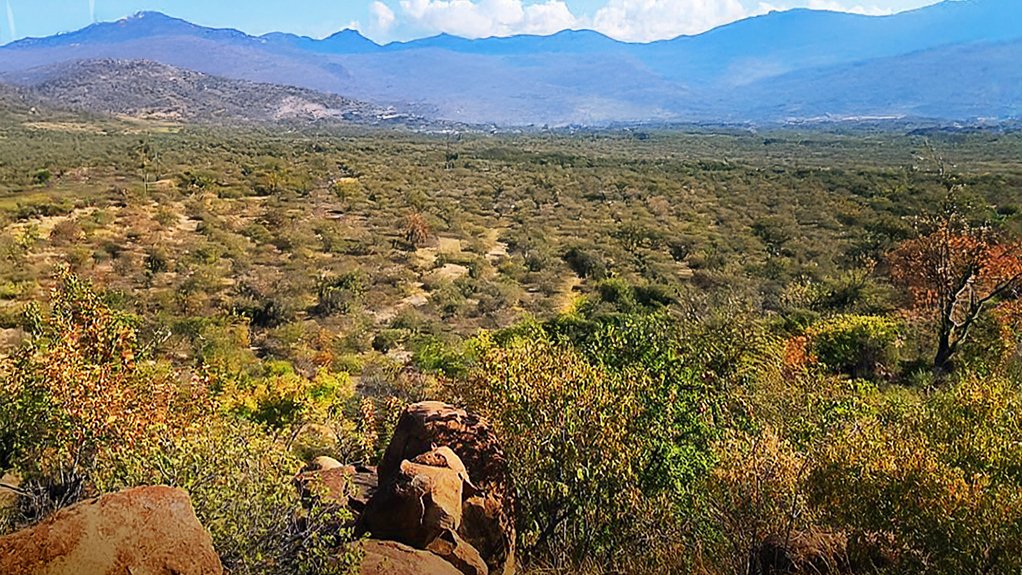

JOHANNESBURG (miningweekly.com) – Combined cash and term deposits support the continued advancement of the Bengwenyama platinum group metals (PGMs) project through the definitive feasibility study (DFS) phase and taking in preparations for early mine development, Southern Palladium reported on Wednesday, October 28, when it published its third-quarter production report.
The Johannesburg- and Sydney-listed Southern Palladium is developing Bengwenyama in a part of South Africa’s prolific Bushveld Complex known for platinum, palladium, rhodium and chrome richness.
During the September quarter, DFS engineering focused on incorporating the improved metallurgical outcomes into the process plant design, infrastructure requirements, capital estimates and overall development plan.
Work also progressed on the geotechnical and infill drilling programme and the technical studies required to support underground mine planning, Southern Palladium stated in a stock exchange news service announcement accessed by Mining Weekly.
In the December quarter, the company expects to:
- continue the permitting process for early works,
- progress contractor engagement,
- undertake further flowsheet optimisation and larger-scale confirmatory Jameson cell testing; and
- continue engaging with prospective smelting and refining counterparties.
These workstreams are intended to progress the project towards DFS completion and early development, subject to regulatory approvals, financing and other project execution requirements.
Quarterly highlights included the updated prefeasibility study (PFS), which forecast a 2.8-year payback from first Bengwenyama production, 30-year mining right approval, three times higher chromite recovery, early box-cut and decline development, and a closing cash balance of A$20.06-million excluding cash of A$1.13-million held by Southern Palladium’s 70% subsidiary, Miracle Upon Miracle Investments. This is the cash that is doing its part to support continued Bengwenyama DFS advancement and early mine development preparations.
Improved DFS metallurgical recoveries have resulted in chrome becoming the third largest revenue earner after rhodium and platinum and ahead of palladium.
The updated PFS forecast a post-tax internal rate of return rise to 39.1% from 26.4% and an 18% funding rise to $329-million.
The updated PFS forecasts a Stage 1 chrome concentrate production of 450 000 t/y and a Stage 2 steady-state output of one-million tonnes a year. Forecast life-of-mine production consequently increases to 17.2-million tonnes.
Stage 1 envisages 100 000 tonnes per month (t/m) from the South Decline, expanding to 200 000 t/m through the North Decline and a second 100 000 t/m processing module. Stage 2 is expected to be funded largely from cash flow generated by Stage 1.
The revised plant design combines dense media separation (DMS), a coarser primary grind and staged PGM and chromite recovery using established conventional processing methods.
DMS is intended to reject low-value footwall waste ahead of milling, reducing the tonnes requiring grinding by between 26% and 31%. With a further 24% of the input being recovered as a saleable coarse chrome product, less than 50% of the run-of-mine (RoM) is presented to the flotation plant. The higher upfront chrome recovery, means that there is less chrome entering the flotation circuit, further assisting in improved PGM recoveries.
The updated PFS assumes Jameson flotation cells in the PGM circuits, with larger-scale confirmatory work still planned.
The optimised flowsheet uses DMS to reject waste rock before primary milling, upgrading the material sent to the concentrator. July testwork suggested that up to 31% of RoM material could be rejected ahead of grinding, with tested three-element (3E) feed grade increased from about 5.2 g/t to 7.2 g/t. By reducing material entering the grinding and flotation circuits, DMS has the potential to improve processing efficiency and reduce equipment and energy requirements.
The updated PFS estimates peak funding, including contingencies, of $329-million (R5.47-billion) compared with $279-million (R5.46-billion).
The forecast all-in sustaining cost (AISC) is a 29%-higher $943/6E oz and the forecast realised 6E basket price is a 57%-higher $2 210/6E oz. With the increase in the realised basket price exceeding the increase in the AISC, the margin improves to 57%.
The project, near Steelpoort in Limpopo province, covers 5 280 ha.
EMAIL THIS ARTICLE SAVE THIS ARTICLE ARTICLE ENQUIRY FEEDBACK
To subscribe email subscriptions@creamermedia.co.za or click here
To advertise email advertising@creamermedia.co.za or click here


