





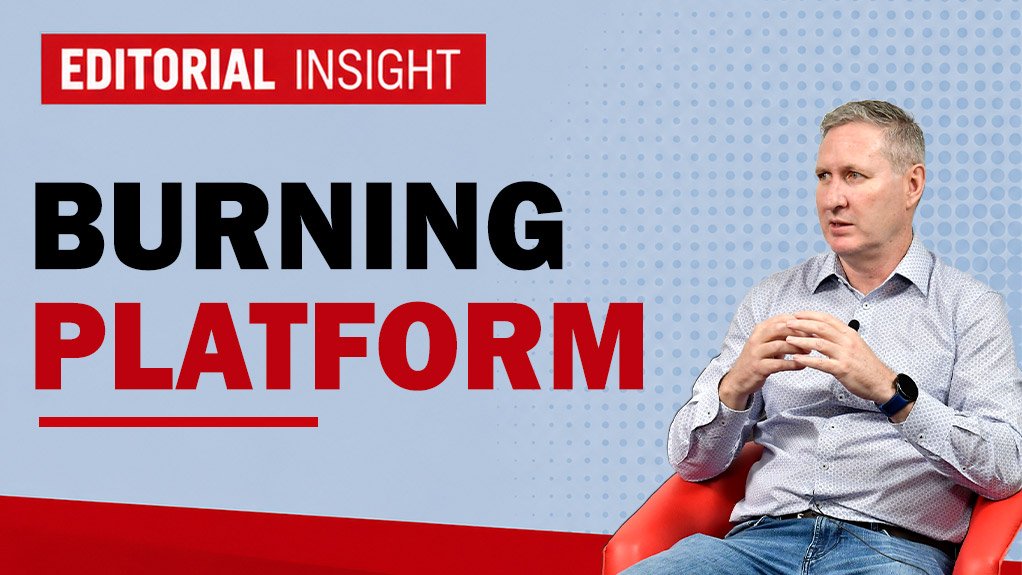
Prior to the stabilisation of Eskom’s operational performance, the issue of loadshedding was undoubtedly South Africa’s ‘burning platform’.
Besides holding back growth and sapping citizens of confidence, the State-owned utility was also a serious financial drain. Many South Africans felt doubly robbed when their taxes were used to bail out the entity while electricity tariffs rose steeply, and triply so when stories of corruption, as well as fruitless and wasteful expenditure, flowed like the diesel being burned in huge volumes in costly open-cycle gas turbines.
Following an impressive turnaround at Eskom, the country’s new burning platform is its municipal governance and service delivery crunch.
The crisis is broad-based and national, but it’s arguably best epitomised in the public imagination by the City of Johannesburg’s physical decay and financial collapse. Problems that have been skilfully highlighted by one mayoral candidate in particular, who has taken to swimming in potholes, rowing boats in streams created by burst water pipes, or quad-biking onto construction sites where repaired roads have been promised but not delivered.
The parallels with Eskom four years ago are depressingly stark, with Eskom chairperson Mteto Nyati having recently drawn them himself during a presentation of a report into the city’s crisis – the third in the ‘Johannesburg Matters’ series being released in stages by the Centre for Development and Enterprise.
The report has a strong focus on people, which it rightly says always trump policies.
Nyati highlighted the damage arising from leadership instability, as well as from the appointment of individuals not equipped for the role, or driven by motives that have little to do with their executive duties. Eskom churned through 12 CEOs and seven chairpersons in 15 years, and significant leadership changes were eventually made as part of the turnaround.
The City of Johannesburg, by comparison, has had eight coalitions and nine mayors since 2016, none of whom completed their five-year terms. Here, too, the turnaround will hinge largely on people, and on who is appointed to key roles.
While this is an obvious point (and one that has been made repeatedly as South Africa has struggled to shed its disastrous State capture years), it nevertheless bears repeating.
The late Pravin Gordhan, who led the fight internally, used to stress that one of the big lessons of State capture is that “people matter”. A lesson he drew on as he then went on to make wholesale board changes at the State-owned companies he oversaw.
Equally in the case of Johannesburg the appointments that follow the November 4 elections will determine the city’s fortunes.
Apart from the role that the voters will play in selecting the political leadership, the appointment of the city manager, including how it is done, will be watched particularly closely, as will the appointments of the boards and senior executives at entities such as City Power and Joburg Water.
Getting it right will not be easy, but the positive spinoffs could well be felt beyond the city’s boundaries given Johannesburg’s marquee status.
EMAIL THIS ARTICLE SAVE THIS ARTICLE ARTICLE ENQUIRY FEEDBACK
To subscribe email subscriptions@creamermedia.co.za or click here
To advertise email advertising@creamermedia.co.za or click here


