





The content on this page is not written by Polity.org.za, but is supplied by third parties. This content does not constitute news reporting by Polity.org.za.
Dear Fellow South African,
Last week, I spoke about our commitment to give effect to the constitutional right of access to water for all South Africans, with particular reference to communities that have remained underserved.
This past week, we released the National Water Action Plan which sets out our government’s determination to ensure that every community in our country has access to a reliable supply of quality drinking water, no matter where they live.
For too many South Africans, turning on a tap has become an act of uncertainty.
In too many cities, towns and rural areas, water disruptions have become a fact of life. Families cannot cook or clean. Children cannot wash. Shops and businesses have to close. We are determined to change that.
The National Water Action Plan sets out a clear, focused programme of immediate interventions and far-reaching reforms to address the root causes of water supply failures in many municipalities.
Our main priority lies in implementation, clear responsibilities and accountability. The National Water Crisis Committee, known as WATERCOM, will meet regularly to oversee implementation, track progress and hold the responsible departments and public entities accountable for delivery.
Just a few years ago, we faced a similar national crisis in electricity. By acting boldly to implement reforms, improve Eskom’s performance and enable massive investment in new generation capacity, we brought an end to load shedding.
We are now applying that same approach to water.
South Africa is a water-scarce country. We must continue to invest in dams, pipelines, treatment works and other bulk water infrastructure to secure our long-term water supply. The immediate challenge, however, is not mainly a shortage of rain or a lack of dams. The problem is that municipal water systems are not being properly managed, maintained and financed.
In too many municipalities, revenue collected from the sale of water is used to fund other municipal functions. This leaves too little money to repair pipes, replace pumps or employ qualified engineers and technicians.
As a result, on average across the country, close to half of all the water pumped never reaches paying customers. It leaks out of broken pipes, is stolen or is simply never billed for. That is water that has been treated at great cost and then lost, along with the revenue that should have paid for maintenance.
We cannot build our way out of the crisis if we do not properly maintain and manage the infrastructure we already have.
The National Water Action Plan will address the root cause of this crisis by changing the way that water services are delivered.
The Water Services Amendment Bill currently before Parliament will establish a clearer separation between the municipality's role as the authority responsible for water and the role of the operator that actually delivers it, so that both can be held to account.
Water service providers will be required to obtain operating licences based on their technical, managerial and financial capability. Municipalities will only be able to appoint providers that meet the required standards and can demonstrate that they are capable of delivering reliable water and sanitation services.
Where a municipality is failing, unwilling or unable to provide an acceptable service, government will intervene in accordance with the Constitution and the law to provide the required services to our people. Where necessary, another capable water utility will be appointed to run the service in the municipality's place.
The plan will also reform the way municipal water services are financed.
Through the Metropolitan Trading Services Reform Programme, the country’s eight metropolitan municipalities are being supported and incentivised to ring-fence their water revenue. This means that money collected for water and sanitation must remain within the water utility and be reinvested in infrastructure, maintenance and improved operations.
Municipalities will also receive more technical support. We will bring in additional funding by partnering with private investors and lenders, and by paying contractors according to results delivered.
Mobilising private finance and expertise does not mean surrendering public responsibility for water. Water will remain a public good and the state will continue to protect public ownership, affordability and universal access. The purpose of these partnerships is to bring additional resources and expertise into a sector where the investment need is far greater than government grants alone can meet.
We will act firmly against the corruption and criminal networks that are benefiting from irregular water contracts and damage to infrastructure.
We are not starting from scratch.
Over the last few months, work has been underway to implement the action plan. This includes immediate interventions in poorly performing municipalities, including, for example, water boards helping struggling municipalities to drill boreholes and provide emergency supply.
Grant money has been redirected to the worst-performing municipalities. Legal action has been taken against dozens of municipalities that have violated the National Water Act.
With the passage of the National Water Resources Infrastructure Agency Act, South Africa will for the first time have a specialised agency to develop, operate, maintain and finance national water resources infrastructure.
Another key reform that we have implemented is the establishment of six Catchment Management Agencies across the country. These agencies will protect and manage our major water systems, bringing control of water closer to local communities.
We are channelling more funds from national government into water infrastructure. Through national grants, we are investing R24 billion a year in municipal water and sanitation, with around 800 projects underway nationwide. Additional funding is being mobilised for municipal water infrastructure through a mix of financial instruments and public-private partnerships.
Through our programme for unserved rural communities, 71 borehole projects have already been completed in Mpumalanga, Gauteng, KwaZulu-Natal and the Eastern Cape, reaching roughly 30,000 households that previously had none. Between 80 and 100 more boreholes will be drilled this year, and 500 over the next two years, extending water to around 250 000 households.
Larger projects are also moving ahead. To give a few examples: in the uMkhanyakude District Municipality in KwaZulu-Natal, R1.3 billion of grant-funded projects will improve the reliability of water services to over 130 000 households. In Thembisile Hani Local Municipality in Mpumalanga, a R2 billion project will provide access to 65 000 unserved households. This project is 80% complete. In Limpopo, mining companies are funding half of a R26 billion pipeline project that will reach 180 000 households.
In Emfuleni, Rand Water has partnered with the municipality to create a new water utility called the Vaal Corporation Water Utility. This will result in a professionally run and financially self-sustaining water service provider that will provide greatly improved water services in a struggling municipality.
In developing the National Water Action Plan, we have had extensive consultations across all relevant national departments and entities, provincial governments, municipalities and water boards.
Everyone is committed to the successful implementation of the plan and to ending the water crisis in our country once and for all.
With best regards,
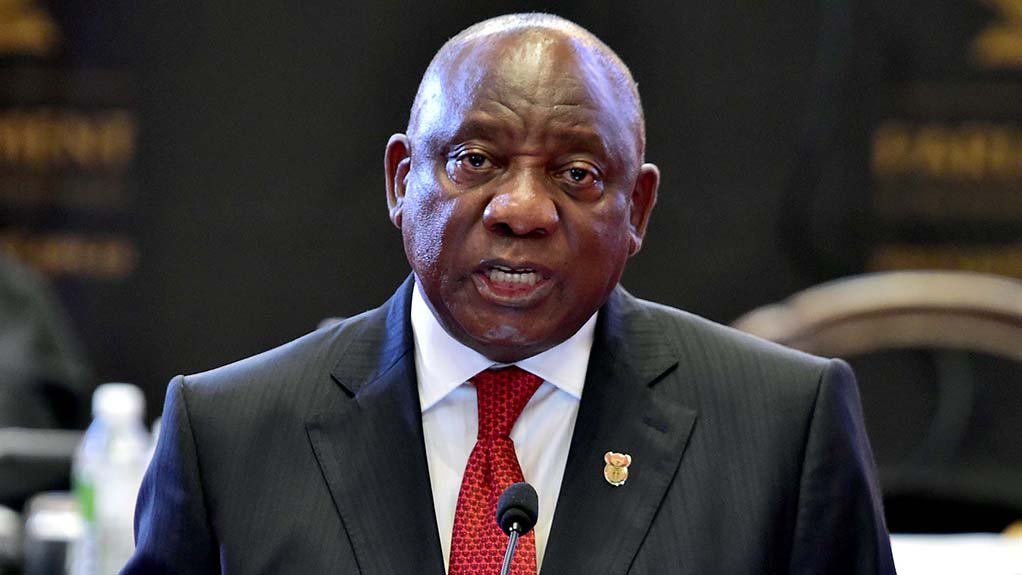
Issued by President Cyril Ramaphosa
EMAIL THIS ARTICLE SAVE THIS ARTICLE ARTICLE ENQUIRY FEEDBACK
To subscribe email subscriptions@creamermedia.co.za or click here
To advertise email advertising@creamermedia.co.za or click here


