





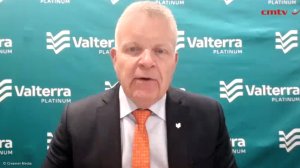
JOHANNESBURG (miningweekly.com) – Can you use AI to find new markets for platinum group metals (PGMs)?
“The simple answer is yes,” was the reply of Valterra Platinum CEO Craig Miller to Mining Weekly during the latest media roundtable of this PGMs mining and marketing company. (Also watch attached Creamer Media video.)
“The work that we’re doing in the market development space through the partnerships that we have, the investments that we've been making in some companies, is exactly that – applying technology to utilise and get to solutions much quicker than you would have done historically, by utilising AI, and that's particularly around how you mix various metals and come up with an alloy, which can then be used in new applications.
“We're already starting to see some of that coming through. It's still relatively small amounts of ounces, but the potential is very much there, and we're quite excited about that.”
In addition, is the use of PGMs in the AI space. “We think that, conservatively, there's probably 200 000 oz to 300 000 oz of PGMs used today in AI-related developments, and we can see that growing sort of four- or five-fold over the next five to eight years.”
Valterra last week presented a set of stunning half-year financial results, which included a headline earnings surge of 1 633%.
Mining Weekly: You expressed considerable bullishness about future demand growth. Share some of that bullishness with us and the reasons for your confidence.
Miller: About two-thirds of PGMs go into the automotive sector, in internal combustion engine vehicles as well as hybrid vehicles. We continue to see relatively good demand from our customers in the automotive sector, but we also recognise that the share of battery electric vehicles will continue to grow. As a result of that, we need to create new demand segments, particularly in industrial applications, also in jewellery, and also in other forms of mobility through fuel cell electric vehicles. As a company, we've entered into several partnerships – with Sibanye-Stillwater here in South Africa, with Johnson Matthey, with Umicore in Germany, and with Pujing Chemicals in China – to advance the opportunities that we see in the industrial space for PGMs. It's on the back of what we've seen from some of the early stages of those partnerships – as well as opportunities to substitute gold for platinum in both the electronics area as well as in jewellery – that you can see additional demand segments materialising, which gives us the confidence of that underlying support for the long-term outlook for PGMs.
SANDSLOOT PROJECT
With its eye also on supply, Valterra is developing a high-grade underground PGM project beneath the Sandsloot openpit at its Mogalakwena PGM flagship mine.
This project aims to offset declining surface ore grades, with potential full production expected after 2030, pending a 2027 investment decision.
Unlike other Bushveld Complex reefs, the reef height is between 40 m and 120 m, with a 45º dip on average, characteristics well suited for bulk, underground mechanised mining. The 4 g/t to 6 g/t is pointing to a substantial potential value-rather-than-volume-based growth uplift that facilitates the use of existing concentrator and tailings facilities, an advantage that is set to save billions of rands in upfront capital expenditure and operating expenditure.
Mining Weekly: You report that trial mining is scheduled to take place at the emerging new Sandsloot underground mine before the end of this year ahead of a final investment decision. Tell us about that.
Miller: Given the significant quality and scale of the Mogalakwena operation, we saw the potential of going underground at Mogalakwena and specifically the Sandsloot area, which is different to where the openpit is. Through long haul open stope mining, we see an opportunity for us to mine two-and-a-half-million tons of high-grade material, which we will be able to process through our existing facilities at Mogalakwena while potentially increasing its output by 10% to 20% and reducing its all-in sustaining costs. We've been undertaking development, we've been undertaking studies, and this year, we're hoping to complete the feasibility study and take that investment decision in the new year. Part of that feasibility study is for us to undertake the trial mining, not only to progress the development that we've done – and we've processed some stockpiles through the concentrator at the moment to test just how it reacts through the concentrator and how it reacts with the openpit material – but through the trial mining we'll have confidence then in being able to execute and ramp up production towards the end of the decade, subject to the board taking that investment decision in the new year.
Mining Weekly: Mogalakwena is a very special mine. What will it all add up to if Sandsloot eventually enters the fray within the Mogalakwena complex as well?
Mogalakwena is the crown jewel in the PGM space, and we have the benefit of owning it, and therefore the responsibility of extracting all the value from the operation, not only to benefit Valterra and its shareholders, but also all stakeholders, the community that surrounds us, through either the procurement, employment, and also most importantly, as shareholders of Valterra, they get to benefit from that. It’s a fantastic orebody, and we're certainly trying to showcase the value that we see from this orebody and realise that value for the benefit of Valterra, and the whole of South Africa. Our contribution to the South African economy was about R46-billion rand in the first half of the year. That's through taxes. That's through procurement. That's through salaries and wages. That's also through our social investments that we've made. So, pretty significant, and that's why we are so passionate about the opportunity we see at Mogalakwena.
Mining Weekly: Minerals Council South Africa last month staged a mining modernisation showcase. Can't you do something that helps everybody and that’s cheaper, quicker and does everything better in a modern environment?
Miller: We certainly see the opportunity around differentiating Sandsloot underground mining methods from what we see at other parts of the PGM sector. We're certainly embracing that, certainly utilising equipment. Taking people out of harm's way is a key component of what I would say is the modernisation, so we're continually looking at how do we modernise our operations such that we take people out of risky areas, and that for me, is a key component of where we see the opportunity from a modernisation perspective. I would argue that we’ve got downstream processing in the PGM sector that’s industry leading. I've had the opportunity of seeing other processors, refineries globally, and I think we've got something pretty special that really showcases the value that we have as a company. But it's a continuous effort, and we do see the opportunity around utilising data and AI more extensively within the business to improve performance and improve safety outcomes.
Mining Weekly: Mogalakwena always gets a lot of mention but what about the merits of your other operations such as Amandelbult, Mototolo and Der Brochen?
We've certainly come out of the demerger from Anglo American as a very PGM-focused company. We've got some of the best assets that there are in the sector and we've been working hard to ensure they all operate sustainably in the lower half of the cost curve, that we realise their full potential. Because of the unique nature of every asset within the portfolio … we're actively investing in those assets. Amandelbult is a conventional mine that produces around about 600 000 oz of PGMs per year. But it also produces about a million tons of chrome ore per year, which is growing in importance to the global economy as a product. As a consequence of that, you see its revenue basket being one of the highest in the industry, and because of the work we've done in resetting its operational performance, its cost base, it generates one of the highest PGM margins in the sector, at about $1 400. We continue to make investments there and extend its life, so that we’ll be able to mine and produce at 600 000 oz to 620 000 oz for at least the next three decades. Amandelbult is a very important asset and a massive cash flow contributor to our business. Mototolo is out on the eastern limb and we’ve been expanding our Mototolo asset and footprint. We’ve now accessed the Der Brochen decline so we’ll be able to combine Der Brochen, Borwa and Lebowa, and then look at producing around about 300 000 oz from Mototolo with the opportunity of increasing that production by another 10% to 20% by the end of the decade. We're actively working on how we do that, and we hope to give more details to shareholders at our year-end results next February. Then, finally, Unki in Zimbabwe is a fantastic asset and a stable producer of PGM ounces and some of the base metals we’ve mentioned.
INTEGRATED VALUE CHAIN
In addition to mining assets, Valterra has an integrated value chain.
“Not only do we mine it, but we process it and refine it here in South Africa. So, we beneficiate our products to their final stage here in South Africa, and export them or use them locally for the benefit of all of our customers. Through the capitalisation that we've been on in our downstream processing assets – focusing around improving recoveries at our concentrators, at our refineries, at our smelters – we've really seen those benefits coming through in the results,” Miller pointed out.
DECARBONISATION
The company is also introducing many megawatts of green renewable energy and has decarbonising targets which are being met. It regards sustainability as both value protection and value creation for it as a business, and that's why sustainability is embedded into everything that it does.
It is focused on climate and the environment as well as community resilience and meeting the highest standards of certification.
A number of years ago, it identified the need to support energy resilience. Some 30% of its energy is now coming from renewable-energy sources through Envusa Energy.
“That helps us decarbonise and puts us well on track to achieve the 30% decarbonisation by the end of this decade and carbon neutrality by the end of 2040.
“That's really important for us because not only is it that energy security I spoke about, it comes at a cheaper cost than what we are currently paying today, and it also then ensures that our metals are attractive to our customers who are quite focused around sustainability,” Miller pointed out.
WATER RESILIENCE
In addition to being a major energy user, Valterra also consumes a large amount of water, and, therefore, regards the development of water resilience as being equally important.
As a result, it has been working with local communities around treating effluent water for use in its processing facilities, enabling potable water to be used in the local community by reducing its own requirement for potable water.
Interestingly, the company has just commissioned a five megalitre water treatment plant in Thabazimbi, which supports its water requirements and ensures that the local community benefits.
EMAIL THIS ARTICLE SAVE THIS ARTICLE ARTICLE ENQUIRY FEEDBACK
To subscribe email subscriptions@creamermedia.co.za or click here
To advertise email advertising@creamermedia.co.za or click here


