





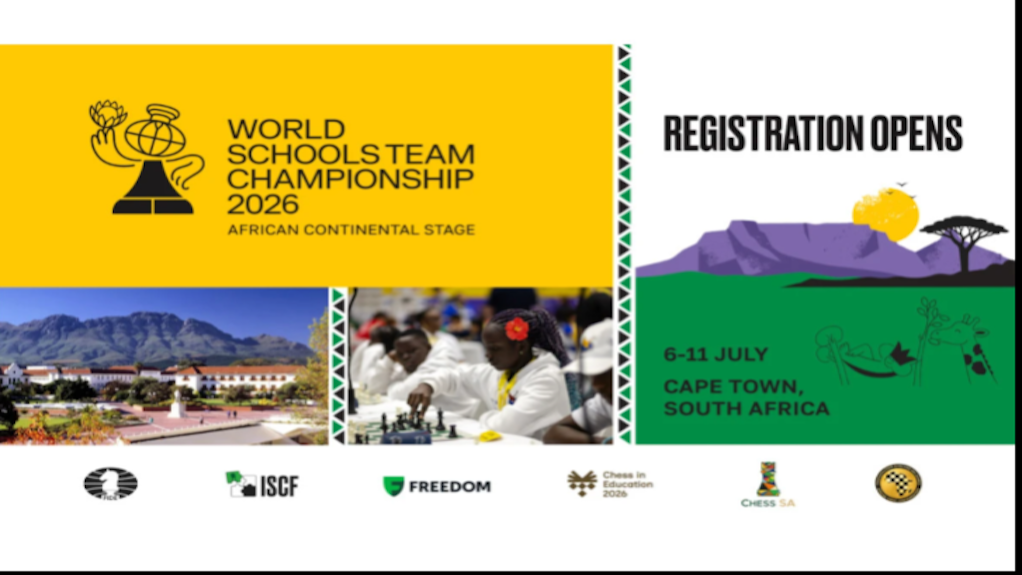
Africa will host a continental stage of the World Schools Team Championship for the first time, determining the team that will represent the continent in the competition’s grand final.
The tournament will take place from 6 to 11 July 2026 in the Cape Town area of South Africa. Teams will be entered through their national chess federations, with the winner securing a place in the grand final, scheduled for December.
The African stage is part of a redesigned WSTC format comprising four continental qualifiers in Africa, the Americas, Asia and Europe. Rather than relying on a single international tournament, the new structure creates a clear progression for school teams, from national selection to continental competition and, for the winners, the world final.
The first event of the 2026 cycle was held in Almaty in April and brought together 26 school teams from 19 Asian countries. Wisdom School of Tashkent won the tournament. Kurchatov School of Moscow finished second, while Velammal MHS School of Chennai took third place.
After the African stage, the cycle will continue in the Americas and Europe. The Americas qualifier is scheduled to take place from 11 to 16 August in San José, Costa Rica.
The Cape Town tournament will give African school teams their own continental route through the WSTC qualification system for the first time. Its programme will also include educational activities, including masterclasses, lectures, interactive workshops and initiatives aimed at encouraging educational exchange and cross-cultural dialogue.
FIDE president Arkady Dvorkovich has linked the launch of the African and Americas stages to the development of chess infrastructure and school programmes in both regions. FIDE sees the competitions as part of a broader strategy to expand organised school chess beyond its traditional centres.
ISCF president Timur Turlov has described the expansion of school championships into Africa and the Americas as a step towards greater youth participation and the creation of more sustainable chess ecosystems.
The long-term development of school chess requires several elements to work together: trained teachers and coaches, domestic competitions, federation involvement, support from educational institutions and stable funding. The significance of the Cape Town event will therefore depend not only on the final standings, but also on whether schools and federations continue their work after the tournament ends.
Kazakhstan offers one reference point for how school chess can be developed at national level. According to the latest FIDE figures, the country’s Chess in Education programme reaches more than 1,500 schools and about 60,000 pupils, while approximately 3,500 teachers have received training.
The first World Schools Team Championship was held in Aktau, Kazakhstan, in the summer of 2023 and attracted participants from 53 countries.
In September 2024, the FIDE general assembly supported granting affiliated-organisation status to the International School Chess Federation, or ISCF. FIDE and ISCF now jointly organise the championship, working with national and regional partners on individual stages.
Freedom Holding Corp, an international fintech group operating in 22 countries, serves as the general partner of the WSTC cycle. Its founder and chief executive, Timur Turlov, also chairs ISCF and has led the Kazakhstan Chess Federation since January 2023.
According to Freedom Holding, the company allocates more than $15m annually to chess-related initiatives, including international, corporate and school competitions. In April 2026, the group also acquired ChessBase, a developer of chess databases, analytical software, training products and online services.
Freedom Holding plans to invest about €5m in the further development of ChessBase. The funding is expected to support platform modernisation, the introduction of artificial intelligence tools and integration with the group’s digital ecosystem. The acquisition is not directly connected to the WSTC, but reflects the expansion of the company’s chess investments beyond tournament sponsorship.
The Cape Town stage will produce a continental champion and a place in the December grand final. The more important result will emerge later: whether federations continue to run selection programmes, schools keep forming teams, and coaching and competition infrastructure across African countries continues to develop after the 2026 cycle.
EMAIL THIS ARTICLE SAVE THIS ARTICLE ARTICLE ENQUIRY FEEDBACK
To subscribe email subscriptions@creamermedia.co.za or click here
To advertise email advertising@creamermedia.co.za or click here


