





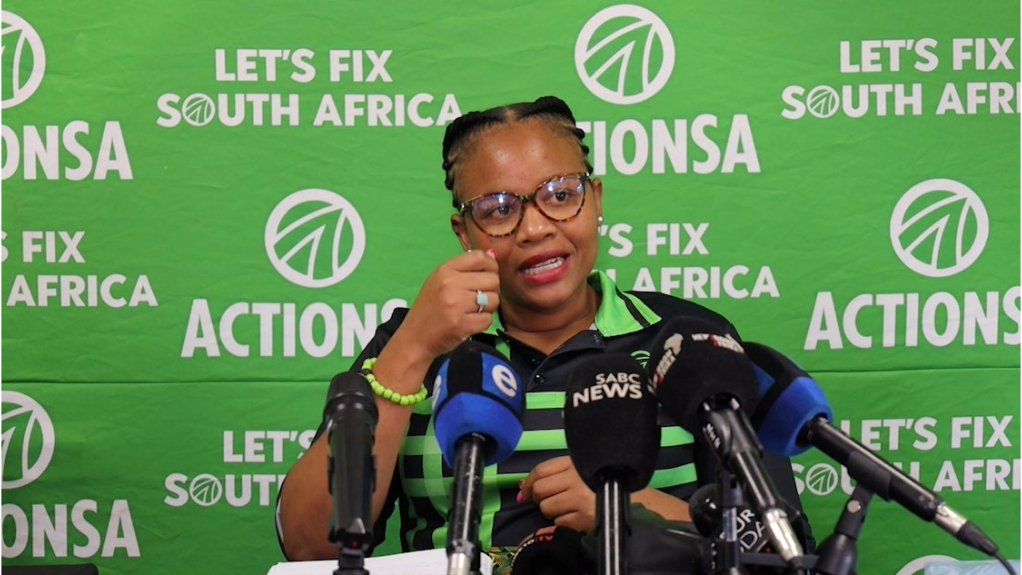
Honourable Speaker
Vice-Chancellor and Senior Management of the University of South Africa
Deputy Executive Mayor
Chief Whip of Council
Members of the Mayoral Committee
Chairpersons of Section 79 Committees
Leaders of all political parties represented in this Council
Fellow councillors
The City Manager and the senior management of the City
Leaders of organised formations, labour and business
Traditional and religious leaders
Members of the media
The first Executive Mayor of Tshwane, Smangaliso Mkhatshwa
Distinguished guests and dignitaries
Last, but certainly not least, we acknowledge the leaders of the political parties that form part of this coalition, whose partnership and commitment continue to sustain this government.
I also wish to acknowledge the President of my own party, ActionSA, Mr Herman Mashaba, and his wife, Mrs Connie Mashaba.
We also extend our sincere appreciation to the University of South Africa for hosting this address, and to Gautrain for their support of this event.
We value the contribution of our stakeholders in making this gathering possible and enabling more residents to be part of this moment.
And, most importantly, the residents of Tshwane who give this city its life.
Honourable Speaker, as we mark the 70-year commemoration of the historic Women’s March in our city, we are reminded of the courage of the 20 000 women who stood against injustice.
Their legacy calls on us to reflect on the inequalities that persist and to renew our commitment to addressing them with urgency and purpose.
Last year, we stood before this Council to deliver our maiden State of the Capital Address.
At that moment, this administration had just taken office, with two years remaining before the next election.
We understood that this was a limited period and that the question before us was how to deliver the greatest possible impact within that time.
We set out clear priorities to stabilise the City and begin the work of rebuilding it.
A year later, we return to account for that work and to reaffirm our commitment to leave the City of Tshwane in a better state than we found it.
We do so with confidence, because that work is already showing results.
It is an honour to rise to deliver this address on behalf of a multiparty coalition government comprising the ANC, EFF, ActionSA, AIC, DOP, PA, ATM, PAC, COPE, IFP and GOOD.
This coalition brings together different ideologies, voices and perspectives.
It reflects a shared commitment to improving the daily lives of our residents and restoring trust in this City.
At a time when coalitions are often associated with instability, this coalition has demonstrated that collaboration in the public interest is both possible and necessary.
This has not always been easy, but our shared responsibility to deliver services to all residents of Tshwane has kept us united in purpose.
Honourable Speaker
When we took office, we found a City under strain.
Systems were weakening.
The institutional foundation was not as strong as it needed to be.
And too many residents were living with uncertainty.
But even then, the strength of Tshwane was clear.
It is seen in the perseverance of families in Hammanskraal and Themba.
It is seen in the determination of business owners in Centurion and Ekangala.
It is seen in the everyday resolve of communities in Gomorrah informal settlement and Winterveld.
Our responsibility has been to stabilise the City so that it can meet its constitutional mandate and deliver consistently to Tshwane residents.
Today, we provide an update on the progress we have made in the past 18 months and the work that remains.
We are building a capable City that pays its bills, delivers services and puts its people first.
Residents of Tshwane
This work is organised around six clear priorities.
These priorities reflect the reality that a capable City is built through systems that work together.
Financial stability provides the foundation for everything we seek to achieve as a City.
A growing economy strengthens that foundation by expanding revenue and creating opportunity.
That growth depends on infrastructure that is maintained and able to support it.
It also depends on a city that is safe, clean and functional in the everyday experience of its residents.
At the same time, social services ensure that those most in need are supported and that no community is left behind.
All of this depends on strong governance and responsive customer care, so that the system works as it should and residents can see and feel the difference in their daily lives.
Together, these priorities are interconnected, each reinforcing the other to move Tshwane forward in a balanced and sustainable way.
Through them, we are building a stronger, more inclusive city, with greater opportunity for all who call Tshwane home.
With that, allow me to reflect on Priority 1: Financial stability and revenue enhancement.
Residents of Tshwane
We took office at a time when the City’s finances were under severe strain, defined by ballooning debt of over R13 billion, consecutive unfunded budgets, weak financial controls and a breakdown in financial discipline.
This was not a City on stable ground.
It was an institution under pressure, constrained in its ability to meet service delivery demands and exposed to growing risks that threatened its sustainability.
From the outset, the focus was on restoring financial discipline, rebuilding credible budgeting and strengthening internal controls.
We delivered a fully funded budget in the 2025/26 financial year – the first funded budget since the 2021/22 annual budget adopted in June 2021.
This budget was independently assessed by the National Treasury of South Africa and confirmed as credible and funded.
Central to this has been the intensification of revenue collection through Tshwane Ya Tima, improved billing accuracy and rebuilding trust with residents.
Cash-backed reserves have grown from R835 million to over R1,9 billion, representing growth of approximately 128%.
This momentum continues, with reserves projected to reach R2,86 billion by the end of the 2025/26 financial year.
This work has been strengthened by the leadership of the Deputy Executive Mayor and MMC for Finance, Cllr Eugene Modise.
Crucially, the City’s financial position has stabilised.
The current ratio has improved from 0,61 in the 2023/24 financial year to 0,72 in the 2024/25 financial year, and is projected to reach 0,86 in 2025/26.
Cash-to-cost coverage has also strengthened, increasing from approximately 17 days in 2023/24 to 25 days in 2025/26, reflecting a more stable and resilient cash position.
Meanwhile, we have worked to reduce historical debt, including Eskom-related debt, which has declined from R6,66 billion in October 2024 to approximately R4,73 billion at the end of March 2026.
We are honouring our commitments, paying service providers more efficiently and restoring confidence in the City’s financial credibility.
To assist residents, within our first 100 days, we introduced the Debt Relief Scheme to support households and businesses still recovering from the effects of COVID-19.
Over R4,3 billion in customer debt was written off, benefiting more than 85 000 indigent households.
We also cleared R1,8 billion in inactive accounts and ensured that support reached those who needed it most.
More than 20 000 residents came forward to regularise their accounts, with over 17 000 cases resolved – an 85% resolution rate.
Within the same period, we committed to achieving 90% meter reading accuracy.
Today, we report that this commitment has been met.
This is more than a statistic. It is the rebuilding of trust between the City and its people.
Residents of Tshwane
The draft 2026/27 Budget and Integrated Development Plan mark the next phase of this work.
These maintain a fully funded, cash-backed position while increasing capital investment from R2,8 billion to R3,5 billion, a R700 million increase, or 25%.
This is a deliberate shift toward infrastructure-led growth and long-term sustainability.
At the same time, we are reducing reliance on outsourced services and strengthening internal capacity:
·Water tanker services have been reduced by 79%
·Security services have been reduced by 17%
·Overall contracted services have been reduced by 4,4%
These savings are being redirected into infrastructure, maintenance and building a capable state.
Because in Tshwane, every rand must work and every rand must deliver value.
And as we rebuild internally, external stakeholders are beginning to take notice.
The positive outlook affirmed by Moody’s is a strong signal that Tshwane is on the right path.
It confirms that we are restoring credibility and managing public finances with discipline.
This strengthens investor confidence, improves access to funding and reduces the cost of borrowing.
It enables the City to expand infrastructure investment and deliver services more reliably.
Residents of Tshwane
We have stabilised the City’s finances, reduced historical debt and rebuilt our cash position.
This provides a stronger and more reliable foundation not only for service delivery, but also for economic growth.
With that foundation in place, allow me to reflect on Priority 2: Economic revitalisation and investment attraction.
My fellow residents
Tshwane is not only the administrative capital of South Africa.
It is a central driver of economic activity in Gauteng and across the country.
Our city contributes 9% of the national GDP and remains one of the fastest-growing metros, with the population increasing by over one million between 2011 and 2022, representing growth of approximately 35%.
Yet despite this potential, our economy was underperforming.
Economic growth declined sharply, from an average of 5,2% between 2004 and 2013 to less than 1% between 2014 and 2023.
Over this period, population growth outpaced economic growth.
As a result, the average resident of Tshwane is poorer today than they were a decade ago.
This decade of decline saw weakened investor confidence, rising municipal debt and fewer jobs created.
When we were elected to office in October 2024, there was no coherent strategy to guide economic recovery, attract investment or create jobs at the scale required.
From the outset, this administration committed to changing that.
Our residents are not asking for favours.
They are asking for a fair chance to participate in the economy.
In April 2025, we adopted the Tshwane Economic Revitalisation Strategy.
This is our roadmap to grow the economy to an average of 3,9% and to create at least 80 000 new jobs by 2029.
It provides the City with a clear framework to restore investor confidence, improve the ease of doing business and expand access to economic opportunity.
We are beginning to reverse a decade of economic decline and restore the conditions for economic growth and job creation.
This work is being driven under the leadership of the MMC for Economic Development and Spatial Planning, Cllr Sarah Mabotsa.
Residents of Tshwane
The first sign that this strategy is taking effect is the return of investor confidence.
In September 2025, we hosted the inaugural Tshwane Investment Summit.
We set a target of R5 billion in new investment.
Instead, we secured R86 billion in investment pledges.
These pledges are linked to 22 projects across key sectors of our economy, including construction, automotive manufacturing, infrastructure, energy, tourism and logistics.
These include over R16 billion in property and development projects, as well as approximately R70 billion in large-scale energy and infrastructure investments that will strengthen the long-term capacity of our city.
Already, more than R200 million of this investment has begun to flow into Tshwane.
This momentum is also reflected in the City’s verified investment pipeline, which has grown from R1,4 billion to almost R12 billion in one year.
We are also unlocking the economic value of City-owned assets.
Underused properties such as the Pretoria Showgrounds, the Sunnyside Nelson Mandela Corridor, industrial sites in Rosslyn and the ODI Stadium precinct in Mabopane have already been released to the market for long-term development.
Bids were invited in November 2025, with submission deadlines concluded in January this year.
The City has received proposals across these sites and is currently evaluating bids for award.
This marks a shift to implementation.
Taken together, these developments signal that Tshwane is once again a credible and competitive destination for investment.
However, attracting investment is only the first step.
We must now ensure that investment moves through the system, that projects are implemented and that jobs are created.
To achieve this, we are aligning the full machinery of the administration behind the Tshwane Economic Revitalisation Strategy.
This includes the introduction of the Catalytic Investment Unit, a focused delivery mechanism to fast-track catalytic projects, remove bottlenecks and ensure that priority investments move from commitment to implementation.
Similarly, the establishment of the InvestSA One Stop Shop in Centurion is helping investors navigate approvals more efficiently, reducing delays and making it easier for businesses to invest and create jobs.
In addition to improving the ease of doing business, we are guiding investment through targeted precinct development.
The approved Precinct Plan for the Tshwane Market and surrounding areas will enable mixed-use development, including more than 7 000 housing opportunities.
Similarly, the Clydesdale Precinct Plan will support increased student housing and higher-density development near key institutions.
This approach allows more residents to live closer to where they work and study, reducing transport costs and improving access to economic opportunities.
The impact of this work is already visible in key sectors of our economy.
The international vehicle manufacturer Chery has chosen Tshwane as its new manufacturing base, reinforcing our position as a leading automotive hub on the continent.
At the same time, BMW Group Plant Rosslyn has produced its 100 000th fourth generation BMW X3 and remains the only global facility manufacturing the plug-in hybrid variant.
To support the continued growth of this sector, we approved the master plan for the Tshwane Automotive City in Rosslyn.
This long-term development will anchor investment, strengthen industrial capacity and create tens of thousands of jobs over time.
Already, this is translating into real activity on the ground.
Abcon Developments is preparing to break ground on the first phase of the Rosslyn Hub Development by July 2026.
More than R1 billion in investment has already been secured, supported by bulk infrastructure works that have created over 1 400 construction jobs.
This investment is not isolated.
ACTOM is expanding its manufacturing operations in Tshwane, with the reopening of the former SGB Smit Power Matla facility in Pretoria West restoring around 250 jobs in December 2025.
Together, these developments show growing investment and renewed industrial activity across the city.
Ladies and gentlemen
Economic growth must also expand access to opportunity.
To support the informal economy, the City has begun constructing new trader facilities in Marabastad, providing safe, serviced trading spaces for 65 traders.
We have also issued 962 licences and 742 permits to informal traders and small businesses.
This enables more residents to operate legally, access services and grow their enterprises with greater certainty.
Through training and support programmes, traders are being equipped to meet regulatory standards, access markets and improve the sustainability of their businesses.
Through the Expanded Public Works Programme and related initiatives, thousands of work opportunities have been created.
By the end of Quarter 3, 4 848 Public Employment Programme opportunities had been provided.
We also provide business support services to SMMEs through our business support offices.
One such beneficiary is Mr Bafana Majola of Bronkhorstspruit, who has grown his business by more than 40%, sustaining five jobs and creating three new ones.
This reflects how support and economic inclusion translate into real outcomes.
Young residents of Tshwane
We recognise that unemployment, particularly among young people, remains one of the most urgent challenges facing our city.
More than 60% of our population is under the age of 35.
For many, the barrier to entering the economy is not potential.
It is access.
To address this, we launched the Ithuba Youth Economic Development Programme at our Tshwane Investment Summit.
Ithuba means opportunity.
An initial R8 million has been allocated to support youth entrepreneurship, with further funding to follow as the programme expands.
The programme takes a full pathway approach, supporting youth entrepreneurship, improving access to markets and supply chains, creating work opportunities and building in-demand skills.
It removes key barriers to participation, enabling young people not only to find work, but to build businesses and enter the economy with greater confidence.
Already, nearly 3 000 young people have registered to participate in the programme.
This begins to turn potential into participation and participation into economic growth.
We are also planning for future growth.
The approval of the Tourism Strategy and Masterplan sets clear targets to increase domestic and international visitors and unlock up to R10 billion in additional annual economic activity.
This will support new businesses, create jobs and expand opportunities across the city.
Honourable Speaker
The economy of Tshwane is not yet growing at the pace we require.
But the direction is now clear.
I now turn to Priority 3: Infrastructure development and service delivery.
Our task is to respond to the daily pressures households are carrying now, while building a city where every child can grow up with water in the taps, lights that stay on, safe streets and a fair chance at a better life.
Communities cannot thrive without the systems that power daily life.
Under the leadership of the MMC for Utility Services, Cllr Frans Boshielo, we are prioritising enabling water and electricity infrastructure as a core pillar and driving its rollout with urgency.
This is about restoring the foundations of a working city and leaving it in a better condition than we found it.
I turn now to water stabilisation – restoring control and reliability.
There is no water crisis in Tshwane.
The challenge is water losses caused by ageing infrastructure, leaks and inefficiencies, not a lack of bulk supply.
The City meets a demand of 800 to 900 million litres per day.
This is achieved through a mix of bulk procurement and internal production.
Bulk procurement accounts for 72% of supply.
This is mainly sourced from Rand Water, which supplies over 600 million litres per day.
Additional bulk supply is sourced from Magalies Water.
Internal production accounts for 28% of supply.
This comes from Rietvlei Dam and Roodeplaat Dam.
It also includes groundwater sources, such as Grootfontein, Fontana and Sterkfontein.
When we took office, non-technical losses were at 39% – driven by theft and unbilled usage, especially in Region 1, alongside infrastructure over 50 years old.
Hammanskraal and Bronkhorstspruit remain key pressure points, but we are committed to restoring water supply after decades.
We introduced a Water Stabilisation Plan to stabilise bulk supply, improve reservoirs and pump stations, manage pressure, fix leaks, reduce illegal connections and strengthen monitoring and metering.
This restores system control while improving long-term performance.
In Mamelodi, the areas of Ikageng and Mahube Valley Ext 3 went without reliable water supply for more than six years.
Water has now been restored, with residents once again able to access water in their taps.
In Winterveld, Olievenhoutbosch, Mabopane and Bronkhorstspruit, interventions are improving consistency and restoring control.
As of April 2026, reservoir and water storage infrastructure is performing strongly.
Winterveld Reservoir, Booysens Ext 4 Reservoir and Louwlardia Ext 57 Reservoir are all at 100% completion or expenditure.
Babelegi Reservoir upgrades are at 86%, and telemetry and bulk meter installations are fully complete for smart monitoring across reservoirs.
Together, these projects will improve storage capacity and strengthen the reliability of the City’s water supply system.
In Hammanskraal, progress has been made in restoring access to clean and drinkable water through the completion of key infrastructure.
Module 1 of Klipdrift Package Plant was completed in January 2025 and Module 2 was completed in November 2025, increasing available treatment capacity.
We acknowledge that this project has experienced delays. Our focus now is on ensuring that sufficient water is pumped into the system to stabilise supply to the first modules before proceeding with the commissioning of Modules 3 and 4.
Sewer and waste water challenges are also being addressed.
Winterveld bulk water line and sewer reticulation are at 98%.
Andeon Ext 37 is at 98%.
Mamelodi Ext 6 (Phomolong) is at 85%.
Ekangala Block A to F is at 100% completion.
Rooiwal Waste Water Treatment Plant Phase 1 is progressing, with completion expected in the coming months.
The City is moving beyond the planning phase of Rooiwal Waste Water Treatment Plant.
Phase 1 of refurbishment is nearing completion, restoring primary settling tanks and digesters to improve capacity and compliance.
More than 28 km of pipe has been replaced.
From January to April 2026, over 150 major leaks were fixed, reducing flooding and pressure drops in Garsfontein, Ga-Rankuwa and Mabopane.
Water losses are being reduced through control, repairs and monitoring.
The goal remains unchanged: To build a water-secure city.
The same pressures are evident across our electricity network.
At the beginning of this year, we were caught off guard by rolling blackouts because we underestimated the fragility of the network.
Large parts of the system were operating with very little margin for error.
More than half of our transformers are over 40 years old and some are older than 60 years.
This exposed the extent of the challenge and made clear the need for a structured response.
It underscored the need for an Electricity Stabilisation Plan, which we have since implemented to restore control and stability to the network.
A growing city places increasing demand on infrastructure that was never designed to carry this scale of pressure.
If growth is to be sustained, the grid must grow with it.
We committed to stabilise the grid and rebuild it for the future.
Primary substations form the backbone of the grid and include Wildebees, Njala, Kwagga, Pyramid, Rosslyn, Kentron and Monavoni.
Kwagga Substation is a critical backbone of the network and supplies electricity to approximately 58% of residents across the central, western and southern parts of Tshwane, including Atteridgeville, Laudium, Pretoria West and surrounding areas.
It is too important to fail, which is why it has been prioritised for stabilisation and protection.
Work at Kwagga has included restoring backup capacity, strengthening system protection, improving switching capability and reinforcing infrastructure resilience.
Wildebees Infeed Station strengthens bulk supply into the city and supports the northern corridor, including Soshanguve, Mabopane, Ga-Rankuwa and surrounding areas.
Njala Substation operates as a critical high-voltage hub supporting a wide distribution area across the eastern and southern parts of Tshwane, including Mamelodi, Eersterust and surrounding communities.
Pyramid Substation supplies communities in the northern parts of Tshwane, including Hammanskraal, Themba and surrounding areas.
Pyramid Substation is a clear example of how the Integrated Asset Protection Strategy is being applied.
It has been fitted with digital security systems and strengthened physical security to protect critical infrastructure.
Rosslyn Substation supports the industrial north, including Rosslyn, Akasia and the automotive manufacturing zone.
Monavoni Substation is approximately 75% complete and will support high-growth areas, including Monavoni, Kosmosdal and surrounding developments.
Fellow councillors, focusing on primary substations is only one part of the plan. We must also strengthen the secondary substations that distribute power directly to our communities.
Upgrades at Wapadrand, Koedoespoort, Waltloo, East Lynne, Jan Niemandpark and Soshanguve will deliver a more consistent supply to these communities.
Wapadrand Substation supplies the eastern suburbs, including Faerie Glen, Equestria, Silver Lakes and surrounding areas, and is approximately 90% complete, with commissioning underway.
Koedoespoort Substation supplies the Moot and surrounding eastern areas, including industrial and residential zones.
Waltloo Substation supports industrial distribution in the Silverton and Waltloo areas.
East Lynne and Jan Niemandpark supply surrounding residential communities in the northeast of Tshwane.
In Soshanguve, stabilisation has been prioritised at substations such as IA and K1, which supply large parts of Soshanguve and surrounding communities. The JJ powerline upgrade will bring much-needed stability and improve reliability across the area.
To address cable theft, there has been a transition to aluminium cabling, which is less attractive for theft and improves network resilience. Infrastructure theft and vandalism remain a major challenge, with damage exceeding R169 million since 2021.
We are also addressing illegal connections and tampering with infrastructure.
To aid these efforts, we have identified nine informal settlements that will be part of the first phase of providing meters.
Restoration of backup capacity at key substations has been prioritised and upgrades across the system have been accelerated.
Preventative maintenance and system protection have been strengthened to improve reliability by resolving abnormalities in the system.
Investment in technical capacity has been made, including filling critical vacancies for engineers, electricians, artisans and support personnel.
Infrastructure protection has been elevated through the Integrated Asset Protection Strategy.
Together, these interventions rebuild the full value chain from supply to distribution.
But infrastructure is not only about what powers the city.
It is also about how the city moves.
Residents of Tshwane
Without roads and transport, our city cannot move.
Roads and transport matter because they connect people to opportunity.
Without transport infrastructure, people cannot reach jobs, schools, healthcare or economic activity.
It is unacceptable that there are residents in Bronkhorstspruit today who have never been to town simply because it is unaffordable.
This is why mobility is not just a technical function, but a foundation for inclusion, growth and daily dignity.
The progress we are making in growing the economy must be matched by the infrastructure that supports it.
Communities cannot thrive without systems that enable movement, access and connection.
Clear decisions have been taken under the leadership of the MMC for Roads and Transport, Cllr Tlangi Mogale.
We are working to restart projects that were terminated in the 2021/22 financial year, including in Soshanguve and Mabopane.
Seven of the ten affected contractors have now been reappointed to complete the work.
New construction projects are also underway as part of a broader transport programme responding to population growth and city expansion.
Despite financial and operational pressures, the City is deliberately investing in roads and transport to keep pace with growth and support a working economy.
A key part of this system is the Bus Rapid Transit (BRT) network, A Re Yeng.
It is designed to move people quickly over long distances and reduce travel time and cost.
Through this system, the Bus Operating Company Agreement (BOCA 1) has been concluded with affected taxi operators.
This is a major step in formalising and improving public transport while extending services to Mamelodi and Atteridgeville.
The goal is a safer, more reliable and more affordable transport system that connects people to jobs and services.
This is supported by the expansion of Line 2B and Line 2C.
Line 2B includes the construction of BRT lanes along Lynnwood and Atterbury Road, as well as upgrades to the Kings Highway culvert and sewer systems to improve flow and reliability.
Line 2C is delivering 3,4 km of dedicated BRT lanes along Lynnwood Road, with sidewalks, cycle paths and landscaping to improve safety and access.
Line 2C has reached practical completion, with final work on stations, bus stops, walkways, cycle lanes and traffic systems being completed under strict quality control.
Line 3, which connects the Pretoria CBD to Atteridgeville, is 85% complete, with remaining work on paving, traffic lights and street lighting moving toward completion on 27 June 2026.
Once complete, it will improve access between residential areas and the city centre and support more reliable daily travel across Tshwane.
Intermodal integration is also being strengthened.
The Denneboom Intermodal Facility in Mamelodi is being built to connect rail, bus, BRT and taxi services.
This improves links between Menlyn, Mahube Valley and Wonderboom.
With an investment of over R134 million, completion is planned for 2028, and about 100 jobs are being created.
The Wonderboom Intermodal Facility is 99% complete.
Final checks are being completed to allow full integration, including a pedestrian link between A Re Yeng and the PRASA station before it opens.
The Comprehensive Integrated Transport Plan has been updated.
It provides a clear long-term plan for the City’s transport system.
The Integrated Public Transport Network is being rolled out for 2025 to 2029.
The focus is on public transport, walking and cycling, while also improving freight movement and safety for goods transport.
Wonderboom National Airport is being positioned as a key economic asset.
It is being developed into a logistics, tourism and regional aviation hub.
This will attract investment, create jobs and support local economic growth.
It has already improved stability, compliance and financial performance through targeted interventions.
The Airport Master Plan and Wonderboom Precinct Plan will support future investment and phased expansion for domestic and regional flights.
In Wonderboom, targeted investment is improving mobility and unlocking development.
It is improving access, strengthening safety and supporting long-term connectivity.
The upgrade of Garsfontein Road into a four-lane road between January Masilela Drive and Loristo Street is progressing well.
It improves movement in the Mooikloof corridor and supports wider development and investment.
The City of Tshwane has increased its sinkhole repair programme in Region 4, including Centurion and surrounding areas.
This responds to the dolomitic soil conditions in the area.
Together, these investments ensure that transport is not just infrastructure, but a system that connects people to opportunity, supports the economy and builds a more inclusive and accessible city.
Road infrastructure remains critical for movement and economic activity.
More than 220 km of roads has been resurfaced across Olievenhoutbosch, Soshanguve and Hammanskraal, with further work planned for Mamelodi and Atteridgeville.
Bon Accord Asphalt Plant has been restored, enabling the City to produce its own asphalt.
It produces up to 220 tons per hour and operates under a five-year licence, improving delivery speed and reducing reliance on external contractors.
This strengthens the War on Potholes programme, which uses Jetpatcher trucks across the city to fix roads quickly and efficiently.
At the same time, we are introducing more durable and innovative materials for road repairs. Through our partnership with GrooveTech, we are deploying advanced pothole repair technology that delivers stronger bonding, faster curing and longer-lasting repairs, even under challenging conditions.
Together, these interventions allow the City to respond quickly to road damage while ensuring that repairs are more durable and sustainable.
Jetpatchers enable rapid repairs, reduce traffic disruption and extend road life by 2 to 5 years at lower cost.
But infrastructure is not only about how the city moves.
It is also about where people live and how they are connected to opportunity.
Mr Speaker
Human settlements are central to spatial justice, correcting the legacy of unequal development and reconnecting people to opportunity by reshaping how and where the city is built.
Housing and human settlements are at the heart of this.
They determine whether a family lives with security or uncertainty, whether opportunity is within reach or remains out of distance, and whether people experience the city as a place that includes them or excludes them.
This work is being driven with focus and intent under the leadership of the MMC for Housing and Human Settlements, Ald Aaron Maluleka.
Too many families remain far from economic opportunity. In Sokhulumi, residents live nearly 90 km from the Pretoria CBD, where jobs and livelihoods are concentrated.
At the same time, security of tenure remained out of reach for many, while informal settlements expanded rapidly from over 200 in 2021 to over 500 today.
This is not just a matter of numbers.
It reflects the daily reality of families who build where they can, not where they should, and who live with uncertainty because there are few alternatives available to them.
Our responsibility is to build a more structured, more dignified and more equitable urban form.
The adoption of the Informal Settlements Management Policy in February 2026 marks a decisive shift in how the City responds to this challenge.
It establishes a clear framework to recognise and manage existing settlements, while taking a firm position against the continued expansion of unplanned development.
This is complemented by a three-year resettlement plan that combines in situ upgrading with targeted relocation, recognising both the scale of the backlog and the limits of available land and resources.
Infrastructure remains the foundation of this work.
In Winterveld, the City is nearing completion of a major bulk infrastructure programme, including a 20 megalitre reservoir and extensive water and sewer networks that will unlock development across the area.
Reticulation projects are progressing in areas such as Rama City, Ga-Rankuwa, Zithobeni and Mamelodi, extending essential services and preparing land for formal settlement.
These projects are expected to benefit more than 18 000 households, enabling access to basic services and laying the groundwork for secure tenure.
The formalisation of informal settlements is also underway, with over 60 settlements currently in planning and nearly 70 000 stands being prepared through detailed studies, approvals and infrastructure design.
Relocation efforts are already translating into real change on the ground.
Relocation efforts are focused on serviced or acquired land, including Pienaarspoort Ext 15 for relocations from the Mamelodi floodplains and Marabastad for inner city residents.
They also include Region 1, Soshanguve and Mabopane, where settlements are being formalised and residents are moved from geologically unsuitable land.
These interventions ensure managed beneficiary allocation, safer settlement patterns and expanded access to appropriate housing across affected areas.
To date, over 3 800 households have moved into permanent serviced stands, transitioning from unsafe or unsuitable conditions into environments that support stability and growth.
While permanent solutions are being developed, the City continues to provide rudimentary services to communities in need.
Water is being delivered to over 160 informal settlements through a combination of mobile tankers and stationary tanks, and sanitation services are being extended to more than 100 settlements.
At the same time, steps are being taken to reduce reliance on these temporary measures through borehole development, improved infrastructure planning and more sustainable service delivery models.
While stabilisation continues, targeted support remains in place to support vulnerable communities.
Over 170 informal settlements are being supported, reaching over 312 000 households with basic water services.
This support has required sustained investment to ensure that no community is left without access while permanent solutions are implemented.
As part of this effort, the City has identified specific areas for the rollout of boreholes and standpipes to secure more reliable, localised access to water.
These interventions are focused on the following areas:
• De Wagensdrift
• Kameeldrift
• Laezonia
• Leeuwfontein Ext 27 and 32
• Onverwacht
• Pienaarspoort Ext 20, 21 and 26
These areas have been prioritised due to persistent supply constraints, infrastructure limitations and their distance from stable bulk supply.
Boreholes and standpipes provide an immediate, dependable source of water while broader network upgrades and long-term solutions are implemented.
This approach ensures that even as we move towards full system stabilisation, vulnerable communities are not left behind and access to water is progressively secured in a practical and sustainable manner.
Security of tenure remains central to restoring dignity and stability.
During the current financial year, over 1 700 title deeds have been issued, reducing the backlog and providing residents with formal ownership for the first time.
Communities such as New Eersterus, Mabopane, Winterveld and Ga-Rankuwa are among those benefiting from this accelerated programme of title deed restoration.
Gogo Mafati Elizabeth Nxumalo, a 90-year-old resident of New Eersterus, is with us today after finally receiving a title deed from this multiparty coalition government.
This brings an end to decades of waiting.
She now has ownership, security for her family and something she can pass on to the next generation.
For many, this is a deeply personal milestone.
The City is also responding to the growing demand for affordable rental housing.
The newly developed Affordable Rental Strategy addresses the needs of households who fall outside traditional subsidy and finance systems, particularly in the rapidly expanding backyard rental market.
Through Housing Company Tshwane, governance has been stabilised, an unqualified audit outcome has been achieved and partnerships have been secured to expand delivery across social housing, student accommodation and large-scale developments.
The Townlands Social Housing Project stands as a clear example of this progress, now reaching approximately 95% occupancy and providing affordable, well-located housing to residents who would otherwise struggle to access accommodation close to opportunity.
These partnerships include collaboration with financing institutions to unlock funding and accelerate implementation.
Looking ahead, several key projects will be completed before the end of the term.
The Winterveld bulk infrastructure project will be finalised, Rama City reticulation will be delivered and thousands of additional title deeds will be issued, including over 400 in New Eersterus in April 2026 alone.
Residents of Tshwane
The work of building homes must be matched by ensuring that people feel safe and secure in those communities.
This brings me to Priority 4: A safe and clean city.
A safe and clean city is not only about enforcement.
It is about how people feel when they move through their neighbourhoods, when they walk home at night and when they open their doors each morning.
It is about whether families feel secure, whether public spaces are respected and whether dignity is visible in daily life.
Too many communities have lived with fear, neglect and disorder for too long.
That is what we are changing.
Under the leadership of Ald Hannes Coetzee, MMC for Community Safety, the City has intensified its response to crime and urban disorder through a coordinated and disciplined approach.
At the centre of this work is the Integrated By-law Enforcement Committee (IBEC).
IBEC is a multidepartmental task team focused on restoring the rule of law across the city.
IBEC brings together the Tshwane Metro Police Department (TMPD), the South African Police Service, Home Affairs and health, fire services and other regulatory bodies.
This ensures that enforcement is not isolated but coordinated across the full system.
In late 2025 and early 2026, IBEC conducted 64 major operations, inspecting over 400 businesses and buildings.
Only a small proportion were found to be compliant, reflecting the extent of urban decay that had taken root.
As part of these operations, 45 utility disconnections were executed for illegal water and electricity use or unpaid municipal debt.
Eight prohibition notices were issued to shut down unsafe and non-compliant operations.
Dozens of illegal car washes, spaza shops and informal trading sites have been closed.
We took this work a step further by launching the Reclaim Our City strategy, alongside the work of the Bad Buildings Committee.
This targets the intersection of urban decay, municipal revenue protection and public safety in the Pretoria CBD and surrounding areas, including Marabastad and Sunnyside.
Through these actions, unsafe and unlawful spaces are being reclaimed for safe and lawful use.
This work is not abstract.
In many of these buildings, vulnerable people were being exploited.
Women and young girls were drawn into cycles of abuse and survival exploitation.
We acknowledge with seriousness that some of the spaces we have recovered were sites of trafficking, exploitation and degrading conditions.
Ending this form of violence requires sustained enforcement and a refusal to normalise criminality.
One of the clearest examples was the shutdown of the Ipi Ntombi Sports Bar in the Pretoria CBD.
During this operation, a multidepartmental enforcement team permanently closed the venue.
Inside, more than 40 small rooms were being used for illegal sex work operations.
Evidence of exploitation was found, including price lists and concealed cash.
The building was in breach of safety laws, lacked fire and electrical compliance, and contained illegal structural extensions.
After repeated attempts to reopen, decisive enforcement ensured its permanent closure.
This marked a turning point in reclaiming inner-city spaces from organised exploitation.
In November 2025, a major prostitution syndicate was uncovered during a late-night operation.
This exposed the extent to which criminal networks had infiltrated parts of the system.
We have made it clear that corruption enables criminality, and it will be addressed decisively.
Several other buildings operating as fronts for illegal activity have also been shut down.
Among them is the Savoy VIP Lounge in Marabastad.
It was found to be operating illegally, without safety compliance and in violation of planning regulations.
Like many similar sites, it was disconnected for illegal water and electricity use.
Where owners refuse to comply, pay debts or legalise operations, the City will pursue stronger measures, including expropriation, to return these spaces to lawful use.
This work is supported by specialised operations targeting drugs and organised crime.
The TMPD K9 Unit continues to intercept narcotics, including crystal meth, cocaine, heroin and nyaope, in key hotspots.
These actions reflect a City that is reclaiming its streets, buildings and public spaces.
A City that is no longer surrendering ground to criminal networks.
A City that is restoring safety, dignity and order.
Speaker
After ten years without new intakes, more than 200 new TMPD officers are being recruited.
This strengthens visible policing, improves response times and enhances targeted enforcement.
We restored two weighbridges in Akasia and Centurion. This exercise has generated more than R6 million in revenue and prevented long-term damage to roads caused by overloaded vehicles.
Speaker, safety is not only about preventing crime.
It is also about how quickly we respond when people are in danger.
Our Emergency Services Department plays a critical role in protecting life and restoring confidence.
Fire stations in Jabulani, Rosslyn and Centurion are being upgraded to bring help closest to the people.
New satellite fire stations will be established in Ga-Rankuwa, Cullinan, Soshanguve and Ekangala.
A total of 39 new firefighters have been appointed, strengthening a service that carries immense responsibility.
Young people are being trained in emergency response, first aid and disaster preparedness.
More than 900 residents have received humanitarian assistance through disaster response interventions.
Emergency teams have responded to flooding at the Hennops River and conducted search and rescue operations.
We also recognise Company Commander Neo Gift Mgudlwa and his team for their work supporting flood-affected communities in Limpopo and Mpumalanga.
To the men and women in uniform across the TMPD, Emergency Services Department and all frontline units, we acknowledge your service.
You carry the weight of this city in its most difficult moments.
That is what makes a city safe.
Residents of Tshwane
We want our city to be safe and clean for everyone.
Cleaner streets are safer, restore dignity and create the conditions for investment and economic activity.
Cleaning our city requires improved operational performance, stronger by-law enforcement and greater environmental accountability across the system.
This work is being driven under the leadership of the MMC for Environment and Agriculture Management, Cllr Obakeng Ramabodu.
The City continues to maintain near universal waste collection coverage, ensuring that households across Tshwane receive reliable and consistent refuse removal.
We are intensifying our response to illegal dumping, which continues to undermine both dignity and environmental health.
Since October 2025, over 19 000 tons of illegally dumped waste have been removed across all regions, with more than 1 200 hotspots cleared repeatedly each week.
Response times have improved from 72 hours to 48 hours, ensuring that waste is removed faster and communities are not left living in unsafe conditions.
We are also strengthening proactive cleaning.
The Re A Spana Campaign has delivered over 300 clean-up activations and engaged more than 28 000 residents, civil society organisations and partners.
These interventions have removed over 6 000 tons of waste and significantly reduced visible waste in targeted areas.
Partnerships remain central to this work.
Through initiatives such as the Andries Tatane Clean-up Campaign, communities, businesses and the City are working together to restore order and pride in public spaces.
We are also strengthening the waste value chain.
Buy-back centres are being supported and better integrated into the City’s waste management system, enabling reclaimers and small enterprises to participate more effectively in recycling and to generate income while reducing pressure on landfill sites.
Landfill site management is being improved through strengthened controls, compliance measures and operational oversight to ensure that environmental standards are upheld.
Air quality and pollution monitoring are being strengthened, with improved tracking and targeted interventions in high-risk areas to protect public health and ensure environmental compliance.
Our public spaces are also a priority.
City resorts and parks are being actively maintained, upgraded and better presented to residents and visitors as clean, safe and accessible spaces that support recreation, tourism and local economic activity.
Operational capacity continues to be strengthened.
Two street sweeping trucks have been procured to enhance the City’s ability to maintain cleanliness along key routes, high-traffic areas and priority precincts.
These are complemented by mechanical sweepers, expanded cleaning teams and shared fleet resources to improve visibility and turnaround times.
Inner city cleaning has been expanded through extended shift operations, including day and night teams, and the provision of larger bins for traders to maintain consistent cleanliness.
In informal settlements, centralised waste collection points are being introduced to improve access to disposal services.
Deterrent measures, including skip containers and controlled waste points, are being deployed at identified hotspots to prevent illegal dumping and provide practical alternatives.
A clean city is not only about appearance.
It is about dignity, safety and the daily lived experience of our residents.
A safe and clean Tshwane is a stronger, more just and more dignified Tshwane for all.
Residents of Tshwane
As much as we need a safe and clean city, we also need a City that cares for Tshwane residents.
This brings me to Priority 5: Social services and community well-being.
We are guided by a simple commitment to leave this City better than we found it for every community and every household we serve.
A City shows its true character in how it stands with people when life is hardest, when families are under pressure and when the cost of living forces difficult choices.
Under the leadership of the MMC for Community and Social Development Services, Cllr Palesa Modise, this administration has placed people at the centre of its work and strengthened support where it matters most.
One of the most important shifts has been to lower the threshold for indigent support so that more struggling families can qualify and receive help.
For the 2025/26 financial year, the qualifying threshold for property value has been increased from R150 000 to R250 000 under the new General Valuation Roll.
For these households, support is not abstract.
It means a full rebate on property rates, access to 12 kilolitres of free water, 100 kilowatt-hours of free electricity, and free sanitation and waste removal services.
It means the difference between staying connected and being cut off.
This expansion has been driven by improved registration systems, proactive identification of vulnerable households and stronger coordination between outreach teams and service centres.
Beyond access to services, we have responded to immediate needs in our communities.
The food bank has supported over 2 000 households, providing relief to families facing food insecurity.
This support is strengthened through partnerships with over 20 non-governmental organisations providing feeding services to vulnerable groups, including the homeless.
In times of crisis, disaster relief has reached nearly 250 residents, ensuring that affected families are supported with dignity and immediate care.
In these moments, families have not had to carry loss alone.
At the same time, we recognise that dignity comes from opportunity, not only relief.
Through our work programmes, over 9 000 opportunities have been created, giving residents income, experience and a pathway forward.
For many, this is the first step back into the economy and a chance to regain independence.
A further 300 residents have accessed apprenticeships and learnerships, opening opportunities beyond immediate support.
These efforts are supported by community spaces that bring people together.
Nearly 50 community halls remain active centres of community life and social cohesion across the city.
We are also investing in facilities that shape the next generation.
Sport is central to this and plays a critical role in development, as well as in the cultural life of residents.
On that note, allow me to acknowledge the Blue Bulls and the Mamelodi Sundowns. We appreciate your contribution to the city.
Sport builds discipline, focus and hope, and keeps young people engaged and away from risk.
This is why we have prioritised the completion of the Refilwe Stadium Project before the end of this term, which will provide a safe space for young people to play, grow and belong.
The project is also supporting local businesses and creating jobs within the community.
We are strengthening the foundation of early development.
Through our Early Childhood Development Waiver, we have made it easier for centres to operate by removing cost barriers and enabling access to safe early learning environments.
This support is directed towards early childhood development centres in informal settlements, unproclaimed areas and townships.
Taken together, these interventions reflect a City that supports its people not only in moments of crisis, but in building a more stable and hopeful future.
Honourable Speaker
That same commitment to care extends to how we deliver public health services across our city.
Under the leadership of the MMC for Health, Cllr Tshegofatso Mashabela, the focus has been on access, quality and dignity of care.
We have extended services beyond normal hours so that residents are not excluded by time or circumstance.
At Olievenhoutbosch Clinic, we committed last year to pilot extended hours and we have delivered on that commitment.
Through this pilot, nearly 7 000 additional patients have been seen after hours.
This means that working families and vulnerable residents are able to access care without having to choose between their livelihoods and their health.
At Lusaka Clinic, we are strengthening frontline service delivery to reduce pressure on facilities and bring care closer to residents.
This forms part of a broader approach to expand access in high-demand areas.
We are now looking at extending after-hour services to more areas where the need is greatest.
These services include HIV testing, treatment initiation, TB screening, non-communicable disease screening, immunisation and substance abuse referrals.
The quality of care has improved across the system.
All City clinics have maintained top national standards, reflecting consistent quality and accountability.
A number of clinics assessed independently have been found compliant with national standards.
Patient experience is now around 90%, with top-performing clinics reaching full satisfaction and others exceeding high thresholds.
These improvements are driven by better infrastructure, staffing, cleanliness, medication availability, reduced waiting times and stronger accountability systems.
Medicine availability remains above national benchmarks, ensuring consistent access to essential treatment.
We have also expanded access to longer-term treatment so that patients can manage their conditions with greater stability.
Since the start of this year, qualifying patients are receiving extended medication supply, reducing the need for frequent clinic visits.
We have introduced digital health systems to modernise care and improve efficiency.
The eHealth system has been piloted at Karenpark Clinic to digitise patient records and improve service delivery.
This reduces waiting times, improves accuracy and strengthens clinical workflows across registration, treatment and medicine management.
Beyond clinics, our public health work continues in communities.
Health teams are monitoring water quality, inspecting food premises, managing waste risks and enforcing environmental health standards.
Nearly 30 000 food premises have been inspected to protect public health.
Thousands of food handlers have been trained to improve safety and compliance.
Facilities such as old age homes and care institutions are inspected regularly to ensure safe and compliant environments.
These inspections ensure that elderly residents live in safe conditions with proper care, sanitation and oversight.
Honourable Speaker
Health is not only about access to clinics and treatment.
It is also about how we support residents when they are struggling and how we respond to challenges that are not always visible.
At the same time, we have strengthened mental health support as a core part of primary healthcare.
Mental health services are now integrated across all City clinics.
As a result, over half a million residents have been screened for mental health and substance use conditions.
This enables earlier intervention, improves well-being and supports better long-term outcomes.
In last year’s address, we committed to expanding the Community Oriented Substance Use Programme (COSUP), and we have fulfilled that commitment.
Through COSUP, this administration addresses substance use directly and sustains a 68% retention rate in opioid substitution therapy, exceeding international benchmarks.
That number reflects residents who remain in care and continue on a path toward recovery, often after long and difficult journeys.
The HopeLine has responded to nearly 1 000 calls within 48 hours, providing immediate support at moments of crisis.
Many of these calls come from residents who simply need to know that they are not alone.
Outreach, peer education and integrated programmes continue to support recovery and reintegration, meeting people where they are.
Partnerships remain central to this work.
Through coordinated programmes, we are addressing HIV, TB, sexually transmitted infections, substance use and broader social drivers of health.
Community-based programmes continue to provide treatment, counselling, harm reduction and pathways to recovery.
Integrated facilities are being developed to bring health, social services and community support together in one place.
This ensures that care is coordinated and centred around the needs of residents at every stage of life.
In moments of crisis, residents are able to access immediate support through dedicated helpdesk services.
These systems respond quickly and provide reassurance when residents need it most.
Public health is not only about treatment.
It is about prevention, dignity and the ability of residents to live stable and productive lives.
Through this work, we are building a healthier city that supports its people every day.
Honourable Speaker
The progress we have outlined across our priorities rests on the strength of the City’s administration.
For any plan to succeed, the institution must be capable of implementing it, accountable in how it operates and consistent in how it delivers.
This brings me to Priority 6: Strengthening governance and customer care.
Strengthening governance and rebuilding administrative capacity is central to the work of this administration.
It is the foundation on which all other progress depends.
Honourable Speaker
Two months after the election in October 2024, we received a briefing from the Auditor-General on the 2023/24 financial year.
The Auditor-General did not mince words in assessing a City whose organisational culture did not enable effective performance management, accountability or consequence management.
The assessment pointed to systemic weaknesses, with internal controls not consistently enforced, records not always complete or reliable, capacity gaps weakening implementation and accountability not applied consistently, resulting in significant financial consequences.
These were not isolated failures.
They reflected deeper weaknesses that had developed over time.
In the 2021/22 financial year, the City received an adverse audit opinion, reflecting a breakdown in financial management and governance.
In 2023/24, the City remained at a qualified audit outcome, with six areas of qualification.
From the outset, this administration committed to addressing these challenges directly.
A consolidated Audit Outcome Remedial Action Plan was introduced early in our term to strengthen controls, improve financial processes and restore accountability.
While the latest outcome for the 2024/25 financial year remains qualified, it shows measurable improvement, with the number of qualification areas reduced to two.
These remaining areas relate to asset management and the accurate recording of contingent liabilities.
It is against this context that the matters currently before the Madlanga Commission do not come as a surprise.
They confirm that the issues identified by the Auditor-General are real and require consistent and disciplined action.
Importantly, reforms were already underway to strengthen oversight, controls and consequence management, and to address the same issues now being examined by the Commission.
In the current financial year to date, 684 incidents have been reported through formal channels, including the fraud hotline and internal reporting systems.
This reflects a system that is becoming more accessible and responsive, with employees and residents increasingly making use of formal reporting mechanisms.
These reports are translating into action.
Over the same period, 178 investigations have been completed, resulting in 48 disciplinary actions and 11 criminal cases.
At the same time, we recognise that significant work remains.
As at March 2026, the City had 889 outstanding cases under investigation.
A focused effort is in place to prioritise and fast-track these cases, including long-standing matters, to ensure that accountability is not delayed.
In parallel, the City continues to address the scale of its financial governance challenges.
Investigations into irregular expenditure to the value of R15,5 billion are underway, reflecting both historical and ongoing matters under review.
In the 2024/25 financial year, amounts totalling R3,3 billion were recommended to the Municipal Public Accounts Committee for recovery.
In the current financial year to date, a further R145 million has been recommended for recovery.
This work is beginning to translate into financial outcomes, reflecting a shift from passively recording losses to actively protecting public funds.
Honourable Speaker
These challenges point to a deeper institutional issue.
We are rebuilding internal capability and restoring institutional control, reducing reliance on external providers and strengthening accountability for service delivery.
Fleet investment has been consolidated, with 120 new vehicles deployed to strengthen frontline services as part of building the City’s own fleet and equipment capacity.
A total of 555 pieces of horticultural equipment have been deployed across our regions, strengthening the City’s ability to maintain public spaces directly and address long-standing service delivery backlogs.
At the same time, waste collection trucks are being procured to expand our fleet, reduce reliance on external contractors and improve the reliability of core services.
Resources are also being used more effectively.
The auction of redundant and unserviceable assets has generated R12 million, which is being reinvested into fleet renewal and operational capacity, turning past waste into present service.
We are stabilising the labour relations environment after years of uncertainty relating to historic backpay.
Following the conclusion of the long-outstanding 3,5% municipal wage settlement for the 2021/22 financial year, I would like to express my sincere gratitude to IMATU and SAMWU for their partnership in stabilising the City’s workforce, while maintaining fiscal discipline and protecting service delivery priorities.
Your leadership over the past 18 months has supported a renewed commitment among officials to our shared goal of delivering services to all residents of Tshwane.
At the same time, we are strengthening the City’s internal capacity.
A total of 2 384 appointments have been made between October 2024 and April 2026, ensuring that critical vacancies are filled and that the administration is better equipped to deliver services to residents.
We are also investing in the City’s future skills base.
In January 2026, 120 artisan apprentices were inducted as part of a structured three-year programme that supports 360 bursary apprentices across six trades.
In addition, 170 contract cleaners have been employed as part of the insourcing programme, further strengthening direct service delivery.
I also wish to welcome and acknowledge the MMC for Corporate and Shared Services, Cllr Flora Monama, whose leadership is now guiding this work.
Honourable Speaker
We are restoring the relationship between the City and Tshwane residents, because there is no government without its people.
That relationship had become strained, with residents often feeling unheard and responses delayed.
This administration is committed to rebuilding that relationship through improved access, responsiveness and engagement.
The Call Centre now handles between 85 000 and 110 000 calls each month, with an average response rate of approximately 88%.
Email engagement remains high, reflecting sustained demand for service interaction.
Access to the City has been expanded.
Walk-in centres have been restructured into a network of mega, satellite and mobile service points, improving accessibility across all regions.
Mayoral open days are taking services directly into communities, focusing on long-standing queries raised between 2019 and 2023 and meeting residents where they are.
Imbizos and by-law awareness programmes are strengthening participation, while Integrated Development Plan and budget engagements enable residents to shape the priorities that affect their daily lives.
Digital platforms, including WhatsApp channels and the Tshwane App, allow residents to report issues and receive feedback more quickly, reducing the distance between problem and response.
Partnerships are also being strengthened through collaboration between the City, communities and the private sector. Initiatives such as Adopt-a-Spot and the Community Upliftment Programme are improving the management and accessibility of municipal facilities.
Residents of Tshwane, as I conclude, these changes are restoring how the City functions and how it is experienced by residents.
At the same time, we are rebuilding a culture of service within the institution, grounded in accountability, pride and responsibility.
And that is how we will leave the City of Tshwane in a better state than we found it.
Honourable Speaker
As we reflect on the past year, we return to a simple commitment.
The future of Tshwane is not something we wait for.
It is something we build, through the choices and decisions we make and the work we do every day.
Over the past year, we have stabilised where there was uncertainty.
We have restored where systems were weakening.
And we have begun to lay the foundation for a City that works.
Not in theory, but in the daily lives of our residents.
We are moving from repair to renewal.
From stabilisation to sustained progress.
For all our people.
I thank the leaders of all political parties represented in this Council and our coalition partners for choosing collaboration and putting the City first.
To the Speaker, the Mayoral Committee and all councillors, thank you for your service.
To the City Manager, Mr Johann Mettler, his team and the entire workforce of the City of Tshwane, thank you for carrying this work every single day.
And to the residents of Tshwane, thank you for your patience, your resilience and your partnership.
You have stayed engaged, even when services have not always met your expectations.
You have continued to hold us accountable.
And you have remained committed to this city.
Everything we do is in service of you.
Honourable Speaker
We are not yet where we want to be.
But we are not where we were.
And we remain firmly on course to leave the City of Tshwane in a better state than we found it.
Thank you.
EMAIL THIS ARTICLE SAVE THIS ARTICLE ARTICLE ENQUIRY FEEDBACK
To subscribe email subscriptions@creamermedia.co.za or click here
To advertise email advertising@creamermedia.co.za or click here


