





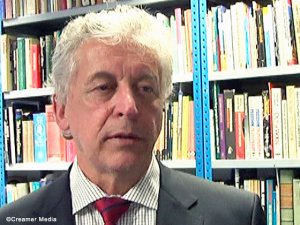
JOHANNESBURG (miningweekly.com) – As the African National Congress’s (ANC’s) national elective conference, in Mangaung, nears, Free Market Foundation (FMF) executive director Leon Louw questioned the ANC Youth League’s (ANCYL’s) use of the 1955 Freedom Charter as a basis for the call to nationalise South Africa’s assets.
Speaking at a FMF media briefing, in Sandton, he dismissed the ANCYL’s claim that the nationalisation of mines, banks, strategic industries and large businesses was one of the requirements of the document, the provisions of which have bound the ANC.
Louw believed that the youth league misconstrued an insert by veteran ANC MP Ben Turok, one of the authors of the charter, saying that the referred paragraph, “… the mineral wealth beneath the soil, the banks and monopoly industry shall be transferred to the people as a whole …”, actually indicated the transfer of government assets to the private sector, in particular, the previously disadvantaged citizens.
He explained that nowhere was it stated that the government – past, current or future – intended to take full control of the country’s assets, and the use of the charter as a principal argument for nationalisation was disputed by Turok himself, who said: “It was the colonial aspect that the charter sought to reverse, not private ownership [of property]”.
Louw’s dissection of the paragraph revealed that “mineral wealth beneath the soil” was not a reference to mines or mining operations and that the charter referred to the people of country, as opposed to government. He said the government aimed for the localisation of banks, which at the time were foreign-owned, and that the monopolies and strategic entities referred to actually meant the government.
During the period in which the charter was written – the 1950s – nationalisation was a popular global policy proposal and, if that had been the intention of the ANC, the charter would have directly stated it.
The ANCYL also outlined, as its secondary arguments, increased fiscal capacity, better working conditions, industrialisation and job creation, transformation of the “accumulation path”, and transformation of unequal spatial development, besides others, as benefits of nationalisation.
However, there was no clear link between the nationalisation of assets and these mooted benefits, Louw argued.
The concept had proved counterproductive and, in some cases, detrimental to the economy of the countries that had pursued and implemented nationalisation, he said, citing falls of 50% in mining output in Venezuela, 70% in Chile, 75% in Zambia, 70% in Ghana and 95% in the Democratic Republic of Congo.
Countries that nationalised also experienced, besides others, inflation, pollution, exploitation, discrimination, corruption, declining revenue and production, unemployment and poor working wages and conditions.
Historically, it may have worked, Louw said, describing an apartheid-era environment wherein the government nationalised several private assets, including power utility Eskom and aviation group South African Airways (SAA), using the proceeds to support about 5% of the population. The same concept would not work for the current government’s attempt to support 80% of the country’s population.
South Africa was already beneficially positioned, as beside the contributions mining made by way of inputs it sourced from the broader economy, government absorbed about 50% of the wealth of mining companies through taxes, without the responsibility to manage and capitalise enterprises, or share any losses.
The government subsidies or bailouts of any failing or struggling State-owned enterprises were not conducive to development, as funds for other development and social needs projects, such as education or housing, were redirected into saving these entities.
Louw commented that successful, prosperous, secure and free countries scored high rankings in indices such as the Fraser Institute’s Economic Freedom of the World, the World Economic Forum’s Global Competiveness Report, the World Bank’s Doing Business, the Freedom House’s Freedom in the World, the Wall Street Journal'a and Heritage Foundation’s Economic Freedom, the Economist Intelligence Unit’s Democracy, Transparency International’s Corruption Perceptions and the Property Rights Alliance's International Property Rights.
South Africa should focus on improving the factors resulting in higher scores within these indices, as this would lead to development and growth.
Louw added that the government should relinquish its stakes in State-owned entities, such as Eskom or SAA, to the previously disadvantaged – either at no cost to the new owners or for a reasonable sum for the benefit of the poor – and privatise rather than nationalise.
He further suggested that the removal of red tape and the deregulation of the labour market would also assist in addressing the country’s poverty and unemployment challenges.
EMAIL THIS ARTICLE SAVE THIS ARTICLE FEEDBACK
To subscribe email subscriptions@creamermedia.co.za or click here
To advertise email advertising@creamermedia.co.za or click here


