|
Green Paper on Electronic Commerce for South Africa - for public discussion |
The positive effects of the Internet permeate every aspect of society ranging from social, economic, technology, education, health, and welfare to the business and academic fields with a common outlook for development and growth. To date much emphasis of the benefits of e-commerce are those directed at big business. Therefore there is a need to extend such benefits to communities and previously disadvantaged individuals as well, through appropriate policy measures.
Most of the policy debates around “Maximising Benefits” are geared toward removing barriers; developing strategies that would enhance and exploit the opportunities brought by e-commerce; and designing programmes to spur economic growth. A critical policy challenge is how to accelerate and enhance the development of the infrastructure necessary to extend the benefits of e-commerce to all South Africans.
The purpose of this chapter is to highlight the benefits that can be gained from e-commerce especially with successful strategies and the contribution e-commerce can make to the sustainable socio-economic growth. The following issues will be addressed:
E-commerce presents unique opportunities for less developed countries to greatly expand their markets both internally and externally. Externally, the Internet and other technologies may allow for low cost international trade, even for small, local businesses. Internally many groups of citizens who had been “marginalised” and “unbanked” may gain affordable access to financial services, and may thus participate more readily in all aspects of the economy.
E-commerce technologies carry the potential to reshape the geographic boundaries and the location of commercial business centres may become less relevant, as companies and workers conduct business with equal effectiveness from almost any location.
Electronic commerce will transform and help to shape society as a whole especially in the areas of education, health and government services. From a public policy standpoint, there is a need to establish the social conditions that allow e-commerce to reach its full economic potential and to ensure that its benefits are realised by society as a whole. The necessary elements or conditions are access, as determined by income and availability, confidence and trust. Access to the physical network will affect the adoption of e-commerce particularly among consumers and small, micro and medium sized enterprises (SMMEs).
Digital divide refers to inequalities in ICTs distribution between developing and developed economies. North-South digital divide is real and needs to be addressed. It also refers to the gap in the information sphere between most developed parts of the country and underdeveloped rural parts, including disadvantaged groups. The challenge is how to narrow down the gap between “information haves” and “information have-nots” through addressing inequalities and inequity. If this matter is not urgently addressed, the benefits of e-commerce will be enjoyed by the few only and the expansion of e-commerce would indeed contribute to broaden rather than reduce a possible digital divide.
When sizing the electronic commerce market, a distinction needs to be made between the value of the commerce transactions, which is potentially large, and the revenues that can be earned by third party commerce facilitators. Another important dimension is revenue that can be earned by aggregators through online advertising. Distinction should also be made between web-centric e-commerce and e-commerce using other networks such as electronic data interchange (EDI).
| 1999 | 2000 | 2001 | 2002 | 2003 | |
| Rands | Rands | Rands | Rands | Rands | |
| B-B | 3.9bn | 8.0bn | 17.0bn | 27.4bn | 37.2bn |
| B-C | 2.7bn | 5.3bn | 8.3bn | 11.8bn | 18.8bn |
| Total | 6.6bn | 13.3bn | 25.3bn | 39.2bn | 56.0bn |
Source: Media Africa com. 2nd SA Web Commerce Survey 1999
South African business, particularly large companies claim to be conducting commercial transactions via electronic networks. Furthermore, e-commerce is now the leading investment area in the Top 200 IT users in South Africa. Although only 6 % of large companies interviewed could estimate the exact revenue accruing from their web site in 1999, nearly 30% believe their web sites are already influencing customer-purchasing behaviour (BMI-T survey 1999). Small to medium sized companies appear to be slow in embracing the use of the Internet and thus the ability to benefit from an increased global market
The rate of adoption of e-commerce by South African citizens shows a relatively high rate compared with other developing countries. A survey by BMI-T indicates that approximately 10 % of all high-income households have adopted e-commerce. This allows these consumers to have access to a range of services available on the Internet such as banking services, online shopping e-ticketing, etc. Travel and accommodation is by far the largest category in the BMI-T forecast model, which indicates that by 2004, more than R13 billion worth of consumer transactions will be influenced by the Web, of which R4 billion will be directly completed on the Web. The outlook in the financial services sector is equally impressive.
Despite increasing evidence of the global explosive growth of e-commerce and its revenue generating and job creating potential, many governments outside of the US are concerned about:
A recent Canadian study illustrates point three above by revealing that 60 % of Canadian on-line demand is supplied by US firms; 2 % by European firms and only 38 % by domestic firms. The report suggests that Canadian business needs to be more aware of the growth in domestic on-line demand and actively seek to capture a greater market share of local on-line demand as well as international demand for on-line goods and services.
The above concerns give reason for the South African government to develop a policy that ensures access for all its citizens in order to speed up the adoption of e-commerce in the country.
The sections that follow attempt to seek ideas on how to deal with this problem in South Africa and what strategies should be developed.
QUESTIONS FOR POLICY CONSIDERATION
- Did we see as much new growth in 1999 as we expected? If not, what are the reasons behind this slow growth?
- What should be done to accelerate the adoption of e-commerce by both businesses and consumers in the marketplace?
In producing a market development strategy, three key elements are relevant, namely, positioning the South African industry in the global e-commerce marketplace more competitively, supporting SMMEs, and developing public private partnerships.
Improving South Africa's industry competitiveness. E-commerce is rapidly transforming the terms of competition in global and national economies in new and unpredictable ways. The unfamiliarity and unknowns of e-business represent an unprecedented competitive uncertainty for firms, supply chains, national export positions and, ultimately, to economic competitiveness. The fact that e-business is creating new value propositions in and between global supply chains poses a fundamental strategic challenges for SA firms in relation to where these firms should aim to position themselves within these evolving global supply chains so as to obtain best comparative advantage and capture value. The core challenge is to identify measures that enable South African firms of all sizes to quickly understand ‘what e-commerce is all about and, with such knowledge, turn e-business threat into e-business opportunity.
While the application of e-commerce in conventional business certainly represents the bulk of activity and investment, whole new business opportunities are emerging, such as shown in the table below.
| Internet Intermediaries | Internet Applications and Services | Internet Backbone Providers |
| Market makers in vertical industries | Internet Consultants | ISP´s |
| On-line travel agents | Internet Commerce Applications | Networking, hardware and software companies |
| On-line brokerages | Multimedia Applications | PC and services manufactures |
| Content Aggregators | Web development software | Security vendors |
| Portal/Content Providers | Search Engine software | Fibre optic makers |
| Internet Ad brokers | Online Trading | Line Accelerators |
| Web enabled databases | ||
| Customer relationship management |
A number of challenges that need to be considered for policy formulation are the following:
Supporting SMMEs: E-commerce has the potential to facilitate growth of small, medium and micro enterprises. According to reports, in the US, one out of three jobs are created by SMMEs. It is therefore evident that a faster adoption of e-commerce by SMMEs can potentially create some employment in South Africa. A recent study conducted by BMI-TechKnowledge group states that of the 600 000 registered SMMEs in South Africa, only 16% of them are conducting e-commerce. What is even sadder to notice is that 31% of these SMMEs believe they will never use the Internet for business. The challenge therefore is to empower the SMME sector to take advantages of e-commerce and increase their capacity to participate in the e-driven trading environment.
UNCTAD has cited the necessary conditions that need to be met for SMMEs to realise the potential of e-commerce:
Public private partnership approach in market development: Partnerships are key to creating the enabling environment necessary for the growth of electronic commerce and in implementing e-commerce. Hence the reason why government is consulting with business, consumers, trade unions, interest organisations and communities in addressing e-commerce issues. The government acknowledges the leading role of the private sector in implementing e-commerce in terms of applications. Various mechanisms have to be employed at discussion level, advisory, applications, infrastructure and networking, research and development. Countries like USA are good examples of partnership programmes initiated to realise the benefits of e-commerce by enterprises of all sizes.
QUESTIONS FOR POLICY CONSIDERATION
- What policies, programmes or partnerships can government develop or leverage to support and encourage the growth of the local industry?
- How successful are South African firms in creating and meeting the demand for local and international on-line goods and services and how should companies position themselves to capture a growing share in this expanding market?
- What are the current constraints and how, could government create a more enabling environment for South African firms.
- What steps or interventions are required to systematically expand the pool of e-commerce expertise and help resolve the skills-gaps or leakages within companies? What, if any specific interventions are required to foster entrepreneurship and innovation in the sector? And what manner of intervention would encourage the participation of formerly marginalised black entrepreneurs and women in particular?
- What level of Research and Development (R&D) is required for the SMMEs? What institutional support framework should be put in place to assist SMMEs in the adoption of e-commerce? How could the existing structures/organisations be enhanced to encourage and promote the faster adoption of e-commerce by SMMEs?
- What mechanisms should be put in place to develop and strengthen public private partnerships in order to enhance the economic and social benefits identified in this section?
- What kind of public investment is required to foster industry development for the proliferation of e-commerce?
Skills and Human Resources: It is clear that the availability of sufficient human resources will continue to be an overriding issue in many areas of global e-commerce. There is a need to develop human infrastructure with skills, ability, training and knowledge to leverage ICT potential benefits. The Human Resources Research Council (HSRC) states that there is a chronic shortage of highly skilled human resources in various segments of the market. The scarcity of technical expertise and skills, in the country is further exacerbated by the “brain drain”. The South African Information Technology Industry Strategy (SAITIS) Baseline Studies identified more reasons for shortage of highly skilled human resources including ICTs workers.
Digital literacy: Digital literacy is required for business and consumers to use and develop electronic commerce. At present, Internet users tend to be more educated, affluent and located in urban centres and Internet usage is higher in larger companies. The challenge is to expand to a wider range of consumers and all sizes of business. There is a need to bridge computer illiteracy since it is an important impediment to the facilitation of e-commerce.
Digital skills for all South Africans: In a country where literacy remains a huge and seemingly intractable problem, what resources and programmes are required to develop an awareness of the potential benefits of the information age; related technologies and e-commerce in particular. Adult and life-long learning programmes, tertiary and higher education schools and in some countries even early learning centres are the focus of review and attention. Policy makers should institutionalise ICT awareness and skills development within the labour market and prepare school leavers for an increasingly knowledge-based society.
Skills for Business: Internationally, the use of the Internet by small and medium enterprise is growing and actively encouraged by a range of government initiatives designed to foster this growth; and ensure that business owners understand the business opportunities that e-commerce presents.
Skills for the future: As elsewhere, the issue of (high-tech) skill shortages is a concern to both the private sector and government. Especially in South Africa where unemployment is high and a growing number of school-leavers enter the labour market with limited prospects of employment. There is a need for a research to inform what skills are required in the future. The Department of Arts, Culture, Science and Technology´s Foresight programme in one way or the other raises and addresses the issue of skills for the future.
Distance education, virtual campuses and technological training will dominate the education sector in the future. Institutions of higher learning need to take a lead role in developing and implementing e-commerce based curricula. The proposals and recommendation for partnerships include the provision of education and training to local entrepreneurs, knowledge workers, users, businesses, policy makers and regulators. The development of educational training content should be inclusive and cater for known learning barriers such as with disabled people.
The labour market is one of the areas likely to feel the most profound impact of the economic transformation being brought about by e-commerce. On the one hand, if e-commerce generates significant economic growth in general, should lead to improved employment opportunities generally. However, the exact nature of employment, and of the skills and experience required to benefit directly from e-commerce, could be significantly different in some industries. For instance many workers could become displaced, temporarily or permanently as a result of this transformation. Some displaced workers might need to be re-skilled/retrained to prepare them for new jobs in the marketplace. Clearly there is need for research in this area to evaluate the nature and number of jobs that could be created by e-commerce and lost or displaced due to efficiencies brought about by new ways of doing business. Although it can be argued that some jobs are lost due to e-commerce replacing intermediaries between business and consumers, a new breed of e-commerce firm “the infomediary” is being created to exploit the Internet.
Central to this issue is educating the wider population about both the opportunities and potential, threats of e-commerce. Coupled with that is the need to popularise or publicise an e-commerce policy process so as to invite participation. The creation of awareness and other related initiatives by government and its partners from the academic and business sectors to promote technological development should be done on an integrated approach. We need to build a new e-community that can take effective advantage of the e-commerce opportunities.
QUESTIONS FOR POLICY CONSIDERATION
- What is the potential of e-commerce to create jobs? How can job creation be maximised? What strategies should both employers and government devise to minimise the effects of perceived job losses or displacements?
- How can we leverage the available resources to maximise their benefits and focus to harness these skills?
- How do we expand the current capacity to maximise e-commerce benefits?
- What strategies and programs should be deployed to inform the process of targeting relevant stakeholders and the level of education required?
- What should be the responsibilities of the institutions of higher learning and that of the Department of Education in the educational, training and awareness sector?
- In what way would the private sector, in partnership with government, be involved in the awareness campaign and training programmes on e-commerce?
- Funding is one of the critical success factors in the implementation of e-commerce strategies. What other innovative funding options are available except government resources?
- What organizational framework should be put in place to continuously promote awareness?
- How can brain drain be minimized?
- How should the educational content be implemented to accelerate e-commerce?
Today governments are moving from old economy government, organised around agencies and bureaucracies that operated like “stove pipes”, to new economy government which will be organised around the functions and the needs of citizens with ICTs as a key enabler. Leading-edge governments are rethinking their web strategies from their citizens´ perspectives. The trend toward a greater level of interactivity, which allows users to obtain services and conduct transactions, continues. The Government service model will shift from the traditional relationship of a citizen interacting with a worker who turns to the IT infrastructure in the background, invisible to the user. Instead the citizen will interact directly with the IT infrastructure and the worker will serve as a problem solver for more complex issues. Being freed from routine, repetitive tasks will allow the government worker to solve problems more effectively. Citizens will, in turn, have more rapid results from routine transactions, as well as 24 hour 7 days´ service.
The long-term goal for the South African government should be to take the reigns and lead the charge with regard to the deployment of ICTs and e-commerce into its business model. If government is to obtain the real benefits of the information age, for better service delivery, better procurement, efficient working and better communication with citizens and businesses, a comprehensive system needs to be formulated and implemented. Public services should be responsive to the needs of citizens and be of high quality. This chapter will identify some of the challenges facing the South African government in transforming conventional government into e-government. The chapter seeks to answer the following questions:
Many countries are or have already launched comprehensive client-driven e-government strategies. These countries include Canada, United States of America, Britain, Australia and Singapore. They have established clear goals and discrete targets for e-government. Their efforts to implement these strategies are supported by high-level leadership, an enabling policy and legislative framework on e-commerce, and an appropriate investment strategy.
| US | UK | Australia | Singapore | |
| Vision | Access America | Modernising Government | Strategic Framework for the Information Economy | Public Service for the 21st Century |
| Political Champion | Vice President | Prime Minister | Prime Minister | Deputy Prime Minister |
| Targets | 2003; “where practicable” | 100% by 2008 | 2001; “where appropriate” | 2001; “for key services” |
| Investment | Modest | Large | Large | Large |
| Legal Framework | Draft legislation | Fall legislation | Legislation pending | 1998 Law |
| Infrastructure | Departmental strategies | Corporate IT strategy | Corporate IT strategy | Broadband strategy |
Source: Industry-Canada
Given the above comparisons, the crucial question that needs to be answered is “Where is South Africa” in this picture.
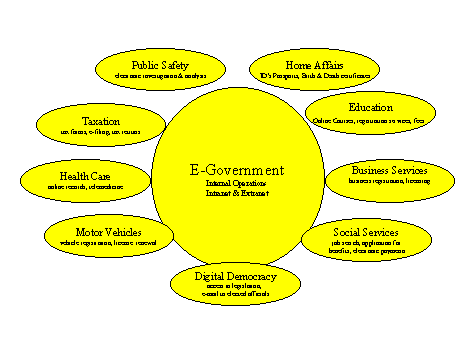
Electronic government can be defined as government use of information communication technologies to offer citizens and businesses the opportunity to interact and conduct business with government by using different electronic media such as telephone touch pad, fax, smart cards, self-service kiosks, e-mail / Internet, and EDI. It is about how government organises itself: it´s administration, rules, regulations and frameworks set out to carry out service delivery and to co-ordinate, communicate and integrate processes within itself.
In understanding e-government, one needs to define:
“Customer” – includes the public, business, other employees, other agencies and other levels of government
“Electronic Business” –use of the Internet to create new business models; new ways of serving customers; new ways of generating profits
“Electronic Commerce” – use of electronic networks to replace paper-based transactions; the transactional part of e-business or e-government
“Electronic Government” – a vision of how government can operate in the 2000s; much broader than just e-commerce or e-business for government
In modernising government, the following issues must be addressed:
Electronic Service Delivery – government of the future that entails a shift to a citizen-and customer focussed thinking where citizens must be able to access more and more public services, delivered online, anytime, anywhere. Moving citizens from ‘ standing in line´ to online. These services must be integrated and customer-centric. This should be aligned to Batho-Pele service delivery framework.
E-business for e-government – government purchasing of goods and services and payments electronically
E-governance – this is about public participation in decision making, the reshaping of policy and evaluating of administrative effectiveness and service delivery efficiency
Governance, Information Sharing and Exchange – reducing number of paper transactions involved in government operation. Use of Intranet and extranet between government departments and among employees.
E-commerce Policy – e-government requires a regulatory and public policy environment that is conducive to e-commerce
Technology behind the scenes - Leaders (Chief Information Officers need to understand the capabilities of the technology infrastructure essential to translate vision to reality.
Increasingly governments are playing a key role in demonstrating the advantages of electronic service delivery. E-government presents with it both opportunities and challenges to governments. There are both environmental pressures and business drivers that necessitate a transformation to e-government. These pressures include shrinking budgets, "do more with less", rapid technology advances, shifts in customer expectations, labour pool limitations. Business drivers include improving customer focus and service, focussing resources on core mission areas, increasing competitiveness in the marketplace. By transforming to e-government, the government will foster entrepreneurial government based on more business-like practices, cost savings and enhanced environment - improved response. The government needs to play a ‘catch up´ role to that of the private sector in terms of e-commerce and to that of other countries.
The ultimate benefits of e-government are illustrated as follows:
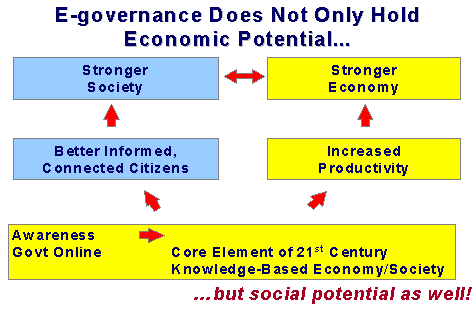
By using e-commerce applications, for instance in procurement, it has been observed that the impact on operations and service delivery will be considerable.
Given that government is the largest purchaser of products and services to the value of more than R65 billion a year, Internet-based e- procurement solutions will present the following benefits:
Ingredients for Success:
Political and Bureaucratic Leadership
Leadership is essential to ensure success in developing e-government initiative.
The grade scale and horizontal nature of the initiative requires strong, high-ranking political and bureaucratic leadership, as evident in the approach taken by the US, UK, Australia and Singapore. Each of these countries has high ranking political leadership – being either the head of state (i.e. Prime Minister) or the second in command (i.e. Vice President) as leader.
Investment
Implementing the government on-line strategy will require a sustained government-wide effort over a number of years in collaboration with provinces, municipalities and third party delivery partners. Departments will have to re-engineer programs and processes in the transition to electronic service delivery, while maintaining all other delivery channels. Success will depend on major investments of both time and money.
Partnerships
There is a need to develop solutions and policies collaboratively with government, citizen and industry partners. Need to address digital divide between government (which is only moving tentatively into digital operations) and the commercial sector into e-commerce)
To transform government into information age government a range of new frameworks and strategies across government need to be developed:
Knowledge-based Workplace: Public servants at all levels must be info-communication literate and tap the power of ICTs to improve work processes, service delivery and teamwork
Change Management – Employees need to change attitudes – for employees to change, they must understand what e-government is; be equipped with skills to implement e-government; must be willing to implement e-government solutions.
Upgrading of the government´s common Information Management/IT infrastructure and an integrated and coherent IT Strategy for government: - IT systems have tended to be developed separately by different Departments. They should converge and inter-connect.
Adaptive and Robust Info-communication infrastructure: A well-designed, reliable and scalable infrastructure is critical for supporting e-government.
Data Standards – standards should be developed to present the data the systems hold in a common way (interoperability).
Roll-out of government Public Key Infrastructure – This is critical for providing security and therefore building trust among users. Digital signatures can provide a means of identification and authentication when conducting business with government and when transmitting sensitive and confidential information over networks. Legislation in this respect is important to ensure legal equivalence between digital and paper signatures and to enable government transactions
Electronic Service Delivery: All public services that are suitable for electronic delivery should be identified and re-engineered accordingly. The starting point is to do an audit of the existing services that are currently being offered by various departments and work out savings that can be accrued to government if the same service was to be offered electronically.
Access points: Government services which can be electronically delivered will be accessed through call centres, mobile phones, digital TV, MPCCs, telecentres, kiosks, smart cards as well as through personal computers.
Websites – to bring a more coherent and uniform approach for presenting and giving government information to the public (same look and feel). Government Communication and Information System (GCIS) needs to develop and publish guidelines and standards for government websites.
Government gateways and portals – Instead of launching online services on a department-by-department basis, they can be aggregated across departments, accessible by using a common portal.
Government departments have set up web sites and employees have PCs and connectivity to each other and globally through the Internet. Departments have separately begun projects aimed at facilitating e-government. However, much still has to be done As a starting point, government has to articulate clear vision, mission, goals and set up achievable targets in the e-government strategy to be developed.
Below is a list of some of the projects being undertaken by various departments:
Departments are requested to list other government-related initiatives toward e-government.
QUESTIONS FOR POLICY CONSIDERATION
- Should government establish explicit e-government targets?
- What should government do to accelerate the transformation to e-government?
- What types of services do citizens and businesses want to see on-line?
- What more should government be doing to use e-commerce to enhance its service delivery and administration?
- How can the private sector contribute toward creating e-government?
Contents | Executive Summary | Chapter 1 | Chapter 2 | Chapter 3 | Chapter 4 | Chapter 5 | Chapter 6
Chapter 7 | Chapter 8 | Chapter 9 | Chapter 10 | Chapter 11 | Chapter 12 | Chapter 13 | Glossary and References