|
Green Paper on Electronic Commerce for South Africa - for public discussion |
This section deals with the infrastructural requirements for e-commerce. The section is divided into three categories viz.: infrastructure access, telecommunications competition and convergence.
The growth of e-commerce depends on broad and affordable access to infrastructure, enabled by convergence of technologies, forward looking telecommunications policy, robust network infrastructure; sufficient bandwidth and support for targeted applications. The infrastructure foreseen for e-commerce in South Africa, against the background of globalisation, should be capable of handling many services and applications. The availability of and access to broadband infrastructures will be important in driving the necessary innovation in e-commerce services.
Information Communications Infrastructure that underlies the emergence of e-commerce is multi-faceted and can be integrated in many ways including: transmission network, hardware and software components of infrastructure. It is the advancement and the integration of the essential infrastructures of these technologies that has fuelled e-commerce growth world-wide. At the same time, the comparative lack of such infrastructure throughout many parts of the developing world is what most impedes the opportunities for e-commerce to flourish in those countries.
With the convergence on Broadcasting, Telecommunications and Information Technologies, the infrastructure capable of supporting e-commerce has become almost ubiquitous in developed countries. Electronic services infrastructures must converge to support electronic commerce applications. Convergence will have broad consequences for domestic policies such as technology and innovation policies, trade policy, telecommunications policy, Broadcasting policy and competition policy.
The challenge confronting South Africa is to create an ideal market structure for e-commerce that will stimulate and modernise network development and infrastructure; accelerate universal access; support affordable access; encourage investment and innovation. Because of the critical nature of these issues, government and the business community are faced with the challenges of developing strategies and policies that will strengthen the infrastructure needed to support effective use of e-commerce.
The topics discussed below focus on the main issues and options confronting South African business and government in their efforts to address the above goals and to bring the opportunities of e-commerce to the entire population. This section addresses issues around infrastructure development and deployment; access and affordability; telecommunications market structure, competition and interconnection; and convergence. It also suggests options to promote the rollout of e-commerce infrastructure in South Africa and poses questions that could lead to new policy direction in these areas in the near future.
The Infrastructure required to enable e-commerce has many components and comprises backbone networks, end-user equipment and access services. The success of e-commerce will depend on the availability of speedy access infrastructure; high quality of service within the backbone network; and affordable prices. Access will not only be through fixed networks (terrestrial, wireline and cable TV) but also through wireless networks (cellular, satellite, and digital broadcast spectrum).
End-user equipment and access devices include hardware (devices) and software, which control access to services and handheld devices. Examples of such devices include personal computers, TV set-top boxes, cellular phones, and other smart handheld devices. Lack of access and cost of hardware and software components of infrastructure, especially to consumers and small businesses lowers, the possibility of participating in the global electronic marketplace for much of the country´s population. Software infrastructures are as important as network infrastructures. Since software provides the bridge between the network infrastructure and applications.
QUESTION FOR POLICY CONSIDERATIONHow can regulation be used to promote the development of these components of infrastructure?
Infrastructure needed for e-commerce should have adequate capacity, that is, it should be fast and reliable. The demands made by users in South Africa on the infrastructure capacity (bandwidth especially for combined data, video, voice and other services) are growing exponentially as the usage of Internet expands. Currently, analogue modems are the most common method of access to the Internet and data services by residential wireline users because of lower price. However, much of this access is at very slow speeds. It is presumed that this lack of capacity constrains what services these users can get from the Internet. With wireline technologies, all the capacity is rigidly dedicated to a particular end user, whether he needs it at that moment or not. While wireless technologies, including satellites systems offer bandwidth on demand and can provide a more economic access technology in a wide range of settings by dedicating only the bandwidth required by a particular application at a particular moment in time.
The infrastructure deployed in South Africa at the moment will not only need to be expanded into under serviced areas with the appropriate capacity, but at the same time capacity in serviced areas will have to be increased.
QUESTIONS FOR POLICY CONSIDERATION
- What incentives and obligations should be put in place to encourage the investment in new carrier networks in all geographic areas and new services, in a manner that will be both commercially viable and socially beneficial?
- What competitive and legal environment will be most effective in creating and encouraging new investments (in transmission networks), innovation, technological leapfrogging to encourage the evolution of networks where customers have a choice of service? (Broadband multimedia, multiservice converged wireline, wireless satellite, fixed and mobile capacity)
- Wireless broadband has great potential for e-commerce so it is important to study spectrum allocation mechanisms. What mechanisms can be used to allocate spectrum without increasing the cost of access?
- Is the user access bandwidth requirement in the future likely to outstrip the network capability? Which mechanisms should be utilised in the broadband access technology to ensure that users access bandwidth requirements does not outstrip the network capability? (Over subscription)
Although South Africa has the most developed infrastructure in Africa, with over five million telephone lines with teledensity of approximately 12%, it is still a dream for the majority of citizens to have access to telephones and computers. For vast segments of the population, in rural areas, teledensity stands slightly over two percent, and infrastructure is typically unaffordable. In major cities and other urban centres, however, high technology facilities and services are widely available to those portions of the population, which can afford them.
Access includes both access to low-cost telecommunications infrastructure and networks (such as Internet) and economic access (costs to access Internet hence e-commerce). The principal goal is to ensure that the infrastructure and services are available to the wide range of potential users so that they can access and distribute information from both local and global sources.
A significant barrier to the development of electronic commerce in South Africa is the lack of access. Government made a policy decision that the roll-out of infrastructure will be better achieved through a period of exclusivity for Telkom which allows it the opportunity to roll out services, especially in places where services have not been available in the past, and modernise network infrastructure. However, Telkom´s efforts alone are not sufficient to achieve all of the infrastructural needs for e-commerce. Furthermore, the deployment of appropriate technology that has adequate data capability must be accelerated in areas where it is needed.
Access to the Internet is as important as access to basic telecommunications network facilities if end users and small businesses are to be able to take advantage of Internet–based e-commerce opportunities. ITU has ranked the country 18th in terms of Internet usage. Although there are now some 120 Internet Service Providers (ISPs) in South Africa access to the Internet remains highly restricted to particular geographic locations and segments of the population (mainly business). The problem of access to ISP services in the most rural areas has yet to be fully addressed. Government needs to reflect on how to ensure access to e-commerce for communities, disadvantaged population, people with disabilities, SMMEs and ordinary citizens.
Initiatives such as the establishment of Multipurpose Community Centres (MPCCs), telecentres, Department of Communications Internet Laboratories, “dotza”, public information terminals have been started to promote universal access to technologies that would be expensive if the volumes are low and unavailable to most citizens beyond the higher income group.
The prices charged by telecommunications operators for access to crucial services can be a major factor determining the effectiveness and affordability of e-commerce opportunities on the whole. These prices become burdensome for smaller entrepreneurs, Internet Service Providers and public operations such as telecentres to afford to connect to the global backbone. Broadband access for the last mile for residential customers needs to be based on a significantly lower pricing structure so as to change how small businesses and citizens use networks.
QUESTIONS FOR POLICY CONSIDERATIONS
- What policies could facilitate and help reduce the price of access and facilitate access?
- Suggest other pricing approaches/models/packages for consideration.
- In complementing the above stated initiatives, how else can we ensure access?
- What options are available to accelerate access to Internet to the rest of the South African population? What means, technical and financial, should be employed to promote new ISP services in rural areas?
- E-commerce requires costly infrastructure. Some kind of incentive should be provided to speed up the e-commerce deployment drives in South Africa.
What kind of partnership should be developed between private sector and public sector with a view to assisting SMMEs and communities to access the Internet and adopt e-commerce?- How do we ensure access (including appropriate facilities) for disabled people?
- In some countries, pricing for local loop access is regarded as the key to e-commerce. Is the unbundling of local loop (local end of transmission networks) likely to play an important role in addressing affordability problems for access customers in South Africa? If so, what mechanisms should be used to ensure speedy unbundling of the local loop?
Telecommunications regulation and policy need to foster effective and efficient competition while at the same time recognising social policy goals such as universality and affordability. In many countries, the transition to competition from a monopoly market structure has been a challenging exercise. It is generally recognised that the introduction of competition in telecommunications requires transitional measures to maximise the benefits of a fully competitive market.
Even in countries where open competition in telecommunications has become relatively widespread, regulation of the industry remains an important public responsibility, both to support fair competition and to oversee appropriate pricing and service responsibilities in those market segments where competition is not fully developed. Such economic regulation is even more crucial in developing countries, as market forces are not likely to emerge strongly enough to constrain dominant operator actions in the near future. This will become an increasingly important responsibility as the South African market is opened to competition. The South African telecommunications sector has undergone some changes in recent years, with the enactment of the new Telecommunications Act of 1996; partial privatisation of Telkom; and the establishment of the regulatory authority, the South African Telecommunications Regulatory Authority (SATRA), under the mandate of the Telecommunications Act of 1996, which has been recently replaced by the Independent Communications Authority of South Africa (ICASA).
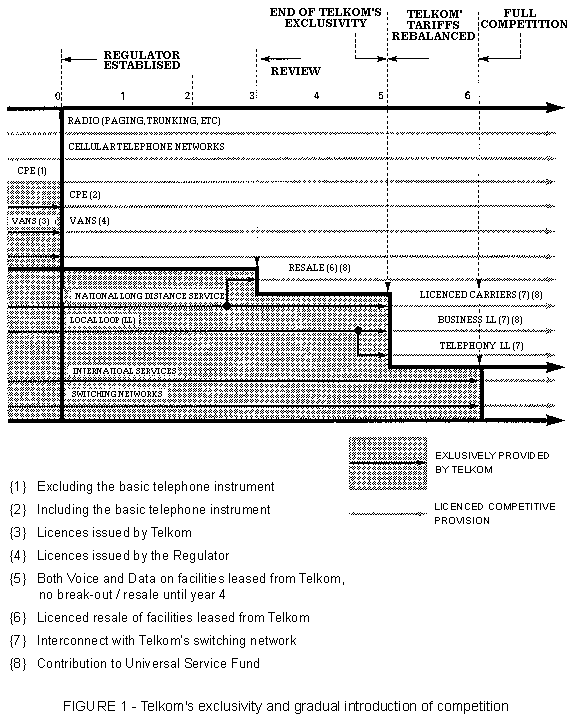
The Act provides Telkom with an exclusive right to provide public switched telecommunication services for a period of time and to provide telecommunication facilities to other service providers, until May 2002. It is the intention of government to introduce facilities based competition in order to enhance the provision of infrastructure and services at the end of Telkom´s period of exclusivity. The aim is to create a competitive basic market structure in the provision of telecommunications, which may have a significant impact on the markets, affected by e-commerce.
Please see the timing diagram as depicted also in the White Paper on Telecommunications below:
QUESTIONS FOR POLICY CONSIDERATION:
- Is the existing telecommunications regulatory framework adequate to deal with the challenges posed by e-commerce?
- How could regulator´s role be enhanced in this new competitive environment of electronic commerce/communications?
- What should be the priorities and objectives for telecommunications market development in South Africa and how will they be achieved?
- What incentives and conditions could be put in place to attract new entrants, particularly small operators in the context of black economic empowerment?
- What are the implications of unbundling for competition and consumers?
- Certain licensing requirements are seen to have a tendency to prevent innovation, competition, and hence limiting efficient operation. Should the existing licensing conditions and requirements be reviewed in South Africa, given the advent of convergence?
The ability of entrants to interconnect with dominant operator´s network is a fundamental requirement which, if completely unregulated, could forestall the development of competition through the dominant operator´s refusal to allow interconnection or to allow it only under prohibitive conditions or prices. Most administrations have implemented some framework to address such abuses from ex post dispute resolution to rates, terms and conditions for interconnection approved by the regulator. In South Africa, ICASA still has to finalise the interconnection regulations.
Convergence is the ability of different network platforms to carry essentially similar kinds of service, or the coming together of consumer devices such as telephone, television and personal computer. These services include voice, data, sound and video and the convergence will make them available through one access point in the user premise via any type of infrastructure whether fixed line or wireless. For instance, while of more limited utility for e-commerce than the telecommunications networks, traditional radio and TV broadcasts have a fair high level of penetration in South Africa and this likely to be of importance to some e-commerce strategies.
Convergence occurs at three levels: technology and network platforms; at the industry and at the services/markets level. One aspect of market convergence occurring within the telecommunications sector is that between fixed and mobile telephony mostly in developed countries. This is only part of a wider trend towards the full integration of wired and wireless technologies. Many studies indicate that radical changes to Telecommunication Act, Broadcasting and Spectrum allocations laws are necessary because of convergence.
The impact of the new services resulting from convergence will be felt in the economy as a whole as well as in the relevant sectors themselves. These are telecommunications services and equipment, computer hardware, computing services, electronic information services, publishing, audio-visual services and consumer electronics. Electronic commerce illustrates those potential opportunities for consumers and businesses, although its impact in South Africa is still not significant. South Africa is however, witnessing and experiencing convergence at the regulatory, market and industry levels. For instance, it is now possible to deliver telecommunications services through electricity networks. Companies in the relevant sectors are also merging. At the regulatory level, we have seen the emergence of ICASA with the relevant amendments to the Act incorporated.
The following barriers to the development of convergence were identified by the European Green paper on e-commerce: access to users; regulatory restrictions on use of infrastructure; prices for telecommunications services; availability of content; regulatory uncertainty; market entry and licensing; access to networks, access systems and content; allocation of radio frequency and other resources; public confidence in new environment; lack of standards supporting interoperability.
As e-commerce changes the ways in which enterprises work, produce and deliver, as traditional market boundaries blur, and as technology undermines the rationale for the monopoly privileges granted to many service activities, competition policy will have to address new types of anti-competitive practices. As South Africa begins to experience convergence at market and service levels, we will begin to see increasing mergers and acquisitions. These factors will create an environment where producers may engage in practices that permit them to establish themselves in the de facto standard. This will have serious implications on innovation and competition and will pose a challenge to the Competition Commission and its enforcement responsibilities. The Commission should therefore guard against competition distortions and abuse of dominant market positions.
QUESTIONS FOR POLICY CONSIDERATION
- Convergence is seen to have significant impact on society, on employment, growth and competitiveness of business in developed countries, and on the way people access a range of services, information, entertainment and culture.
- To what extend are the effects of convergence already being felt in South Africa and in what way? What initiatives should be undertaken in order to take full advantage of convergence?
- Should telecommunications companies provide broadcasting services and vice versa.
- Regulation in terms of ownership of broadcast facilities – should this continue?
- Free marketers argue that in the converged marketplace, more emphasis and reliance should be placed on market forces for achieving wider social, economic and policy objectives.
- To what extent would market forces protect consumers and safeguard public interest objectives?
- What are the implications of convergence and e-commerce on competition policy?
Standards are rules, and serve as a basis for comparison and a form of order. The major objective for standardisation is to achieve interoperability between networks and services and ensure compatibility. Users may want access from any terminal to any service, independent of the technology used, or the geographical point of such access, within a multi-vendor environment. Standards are needed for long-term commercial success of the Internet since they can allow products, services and applications from different firms to work hand in hand. Standards encourage competition and reduce stress or uncertainty in the market place. Standards can also be employed as de facto non-tariff trade barriers to “lockout” non-indigenous business from a particular national market.
Like EDI, e-commerce needs a standard platform. However, EDI has been trying to gain acceptance in the market since the 1970s, but the complexity of the standard for business transactions and the emergence of the confusing array of industry-specific subsets have made this an uphill battle. A similar lack of agreement on standards will also hinder the development of e-commerce.
An attempt therefore to develop standards in an environment in which technology is developing rapidly may be counter productive at this stage of e-commerce. It is, however, important to participate in international bodies that are currently involved in standards generating and maintenance such as the International Standards Organisation (ISO), International Telecommunications Union (ITU), International Electro-technical Commission (IEC), etc. The ITU has had a long-standing role in the development of communications standards and continues to play a lead role in producing standard sets that seek to ensure interconnection and interoperability of telecommunication networks. ITU is currently working on the development of standards on privacy, security and encryption techniques for multimedia terminals and digital certificate/certification authority issues.
Standards may be divided into three categories viz.
QUESTIONS FOR POLICY CONSIDERATION
- 1. What factors affect the competitive position of standards in global markets?
- 2. Should the market place determine technical standards and other mechanisms for interoperability?
- 3. How should South Africa influence the work of ITU and other international standard setting bodies in the development of e-commerce related standards?
Domain names are Internet addresses allocated to users on application to the relevant institutions assigned with the responsibility of allocating these addressees locally and worldwide. There are two main forms of domain names classified as, first, country top-level domains and denoted by cc TLD´s, and second, the sub-domains or generic top-level domains denoted by the abbreviation: g TLD´s.
To find an orderly manner in which the Internet can be accessed, a system that associates names with each user referred to as a Domain Name System (DNS) was established.
While designed to serve the function of enabling users to locate computers and other devices in an easy manner, domain names have further significance as business identifiers and, as such, have come into conflict with the system of business identifiers that existed before the arrival of the internet and that are protected by intellectual property rights. Details on this new conflict, known as ‘cybersquatting´, will be discussed under the heading ‘DNA Dispute Resolution´.
Internet governance issues have generally fallen outside the ambit of national policy, largely because of the complexities of Internet regulation. International processes and structures overwhelmingly influence the domain name space issue. In developing policy, South Africa´s overall governance goal should be to enhance the welfare of all those who operate and use the Internet and to extend the Internet to a wider population of users. A balance between the need for a technically sound, efficient and secure operation should, however, be struck while desiring to open the market to a broad range of potential players in this area.
A number of governments believe that they have the right to manage the domain for their country, top-level domain (for example .za). From the outset, the registration and management of Internet naming and addressing was the responsibility of the Internet Assigned Numbers Authority (IANA), a US government funded body. Later it became clear that governance of the addressing schemes and domain name space could not be seen as a global and independent initiative if it was funded by the US government. Therefore the US government created an “independent structure”, the Internet Corporation for Assigned Names and Numbers (ICANN) which replaced IANA. This new structure has yet to establish credibility as a truly independent player in the international context to remove the perception that it is a US voice. To this end, ICANN has embarked on an informal membership recruitment drive through its “at large” membership Programme. There is a danger that only the connected society, those with access to the Internet, will join and only their voices will be heard. The voice of developing countries, which have typically few people with access to the Internet, may be poorly represented and policy decisions may be made without adequate inputs that take cognisance of needs of developing countries into account. A regional body to represent Africa in ICANN, called AfriNIC (a private sector initiative), is in the process of being formed to have inclusivity in ICANN.
There have been discussions and disputes over domain name management internationally and nationally. There is concerted effort to resolve these disputes with varying levels of success. Of greatest concern are cybersquatting, trademarks Vs domain names and potential security concerns.
The fact that in electronic commerce businesses can exist entirely as virtual entities with only an electronic presence, the relationship between intellectual property, usually protected through trademarks and branding, and domain names becomes an issue that require attention. At this stage, registrars of domain names are not required to verify whether names that are to be registered are protected through trademarks. Therefore it means anyone can register a trademark as a domain name irrespective of whether he or she owns the trademark. This situation has led to abuse by citizens of cyberspace who see potential profit making opportunity through registering a domain name and selling it to any company that would want to use it. In response to this concern, the World Intellectual Property Organisation, undertook an extensive study of the issues, which culminated in recommendations on the governance of allocation of addresses and domain names. The salient features of the recommendations are as follows:
In older versions of the DNS system, security problems related to an organisation´s domain name could be falsely “taken over” by another organisation. The effect would be that when browsing the web, a user would think that he/she have gone to a particular organisation´s web site, but might have been diverted to another site masquerading as the original one. This type of problem has been addressed in newer versions of the system, but it is important that all registrars of the DNS, who operate and administer the system on behalf of the users of the Internet, be competent and able to administer the system correctly. This would include ensuring regular upgrade of software used in servers to maintain adequate levels of security. Therefore it is necessary that minimum criteria be set for registrars to meet and adhere to, so that security concerns can be adequately managed.
In South Africa, the .za domain has until now been administered by UNINET, which was the domain name register for the .za domain as designated by IANA. The most commonly used name address in South Africa, and probably in Africa, is co.za domain and a section 21 company, called Uniforum, manages it. Fees for registering the domain are applicable. In recent years, it has become clear that a new governance structure for domain names in South Africa will be required. A discussion document commissioned by the Internet Society was issued (www.isocSOC.org.za). This paper seeks views from stakeholders on what type of management structure would be ideal in South Africa. The document also made a number of recommendations. These include establishing section 21 company with open membership. The Department of Communications has also proposed that an independent Domain Name Authority (DNA) be established (Discussion Paper on the Establishment of an Independent Domain Name Authority, April 2000 – www.ecomm-debate.co.za). This non-profit making organisation will be run by a Board of Directors representing all stakeholders within the Information Communication Technologies (ICT) private sector, public sector and civil society, in general. This thinking is in line with developments in countries where transformation of domain naming has occurred. In these countries a common understanding has been reached on varying principles such as:
The DNA would among other things look at issues such as provision of universal Internet addresses; deal with the question of dispute resolution and trademark “cybersquatting”; find appropriate means for deregulation of registration and competition in registry in order to introduce and encourage competition in all activities related to registration. Lastly, such a body will acquire accreditation from an international body such as ICANN.
QUESTIONS FOR POLICY CONSIDERATION
- What should be South Africa´s position regarding international processes that are underway and structures being put together to effect governance of the Internet, for example ICANN and AfriNIC? Should South Africa support those structures?
- Given the above discussion, what should be the role of the private sector and government in the management of domain names in South Africa?
- Is the proposed organisational framework to administer domain naming in South Africa an adequate one? How should such a structure be financed?
- What kind of criteria should be applied for the business, technical environment and processes of registration so that stability of the DNS is maintained while at the same time encouraging robust competition in the delivery of registration services?
- What suggestions do potential users (notably SMMEs) have as to how the domain names in South Africa might be managed in order to promote access to the Internet addresses and encourage competition.
- What would be the barriers of entering the market at the registry level?
- How should we promote access to Internet addresses?
- In order to preserve heritage and promote the South African culture and tourism, particular attention should be paid towards creating, naming and registering heritage and cultural websites for South Africa. Should there be a dedicated institution mandated to performing this task?
Payment systems, in the electronic commerce environment, refer to methods or instruments of effecting payment through electronic means. E-commerce transactions/payments rely on the intermediary role of banks, credit card companies and other financial institutions.
The challenges we face in this environment relate particularly to emerging payment mechanisms which can either be network-based or be stored-value cards smart cards since some have the potential to exchange value (payment) without the necessity of direct linking to bank accounts. The legitimacy and security of electronic money payment systems may "make or break" electronic commerce growth in South Africa. For instance, if payment systems are too complex or expose consumers to on?line fraud and theft, the viability of electronic commerce may suffer a material blow.
For consumers, electronic payment can readily be made using traditional credit and debit cards and new types of credit instruments that are being introduced. Questions surrounding the security of these forms of payment are among the key concerns involved in building trust in Internet?based transactions (see earlier sections). In the USA, some businesses are finding that as many as 60 per cent of their Internet credit card transactions are fraudulent. Even if these mechanisms can be made secure and effective from the consumer's perspective, however, they may not always be the most efficient ways of transferring funds around the world over the Internet. Other alternatives being considered within the industry include so?called "digital cash" (also referred to as "electronic money") and prepaid accounts. Some of these ideas might also be applied directly to the challenge of serving customers who lack access to full banking services.
In summary, most digital cash proposals involve the establishment of a virtual bank account into which the user deposits some amount of funds, or through which he or she establishes a line of credit. The account operator (which could be a bank, credit card Company, or retailer) establishes relationships with on?line merchants that allow for payments to be made directly from the subscriber's virtual account for purchases from those merchants. When selecting a product for purchase, the user may authorise payment by means of a secure, coded transmission, similar to a digital signature. This instructs the account operator to effect a transfer of funds from the user's account to the merchant's (including a transaction?processing fee to the intermediary). Although this system exists in various forms, particularly for certain well?established on?line merchants, there is no single standard or worldwide coalition of providers. Issues of security and trust, and also of competing interests by the financial and retail firms involved, have slowed acceptance of these types of services to date, but they are likely to continue to gain acceptance in the future. Proposing new and secure online solutions for electronic payments will be one of the most important challenges to financial operators.
Another mechanism that has been gaining popularity with companies and consumers is integrated circuit cards, commonly known as "smart cards." Smart cards contain programmable microchips, which can be set to identify the total value of the card (in the case of "pre?paid" cards), or the amount of funds on deposit in the user's associated bank or virtual cash account.
The cards can be issued by a specific merchant or service provider (telephone smart cards are especially popular), or can serve as general?purpose payment vehicles. The cards can be used to make regular transactions, with the amount of the payment deducted automatically (by a point-of-sale device, public telephone, or other device) from the total available on the card.
Although some smart cards are disposable once the value on the card has been expended other smart cards are re-loadable and allow the user to replenish the value on the card at an authorised agent.
Smart cards or similar ideas might be especially useful for providing financial services and access to electronic payment systems for the so?called "unbanked" consumers in rural areas or others without access to bank accounts and credit cards. Instead of paper pay cheques, for example, the general public could receive payment for their jobs or transfer payments via electronic transfers, by loading the correct amount to their personal smart card. The benefit could include reduced risk of theft and fraud, and much wider access for the general public to both electronic and traditional products and services.
Other chip card based instruments that would have to be considered in terms of electronic commerce include:
South Africa's financial services sector is well advanced, especially for providing business services in the urban areas. The South African Multiple Option Settlement (SAMOS) System was developed by the South African Reserve Bank and has been operational since 1998. This system links all the settlement banks in the country and allows real?time settlement between the banks. Major South African banks have data networks connecting their branches and large corporate customers.
These accomplishments mean that the South African financial sector is well positioned, especially with regard to large corporate businesses, to support widespread applications of e?commerce.
The South African Reserve Bank has published a document which gives an overview of emerging electronic money and commerce models. Traditional and new options for making electronic payments, including digital cash and smart cards, authentication and technical implementation issues surrounding them are discussed in this document. At this stage, there is no intention that the Reserve Bank should itself issue stored?value cards, or provide other forms of electronic money to the public.
The South African Reserve Bank also published a position paper in April 1999 on "Electronic Money". This paper highlights certain criteria applicable for the implementation of electronic money, products and schemes.
Steps are also being taken by government, banks and the private sector to find a common standard for smart cards in South Africa, which will be acceptable both nationally and internationally.
Although the South African Reserve Bank has taken the lead in publishing its position paper on electronic money in April 1999, it is proposed that the following issues be investigated.
In terms of the South African Reserve Bank Act, 1989 (Act No. 90 of 1989), the Banks Act, 1990 (Act No. 94 of 1990), the National Payment Systems Act, 1998 (Act No.78 of 1998) and the position paper on "Electronic Money", the South Africa Reserve Bank is in a position to regulate electronic money. However, the Reserve Bank does not want to discourage innovative new technological developments by pre-regulating electronic money but instead wishes to familiarise itself with electronic money schemes generally, the effect of electronic money on monetary aggregates and the potential risks that electronic money might pose for the national payment system.
QUESTIONS FOR POLICY CONSIDERATION
- What steps need to be taken to further upgrade and integrate national financial services infrastructure so as to facilitate e-commerce?
- How can basic banking services be extended to the broader population, to allow use of electronic payments, credit, and funds transfers?
- What types of electronic payment systems and technology are most appropriate and practical? How can these be developed effectively on a national level, in co?ordination with international industry efforts?
- How should the government support these development efforts, both logistically and financially? Which agencies should be responsible? Are these legislative actions that need to be considered?
- Should non-banking institutions be allowed to issue e-money? How can the Reserve Bank ensure that such non-banking institutions are licensed, regulated and prudentially secured?
Contents | Executive Summary | Chapter 1 | Chapter 2 | Chapter 3 | Chapter 4 | Chapter 5 | Chapter 6
Chapter 7 | Chapter 8 | Chapter 9 | Chapter 10 | Chapter 11 | Chapter 12 | Chapter 13 | Glossary and References